


Raw pork products should be disposed of in regular garbage bins for incineration, the Environmental Protection Administration (EPA) said yesterday, after media reports questioned whether the agency’s policy contradicts that of the Council of Agriculture (COA).
Raw leftovers were previously used to make compost, but in light of the African swine fever threat, the agency earlier this year began encouraging people to treat unwanted pig products as general garbage to be incinerated, EPA Deputy Minister Shen Chih-hsiu (沈志修) said.
The agency has required local environmental bureaus to advertise the policy on garbage truck loudspeakers, he said.
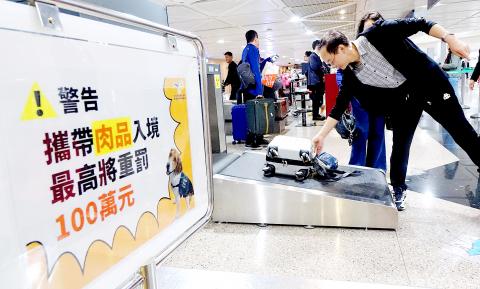
Photo: Chu Pei-hsiung, Taipei Times
However, the Chinese-language United Daily News yesterday reported that COA Deputy Minister Huang Chin-cheng (黃金城) disapproved of the EPA’s policy.
Wild animals might eat discarded pork from garbage cans and transmit the virus if African swine fever enters the nation, the report cited Huang as saying.
Shen and Huang later told a news conference in Taipei that their policies did not differ and hugged each other for media photographs.
Unwanted pig products that originated in Taiwan should be disposed of in garbage bins, while Chinese pig products should be sent to the council for disposal, Shen said.
Hog farmers who still use leftovers to feed pigs should apply for EPA approval by Thursday next week, or else switch to fodder or stop raising pigs, he added.
As the disease has not yet spread to Taiwan, there is no problem with incinerating unwanted pork products, Huang said.
If the disease enters the nation, the council would fully compensate hog farmers who report infections and whose pigs are culled, he said, adding that farmers who conceal information would not be compensated.
The council on Thursday announced that four more pork products seized at airports were confirmed to contain the African swine fever virus, with the number of infected products reaching 18 as of yesterday.
To ensure that every piece of luggage is checked, the council is to install 16 additional X-ray scanners at Taiwan Taoyuan International Airport before the Lunar New Year holiday begins, Bureau of Animal and Plant Health Inspection and Quarantine Director-General Feng Hai-tung (馮海東) said.
Separately yesterday, Premier Su Tseng-chang (蘇貞昌) said that visitors should not be importing pork products in the first place, and that no country at risk of an African swine fever outbreak is concerned with how a culprit would pay the fine.
Su made the remarks in response to media queries on how to deal with visitors who bring pork products through customs, but do not have enough cash with them to pay the fine, as people are only allowed to bring cash totaling NT$100,000 into the nation.
To maintain national security, concerted efforts and stringent law enforcement are needed, Su said.
Additional reporting by Sean Lin
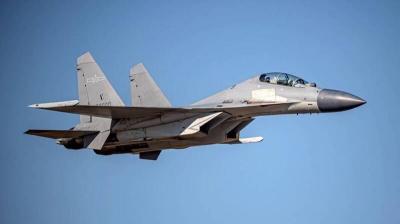
Eight Chinese naval vessels and 24 military aircraft were detected crossing the median line of the Taiwan Strait between 6am yesterday and 6am today, the Ministry of National Defense said this morning. The aircraft entered Taiwan’s northern, central, southwestern and eastern air defense identification zones, the ministry said. The armed forces responded with mission aircraft, naval vessels and shore-based missile systems to closely monitor the situation, it added. Eight naval vessels, one official ship and 36 aircraft sorties were spotted in total, the ministry said.
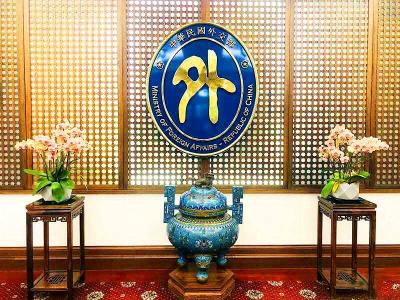
The Ministry of Foreign Affairs (MOFA) today said that if South Korea does not reply appropriately to its request to correct Taiwan’s name on its e-Arrival card system before March 31, it would take corresponding measures to alter how South Korea is labeled on the online Taiwan Arrival Card system. South Korea’s e-Arrival card system lists Taiwan as “China (Taiwan)” in the “point of departure” and “next destination” fields. The ministry said that it changed the nationality for South Koreans on Taiwan’s Alien Resident Certificates from “Korea” to “South Korea” on March 1, in a gesture of goodwill and based on the

Taiwanese officials were shown the first of 66 F-16V fighter jets purchased by Taiwan from the United States, the Ministry of National Defense said yesterday, adding the aircraft has completed an initial flight test and is expected to be delivered later this year. A delegation led by Deputy Minister of National Defense Hsu Szu-chien (徐斯儉) visited Lockheed Martin’s F-16 C/D Block 70 (also known as F-16V) assembly line in South Carolina on March 16 to view the aircraft. The jet will undergo a final acceptance flight in the US before being delivered to Taiwan, the
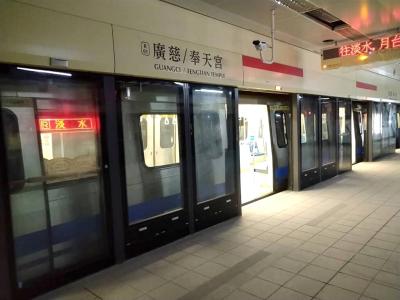
The New Taipei Metro's Sanyin Line and the eastern extension of the Taipei Metro's Tamsui-Xinyi Line (Red Line) are scheduled to begin operations in June, the National Development Council said today. The Red Line, which terminates at Xiangshan Station, would be connected by the 1.4km extension to a new eastern terminal, Guangci/Fengtian Temple Station, while the Sanyin Line would link New Taipei City's Tucheng and Yingge stations via Sanxia District (三峽). The council gave the updates at a council meeting reviewing progress on public construction projects for this year. Taiwan's annual public infrastructure budget would remain at NT$800 billion (US$25.08 billion), with NT$97.3


 RSS
RSS