


Advocates flying Tibetan flags yesterday biked around Taipei to raise awareness for human rights issues in Tibet ahead of the annual Tibetan Uprising Day march.
Although the 1951 Seventeen-Point Agreement for the Peaceful Liberation of Tibet promised religious freedom and autonomy for Tibetans, neither has been realized under the People’s Republic of China government, Cycling for a Free Tibet founder Tashi Tsering told a news conference outside the Legislative Yuan.
“More than 160 Tibetans have self-immolated in protest, the Dalai Lama is still in exile and the 11th Panchen Lama remains missing after being abducted at age six and replaced with a fake,” the Indian-born Tibetan-Taiwanese said.
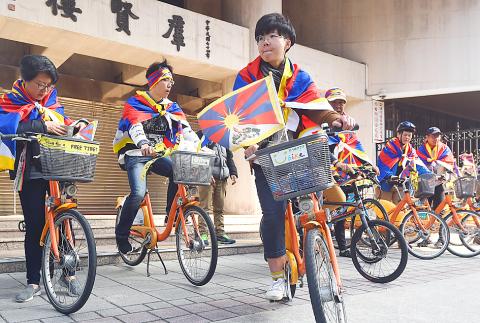
Photo: Liao Chen-huei, Taipei Times
The agreement was a “one country, two systems” arrangement, Tashi said, adding that “we absolutely cannot accept the way the arrangement turned out.”
Tibet’s experience could be of value to Taiwan, as Beijing has threatened to annex the nation under a similar arrangement, he said.
“Taiwan must look at what happened in Tibet before negotiating with China. We would not trust them at all,” Tashi said.
To raise awareness for human rights issues in Tibet, civic groups have planned nine cycling trips in Taipei, Taichung and Kaohsiung, as well as a march on March 10 to mark the 60th anniversary of the Tibetan uprising against China, Human Rights Network for Tibet director Lin Hsin-yi (林欣怡) said.
Yesterday’s event was the first cycling trip.
The group, which consists of a dozen people from the network, the Taiwan Association for Human Rights and other non-governmental organizations, set off from 228 Memorial Park at 9:30am.
After the news conference, they cycled to the Kelti Building, which houses Chinese representative offices, before heading to Taipei 101.
Worried that increased pressure from Beijing could discourage people from joining the annual march, civic groups have decided to promote the events earlier than usual this year, Lin said.
Last year’s referendums and local elections saw political forces that backed China’s authoritarianism and conservatism win public support by stressing the need to improve the economy, New Power Party Legislator Freddy Lim (林昶佐) said.
“This has caused many to be concerned about Taiwan’s future, and the march is a great opportunity to show the world that Taiwanese still support freedom and democracy,” he said.
Beijing’s crackdowns on human rights are not limited to Tibet and have become more relentless in the past few years, Democratic Progressive Party Legislator Yu Mei-nu (尤美女) said.
In addition to requiring Tibetans to hang portraits of Mao Zedong (毛澤東) and Chinese President Xi Jinping (習近平) in their homes, the Chinese government has also been closing and tearing down churches, she said.
“We should not think of things happening in Tibet as being far away from us, because the same things could happen here. The results of last year’s referendums suggest that Beijing’s influence is growing in Taiwan,” Yu said, urging people to support human rights by joining the events.
The dates and routes of the cycling trips can be found on the network’s Facebook page.

UPGRADE: The Kang Ding-class frigate is replacing its Chaparall missiles with Tien Chien II and Hua Yang VLS, which would provide it with long-range, 360° air defense Taiwan plans to produce 1,200 to 1,376 Hai Chien II missiles (海劍二, Sea Sword II) — also known as TC-2N — to serve as the standard air defense system of the navy’s surface combatant fleet, a source said yesterday. Last week, the Hai Chien II, the naval version of the Tien Kung II missile (天劍二, Sky Sword II), completed a live-fire test in waters off the National Chungshan Institute of Science and Technology’s Jiupeng facility (九鵬) in Pingtung County’s Manjhou Township (滿州). The MIM72 Chaparral and other dated air defense missiles that currently arm Taiwanese ships have inadequate range to combat Chinese

REASONS FOR TRAVEL: An assistant professor said that proposed amendments to penalize drivers if they used drugs overseas would not deter people from traveling People who operate a motor vehicle under the influence of marijuana would have their driver’s license revoked, even if they used the substance while overseas, the Ministry of Transportation and Communications said yesterday, citing proposed amendments to the Road Traffic Management and Penalty Act (道路交通管理處罰條例). The amendments would also authorize the government to revoke the licenses of people determined to have used Category 1 or Category 2 narcotics, even if they were not operating a vehicle while under the influence of drugs, as well as ban them from taking the license test for three years, the ministry said. People aged 18 or

HEAVY WEATHER: Typhoon Jangmi is due to crash straight into the Ryukyus as airlines look to shift flights to larger aircraft or cancel flights to Okinawa entirely Taiwan’s international air carriers announced flight adjustments over the weekend as Typhoon Jangmi is forecast to hit the Ryukyu Islands today and tomorrow. The Central Weather Administration (CWA) upgraded Jangmi from a tropical storm to a typhoon at 8am yesterday, with the eye located 580km south of Naha city. It was moving north at 19kph. Today, China Airlines’ CI-120, CI-121, CI-122 and CI-123 flights between Taoyuan and Naha, Okinawa, have been canceled as well as CI-132 and CI-133 between Kaohsiung and Naha. EVA Air’s BR-112, BR-113, BR-186 and BR-185 flights between Taoyuan and Naha are also canceled. Low-cost carrier Tigerair Taiwan canceled IT-230,
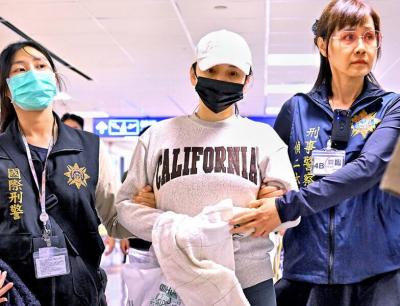
Johanne Liou (劉喬安), a Taiwanese woman who shot to unwanted fame during the Sunflower movement protests in 2014, returned to Taiwan last night after being deported from the US. She is to stand trial in Taiwan for charges involving embezzlement, fraud and drug crimes. The Criminal Investigation Bureau (CIB) said it took her into custody at Taiwan Taoyuan International Airport and would first question her before transferring her to the New Taipei District Prosecutors’ Office. She was arrested upon disembarking a flight from San Francisco that landed shortly before 7pm. Liou absconded to the US in 2019 after jumping bail


 RSS
RSS