


Former entertainer Lisa Cheng (鄭心儀) was yesterday confronted by pro-localization protesters as she went to the Ministry of Culture in Taipei in a failed attempt to apologize to Minister of Culture Cheng Li-Chiun (鄭麗君) for slapping her in the face on Tuesday.
Lisa Cheng slapped the minister at a Chinese Television System-hosted lunar year-end banquet for veteran entertainers, saying that the minister “had it coming” for attempting to purge all memory of Chiang Kai-shek (蔣介石) and his son, former president Chiang Ching-kuo (蔣經國), from history by “pushing policies aimed at demolishing the Chiang Kai-shek Memorial Hall.”
After the banquet, she visited the police and the Taipei District Prosecutors’ Office, which placed limitations on her movement for alleged obstruction of official duties, assault and public defamation.
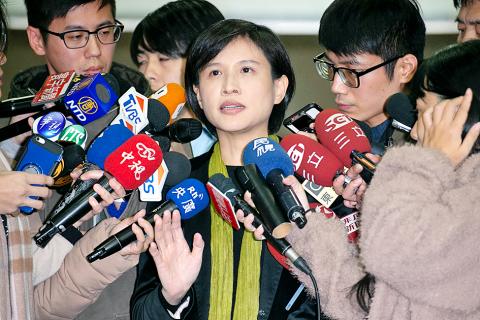
Photo: Chen I-kuan, Taipei Times
Lisa Cheng yesterday said that her apology was sincere, adding that her “actions were wrong” and set a bad example.
Asked whether it was arbitrary to label the ministry’s transitional justice policies as purging the memories of the Chiangs from history, Lisa Cheng said that the minister “is pushing for the demolition of the memorial hall. That is what I saw on the news.”
However, she said that admitting her actions were wrong does not mean that Cheng Li-Chiun’s actions are right, and called on the ministry not to demolish the hall.
Asked about media reports of her participation in China Unification Promotion Party events, Lisa Cheng said that such reports are meaningless, as the events were open to the public.
Ministry official Chang Hui-chun (張惠君) said that the minister’s thoughts on the incident were made clear in an official news release and on her Facebook page.
President Tsai Ing-wen (蔡英文) said that it is wrong to resort to violence and called on the public to be rational when expressing opinions.
Tsai, Premier Su Tseng-chang (蘇貞昌) and Vice Premier Chen Chi-mai (陳其邁) have all called Cheng Li-Chiun to offer consolation.
Raising the hypothetical question of what would have happened if the incident had taken place during the White Terror era, Tsai said that the answer was exactly why democracy should be cherished.
Separately, Chinese Nationalist Party (KMT) Vice Chairperson Hau Lung-bin (郝龍斌) said in a radio interview that he did not endorse violence, but added that the Democratic Progressive Party (DPP) should have a unifying standard when considering violent actions.
Hau on Tuesday said on Facebook that “the slap hurts, but many have also been hurt by the DPP’s desinicization efforts,” adding that the slap was the result of “the government forcing people to rebel.”
In 2008, Tsai, who was then DPP chairperson, organized a protest against a visit by then-Association for Relations Across the Taiwan Straits chairman Chen Yunlin (陳雲林) that resulted in injured police and bystanders, he said.
“Tsai said at the time that the KMT government had ‘forced the people to rebel,’” Hau said.
The DPP should not castigate the government when it is not in power and forbid violence when it is in office, he said.
Quoting Tsai, Hau said that he wished the public would “regard protesters with empathy.”

Taiwan has received more than US$70 million in royalties as of the end of last year from developing the F-16V jet as countries worldwide purchase or upgrade to this popular model, government and military officials said on Saturday. Taiwan funded the development of the F-16V jet and ended up the sole investor as other countries withdrew from the program. Now the F-16V is increasingly popular and countries must pay Taiwan a percentage in royalties when they purchase new F-16V aircraft or upgrade older F-16 models. The next five years are expected to be the peak for these royalties, with Taiwan potentially earning
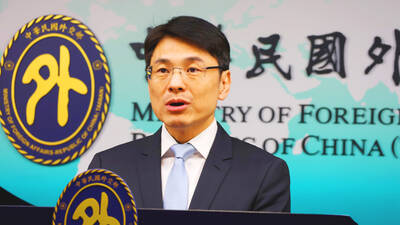
STAY IN YOUR LANE: As the US and Israel attack Iran, the ministry has warned China not to overstep by including Taiwanese citizens in its evacuation orders The Ministry of Foreign Affairs (MOFA) yesterday rebuked a statement by China’s embassy in Israel that it would evacuate Taiwanese holders of Chinese travel documents from Israel amid the latter’s escalating conflict with Iran. Tensions have risen across the Middle East in the wake of US and Israeli airstrikes on Iran beginning Saturday. China subsequently issued an evacuation notice for its citizens. In a news release, the Chinese embassy in Israel said holders of “Taiwan compatriot permits (台胞證)” issued to Taiwanese nationals by Chinese authorities for travel to China — could register for evacuation to Egypt. In Taipei, the ministry yesterday said Taiwan
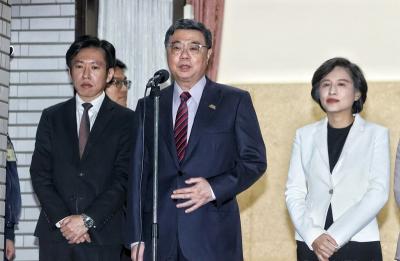
Taiwan is awaiting official notification from the US regarding the status of the Agreement on Reciprocal Trade (ART) after the US Supreme Court ruled US President Donald Trump's global tariffs unconstitutional. Speaking to reporters before a legislative hearing today, Premier Cho Jung-tai (卓榮泰) said that Taiwan's negotiation team remains focused on ensuring that the bilateral trade deal remains intact despite the legal challenge to Trump's tariff policy. "The US has pledged to notify its trade partners once the subsequent administrative and legal processes are finalized, and that certainly includes Taiwan," Cho said when asked about opposition parties’ doubts that the ART was
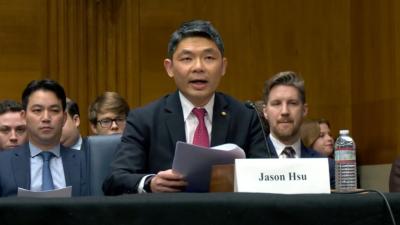
If China chose to invade Taiwan tomorrow, it would only have to sever three undersea fiber-optic cable clusters to cause a data blackout, Jason Hsu (許毓仁), a senior fellow at the Hudson Institute and former Chinese Nationalist Party (KMT) legislator, told a US security panel yesterday. In a Taiwan contingency, cable disruption would be one of the earliest preinvasion actions and the signal that escalation had begun, he said, adding that Taiwan’s current cable repair capabilities are insufficient. The US-China Economic and Security Review Commission (USCC) yesterday held a hearing on US-China Competition Under the Sea, with Hsu speaking on


 RSS
RSS