


Kaohsiung-based veterinarians have recommended that pet owners keep their animals warm, as cold weather was forecast for the next few days.
Cats and dogs common in Taiwan prefer temperatures from 20°C to 30°C, Jonghsin Animal Hospital’s 16th Agricultural Zone Branch veterinarians said, adding that while their fur is usually enough to keep cats and dogs warm, those that are old, short-haired, small or have chronic health issues could be more vulnerable to the cold.
A cat or dog that is uncomfortable in the cold could quiver or become lethargic, while signs of severe distress include weakness, stiff muscles, slowed breathing and heartbeat, and even loss of consciousness, they said.
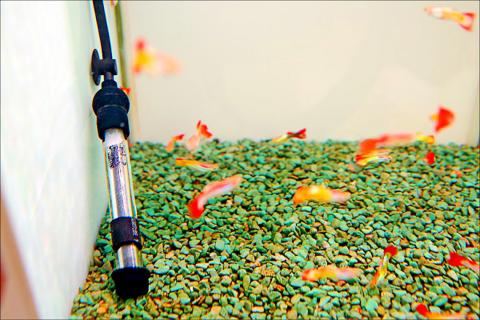
Photo: Lee Hui-chou, Taipei Times
Owners should provide indoor heating or an outside shelter, they said, adding that heat pads for beds should be wrapped in blankets or towels to avoid contact burns.
Tropic fish require heated tanks, while carp or goldfish are adapted for cold weather and do not need special attention, except during particularly severe drops in temperature, they said.
The optimal temperature for rays is 28°C to 32°C, 25°C to 28°C for small freshwater subtropical or tropical fish of the Characidae family, and 22°C to 26°C for goldfish, they said, adding that people should do research before buying fish.
Fish tank heaters must be the correct size and meet the requirements of the fish, while submersible heaters must be sleeved and placed at an angle to discourage bottom-dwelling fish from attaching themselves to it, they said.
Owners should warm the environment for a bird that persistently fluffs its feathers, tucks its head behind its neck, quivers or remains in its nest, they said, adding that a vet visit is necessary if the situation does not improve.
Juvenile and fledgling birds’ warmth requirements vary by species and heaters should not emit light to avoid disturbing their sleep, they said.
Many reptiles do not need to hibernate in winter if there is sufficient warmth, they said, adding that reptiles sometimes die in hibernation and the process should be avoided if possible.
For turtles, having artificial light and warmth through the winter encourages shell health, the vets said.
Enclosures for reptiles should have the same warmth and humidity as their natural environment, they said.
Heat stones or pads should be used with care to prevent overheating, while heat lamps should be kept at safe distances, they said.
Pet mice or rabbits that are too cold will seek small spaces to curl up in, they said, adding that their abdomens would be cold to the touch if the temperature is too low.
Healthy hamsters prefer temperatures of about 20°C and shredded paper towels, paper-based padding or cotton balls are appropriate materials for nests, they said.
However, socks and other fabric that could collect lint should be avoided for hamster habitats, as the animals can become entangled or sustain cuts from lint, which are potentially fatal, the vets said.
Hamster living spaces can be heated with 40-watt or 100-watt heat lamps, depending on the space, but the device should be kept in a corner of the cage to create hot and cold zones, which is important to prevent the animals overheating, they said.
Rabbits should be kept warm if temperatures fall below 18°C and owners should not shave their winter coats, they said.
Additional turf should be added to a rabbit box or nest for warmth, while 100-watt heat lamps are recommended for caged rabbits, with wiring kept well out of their reach, they said.
A strong, cold-air mass began to affect the nation yesterday, with temperatures falling to 16°C in northern Taiwan and 18°C to 20°C in the rest of the country, the Central Weather Bureau said, adding that strong winds were adding to the cold.
Moisture is likely to increase today and tomorrow, with intermittent rain forecast for all parts of the country, with snow above 3,000m, it said.
On Wednesday, the mercury in areas north of Tainan and in northeastern Taiwan is expected to slide to 10°C in the early morning, and 13°C to 15°C in Kaohsiung, and Pingtung, Hualien and Taitung counties, due to a radiative cooling effect, it said, adding that the cold air mass would begin to weaken on Thursday and Friday.
Additional reporting by CNA

Eight Chinese naval vessels and 24 military aircraft were detected crossing the median line of the Taiwan Strait between 6am yesterday and 6am today, the Ministry of National Defense said this morning. The aircraft entered Taiwan’s northern, central, southwestern and eastern air defense identification zones, the ministry said. The armed forces responded with mission aircraft, naval vessels and shore-based missile systems to closely monitor the situation, it added. Eight naval vessels, one official ship and 36 aircraft sorties were spotted in total, the ministry said.

The Ministry of Foreign Affairs (MOFA) today said that if South Korea does not reply appropriately to its request to correct Taiwan’s name on its e-Arrival card system before March 31, it would take corresponding measures to alter how South Korea is labeled on the online Taiwan Arrival Card system. South Korea’s e-Arrival card system lists Taiwan as “China (Taiwan)” in the “point of departure” and “next destination” fields. The ministry said that it changed the nationality for South Koreans on Taiwan’s Alien Resident Certificates from “Korea” to “South Korea” on March 1, in a gesture of goodwill and based on the

Taiwanese officials were shown the first of 66 F-16V fighter jets purchased by Taiwan from the United States, the Ministry of National Defense said yesterday, adding the aircraft has completed an initial flight test and is expected to be delivered later this year. A delegation led by Deputy Minister of National Defense Hsu Szu-chien (徐斯儉) visited Lockheed Martin’s F-16 C/D Block 70 (also known as F-16V) assembly line in South Carolina on March 16 to view the aircraft. The jet will undergo a final acceptance flight in the US before being delivered to Taiwan, the

The New Taipei Metro's Sanyin Line and the eastern extension of the Taipei Metro's Tamsui-Xinyi Line (Red Line) are scheduled to begin operations in June, the National Development Council said today. The Red Line, which terminates at Xiangshan Station, would be connected by the 1.4km extension to a new eastern terminal, Guangci/Fengtian Temple Station, while the Sanyin Line would link New Taipei City's Tucheng and Yingge stations via Sanxia District (三峽). The council gave the updates at a council meeting reviewing progress on public construction projects for this year. Taiwan's annual public infrastructure budget would remain at NT$800 billion (US$25.08 billion), with NT$97.3


 RSS
RSS