


The Democratic Progressive Party (DPP), the Chinese Nationalist Party (KMT) and the People First Party (PFP) yesterday agreed to prioritize the review of the central government budget at the Legislative Yuan’s extraordinary session.
At a cross-party negotiation held in Taipei to discuss the extraordinary session, which began yesterday and is to run through Friday next week, DPP caucus whip Ker Chien-ming (柯建銘) said he hoped the session could be simplified and focused on the national budget.
PFP Legislator Chou Chen Hsiu-hsia (周陳秀霞) and KMT caucus whip Johnny Chiang (江啟臣) also agreed that the budget should be the priority.
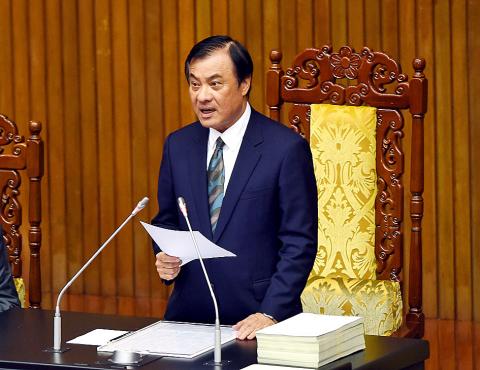
Photo: Huang Yao-cheng, Taipei Times
However, the New Power Party (NPP) suggested that the session also be used to discuss other matters.
NPP Legislator Hsu Yung-ming (徐永明) said that he does not oppose tackling the general budget at the extraordinary session, but it could, in response to President Tsai Ing-wen’s (蔡英文) New Year’s Day address, also be used to review bills related to the organization of a national transportation safety and investigation agency, immigration and the protection of classified national security information.
Legislative Speaker Su Jia-chyuan (蘇嘉全) said those bills could be prioritized for review in the next legislative session, which begins next month.
The Legislative Yuan should be able to reach a conclusion on those bills next month, he added.
With regards to the KMT caucus’ plans to boycott the review of the Transitional Justice Commission’s budget, Su urged lawmakers to express their opinions through other methods besides denying the budget request, which would render the commission unable to pay its staff.
He said the caucuses should be able to communicate and negotiate a solution, he said.
The KMT does not oppose transitional justice, but it must be “authentic” justice, Chiang said.
The commission has no official chairperson or deputy chairperson and should not be functioning, he said, adding that the vacant positions are still being filled illegally.
The commission must first earn the people’s trust, and only by functioning legally would it have a chance of doing so, he said.
It is therefore reasonable to freeze the budget before the commission officially nominates candidates to fill the chairperson and deputy chairperson seats, he added.

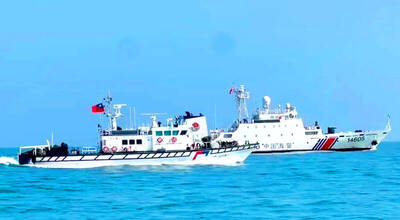
The military has spotted two Chinese warships operating in waters near Penghu County in the Taiwan Strait and sent its own naval and air forces to monitor the vessels, the Ministry of National Defense (MND) said. Beijing sends warships and warplanes into the waters and skies around Taiwan on an almost daily basis, drawing condemnation from Taipei. While the ministry offers daily updates on the locations of Chinese military aircraft, it only rarely gives details of where Chinese warships are operating, generally only when it detects aircraft carriers, as happened last week. A Chinese destroyer and a frigate entered waters to the southwest
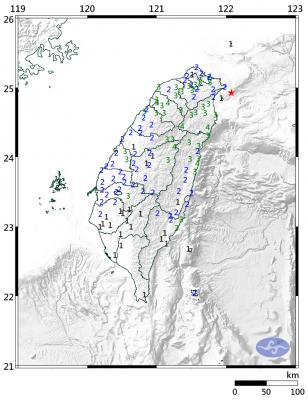
A magnitude 6.1 earthquake struck off the coast of Yilan County at 8:39pm tonight, the Central Weather Administration (CWA) said, with no immediate reports of damage or injuries. The epicenter was 38.7km east-northeast of Yilan County Hall at a focal depth of 98.3km, the CWA’s Seismological Center said. The quake’s maximum intensity, which gauges the actual physical effect of a seismic event, was a level 4 on Taiwan’s 7-tier intensity scale, the center said. That intensity level was recorded in Yilan County’s Nanao Township (南澳), Hsinchu County’s Guansi Township (關西), Nantou County’s Hehuanshan (合歡山) and Hualien County’s Yanliao (鹽寮). An intensity of 3 was
Instead of focusing solely on the threat of a full-scale military invasion, the US and its allies must prepare for a potential Chinese “quarantine” of Taiwan enforced through customs inspections, Stanford University Hoover fellow Eyck Freymann said in a Foreign Affairs article published on Wednesday. China could use various “gray zone” tactics in “reconfiguring the regional and ultimately the global economic order without a war,” said Freymann, who is also a nonresident research fellow at the US Naval War College. China might seize control of Taiwan’s links to the outside world by requiring all flights and ships entering or leaving Taiwan
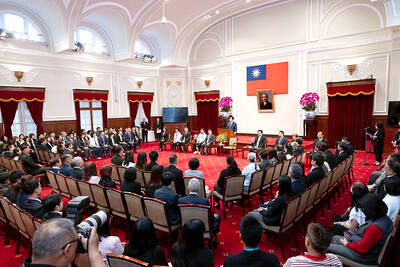
The next minimum wage hike is expected to exceed NT$30,000, President William Lai (賴清德) said yesterday during an award ceremony honoring “model workers,” including migrant workers, at the Presidential Office ahead of Workers’ Day today. Lai said he wished to thank the awardees on behalf of the nation and extend his most sincere respect for their hard work, on which Taiwan’s prosperity has been built. Lai specifically thanked 10 migrant workers selected for the award, saying that although they left their home countries to further their own goals, their efforts have benefited Taiwan as well. The nation’s industrial sector and small businesses lay


 RSS
RSS