


The cost of replacing currency bearing the likeness of Chiang Kai-shek (蔣介石) would not reach NT$50 billion (US$1.62 billion) as rumored, but likely about one-10th that figure, a source said yesterday.
The Transitional Justice Commission last week sent a letter to the central bank asking for financial documents related to currency redesigns in 2000 and 2005, which could be used to verify if changing currency featuring Chiang would be too costly.
The currency redesign in 2000 cost the central bank NT$4.894 billion, a source close to the commission said, citing documents released by the central bank after the issue was raised by New Power Party Legislator Hsu Yung-ming (徐永明) on Tuesday last week.
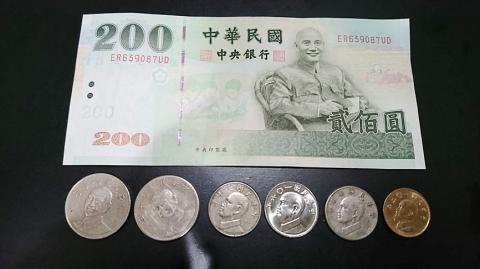
Photo: Chen Yu-fu, Taipei Times
Recalling NT$200 banknotes that feature Chiang’s likeness and redesigning the NT$5 and NT$10 coins would cost significantly less than the NT$50 billion estimate given by critics of the proposal, the source said.
Issuance Department Director-General Shih Tsuen-hua (施遵驊) on Tuesday last week told lawmakers that the central bank would send documents on the 2005 currency redesign, as well as those on a 2002 redesign of the NT$50 coin, to the commission.
The central bank has no plans to redesign currency that still features Chiang, he said, adding that it would wait until the commission has finished deliberating the issue.
The currency changes implemented in July 2000 — known internally as the “secure one” set — included the issuance of new NT$100, NT$500 and NT$1,000 banknotes to introduce new anti-counterfeiting measures and images that highlighted unique elements of Taiwan, he said.
The NT$500 and NT$1,000 banknotes had featured Chiang’s image, but the changes in 2000 replace his likeness with a baseball team and an image of four children respectively, Shih said, adding that the NT$200 bill is the only banknote still to feature Chiang.
In 2005, the central bank introduced the “secure two” set, which added more anti-counterfeiting measures to banknotes, he said.
Issuance of 800 million of the new banknotes cost the central bank NT$4.232 billion, Shih said, adding that introducing the new NT$50 coin in 2002 cost it NT$1.783 billion.
New NT$10 coins introduced in January 2011 featured improved anti-counterfeiting measures and replaced Chiang with the likeness of Sun Yat-sen (孫逸仙), he said, adding that those coins had constituted 36 percent of NT$10 coins in circulation as of the end of last year.
In their first year of issuance, a total of 210 million of those coins were issued at a cost of NT$1.13 billion, Shih said, adding that last year NT$1 billion was spent on minting NT$10 coins.

SECURITY: Starlink owner Elon Musk has taken pro-Beijing positions, and allowing pro-China companies to control Taiwan’s critical infrastructure is risky, a legislator said Starlink was reluctant to offer services in Taiwan because of the nation’s extremely high penetration rates in 4G and 5G services, the Ministry of Digital Affairs said yesterday. The ministry made the comments at a meeting of the legislature’s Transportation Committee, which reviewed amendments to Article 36 of the Telecommunications Management Act (電信管理法). Article 36 bans foreigners from holding more than 49 percent of shares in public telecommunications networks, while shares foreigners directly and indirectly hold are also capped at 60 percent of the total, unless specified otherwise by law. The amendments, sponsored by Chinese Nationalist Party (KMT) Legislator Ko

The military has spotted two Chinese warships operating in waters near Penghu County in the Taiwan Strait and sent its own naval and air forces to monitor the vessels, the Ministry of National Defense (MND) said. Beijing sends warships and warplanes into the waters and skies around Taiwan on an almost daily basis, drawing condemnation from Taipei. While the ministry offers daily updates on the locations of Chinese military aircraft, it only rarely gives details of where Chinese warships are operating, generally only when it detects aircraft carriers, as happened last week. A Chinese destroyer and a frigate entered waters to the southwest
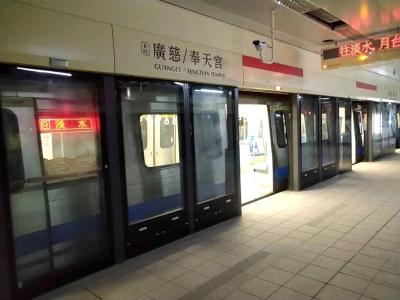
The eastern extension of the Taipei MRT Red Line could begin operations as early as late June, the Taipei Department of Rapid Transit Systems said yesterday. Taipei Rapid Transit Corp said it is considering offering one month of free rides on the new section to mark its opening. Construction progress on the 1.4km extension, which is to run from the current terminal Xiangshan Station to a new eastern terminal, Guangci/Fengtian Temple Station, was 90.6 percent complete by the end of last month, the department said in a report to the Taipei City Council's Transportation Committee. While construction began in October 2016 with an
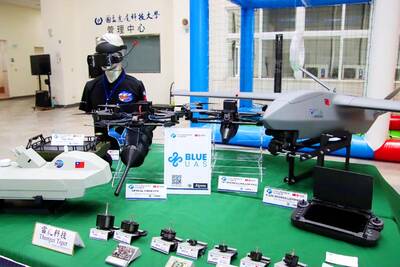
NON-RED SUPPLY: Boosting the nation’s drone industry is becoming increasingly urgent as China’s UAV dominance could become an issue in a crisis, an analyst said Taiwan’s drone exports to Europe grew 41.7-fold from 2024 to last year, with demand from Ukraine’s fight against Russian aggression the most likely driver of growth, a study showed. The Institute for Democracy, Society and Emerging Technology (DSET) in a statement on Wednesday said it found that many of Taiwan’s uncrewed aerial vehicle (UAV) sales were from Poland and the Czech Republic. These countries likely transferred the drones to Ukraine to aid it in its fight against the Russian invasion that started in 2022, it said. Despite the gains, Taiwan is not the dominant drone exporter to these markets, ranking second and fourth


 RSS
RSS