


The People First Party (PFP) caucus yesterday urged members of the Transitional Justice Commission to resign en masse and threatened to freeze the commission’s budget for next year until the Cabinet-level body is filled with new members.
The commission’s main tasks should be to restore historical truth and clear the names of wrongly convicted people, PFP caucus whip Lee Hung-chun (李鴻鈞) said.
Those were also the answers given by commission Acting Chairwoman Yang Tsui (楊翠) in a questionnaire that the party sent to Yang after her appointment as a commission member in April, Lee said.
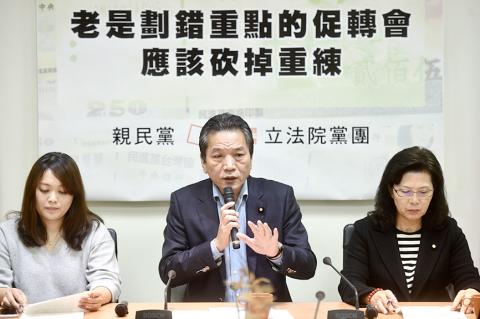
Photo: Chien Jung-fong, Taipei Times
“However, now Yang’s priorities are to remove statues of Chiang Kai-shek (蔣介石), change the design of the nation’s currency and abolish military honor guards [at Chiang Kai-shek Memorial Hall in Taipei],” Lee told a news conference in Taipei.
Lee said that the commission members should have held a meeting to discuss Chiang’s achievements and mistakes, and released their conclusions for public review.
“The process of removing statues of Chiang should only begin after the public accepts their conclusions. Skipping the process will make such a process like fruits grown on a poisonous tree. No matter how sweet the fruits are, they are also toxic,” he said.
Transitional justice touches on many issues, including history, laws, politics and cultural values, PFP Legislator Chen Yi-chieh (陳怡潔) said.
In light of the limited time and staff the commission has been given, and as many historical documents are decaying, the commission should make salvaging historical documents its top priority and comforting White Terror victims its second, Chen said.
Even though Cheng Hsin General Hospital, which was established by Chiang’s wife Soong Mayling (蔣宋美齡), was founded with money from questionable sources, it does not make it less of a good hospital, PFP Legislator Chou Chen Hsiu-hsia (周陳秀霞) said.
“We should not ruin the hospital in pursuit of transitional justice,” he said.
“Similarly, 99.9 percent of the shares of Hua Nan Commercial Bank came from assets that were appropriated by the government from Chen Hsin (陳炘), Taiwan’s richest man during the late Japanese colonial era,” Chou Chen said. “Is the government going to destroy the bank just to make sure that justice is served?”
Facilitating reconciliation is transitional justice’s ultimate goal and the commission should steer society toward harmony, instead of sowing conflict and division, while wasting government resources, the caucus said.
The Act on Promoting Transitional Justice (促進轉型正義條例) stipulates that the commission should consist of nine members, including a chairperson and a vice chairperson, with the number from any single political party capped at three.
The members should be nominated by the premier and approved by the legislature. Their tenure is not to expire until after the commission completes its initial task of compiling a detailed investigative report, a plan of action and draft legislation, which it is to do within two years, before being dissolved.
Meanwhile, a transitional justice repeal bill proposed by Chinese Nationalist Party (KMT) Legislator Lai Shyh-bao (賴士葆), which was scheduled to be reviewed at a plenary legislative session yesterday, has been returned to the Legislative Yuan’s Procedure Committee after the Democratic Progressive Party and New Power Party caucuses submitted objections.
Lai said he would refile the bill every week.
Additional reporting by Chen Yun

FUKUOKA SITUATION: Japanese media reported that the pathogen is expected to be identified by the summer, while the CDC downplayed the idea that it was hMPV A “mysterious cold-like illness” reported in Japan’s Fukuoka Prefecture does not seem to be a new disease, but Japanese authorities have been asked about the situation, the Centers for Disease Control (CDC) said yesterday. The Fukuoka Prefectural Medical Association on Wednesday told a news conference that a “mystery cold” that has become a hot topic on social media is “highly likely to be caused by some kind of viral infection,” Japan’s KBC News reported. “Many people are experiencing symptoms starting with a sore throat, followed by a runny nose, phlegm and a severe cough,” KBC News reported, citing association officials. Health authorities are

Nvidia Corp CEO Jensen Huang (黃仁勳) arrived in Taiwan yesterday ahead of upcoming AI and technology events, saying he plans to meet with clients and Taiwan Semiconductor Manufacturing Co Chairman C.C. Wei (魏哲家) during his visit. After landing at Taipei Songshan Airport, Huang posed for photos with fans and handed out Yakult drinks to reporters and supporters waiting at the scene, saying he has “a lot to do” during the trip. Asked about reports that Nvidia’s planned headquarters site in Taipei’s Beitou Shilin Technology Park could break ground on May 27, Huang said that if the company holds an event, he would

The Ministry of Finance this afternoon announced the winning numbers for the March-April uniform invoice lottery. The winning number for the NT$10 million (US$318,060) special prize is 19531471, and the winning number for the NT$2 million grand prize is 85941329. Three numbers were drawn for the NT$200,000 first prize: 07225810, 20231230 and 83518781. Those with receipts matching the last seven digits of any of the first-prize numbers will win the NT$40,000 second prize, while those matching the last six digits will win the NT$10,000 third prize. Those whose receipts match the last five digits of the first-prize numbers can claim the NT$4,000 fourth prize,
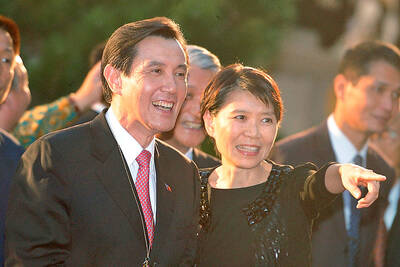
Former president Ma Ying-jeou (馬英九) yesterday expressed “shock and regret” over a statement issued by his wife without his consent, and rejected her assertion that his eldest sister, Ma Yi-nan (馬以南), would manage his medical care or act as his spokesperson amid an ongoing embezzlement probe into his foundation. Ma Ying-jeou in a statement said he was shocked by a statement by his wife, Chou Mei-ching (周美青), regarding his affairs. Ma Yi-nan “must not” be in charge of his healthcare and other personal affairs, nor can she be allowed to represent the Ma family, the former president said. He said he was also


 RSS
RSS