


Lung Teh Shipbuilding Co has been awarded contracts to build 11 Tuo Jiang-class corvettes and four minelayers for the navy.
The shipbuilder is to deliver the Tuo Jiang-class guided missile corvettes by 2026, or a decade ahead of schedule, Democratic Progressive Party (DPP) Legislator Tsai Shih-ying (蔡適應) said on Sunday.
With a displacement of less than 700 tonnes, the corvettes are to have anti-aircraft and anti-ship capabilities, but no anti-submarine capabilities, he said, adding that the navy’s original plan of having three corvette subtypes — anti-aircraft, anti-ship and anti-submarine — was scrapped to save time.
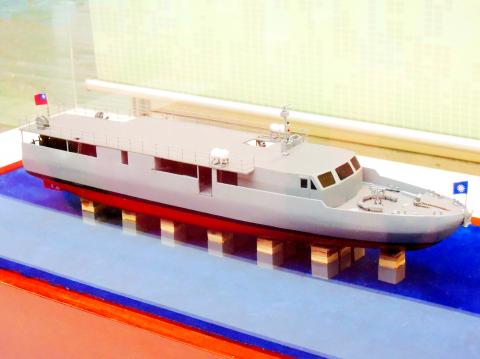
Photo: Lo Tien-pin, Taipei Times
In July, the navy contracted with the Ministry of National Defense-affiliated Chungshan Institute of Science and Technology to take charge of the procurement platform, systems integration and combat systems development for the project, the institute’s Web site said.
According to the contract’s terms, the institute had to contract with a qualified Taiwanese shipbuilder no later than Nov. 11.
The institute said that the contractor was selected for its superior technical and financial performance through a transparent process to ensure successful indigenous production of high-performance warships.
Lung Teh was also awarded a contract to build fast minelayers for the navy, a defense official said on Sunday, speaking on condition of anonymity.
The ministry later confirmed that report in an announcement.
The ministry said the shipbuilder is to deliver the minelayers by November 2021 at a cost of NT$738.31 million (US$24.01 million).
The remainder of the NT$917. 77 million budgeted for minelayers is reserved for the production of a naval mine that the institute is to develop, the navy said.
The minelayers would be a crucial asset to counter the Chinese People’s Liberation Army Navy, the navy said, adding that the shipbuilding projects would benefit industry in Taiwan.
Deploying mines rapidly to close sea lanes and maritime zones that a hostile force might have chosen to move through helps disrupt enemy battle plans, the navy said.

The Ministry of Finance this afternoon announced the winning numbers for the March-April uniform invoice lottery. The winning number for the NT$10 million (US$318,060) special prize is 19531471, and the winning number for the NT$2 million grand prize is 85941329. Three numbers were drawn for the NT$200,000 first prize: 07225810, 20231230 and 83518781. Those with receipts matching the last seven digits of any of the first-prize numbers will win the NT$40,000 second prize, while those matching the last six digits will win the NT$10,000 third prize. Those whose receipts match the last five digits of the first-prize numbers can claim the NT$4,000 fourth prize,

SIX SUBSIDIES: The monthly allowance for older farmers is to increase to NT$10,000, and NT$5,000 is to be given to homemakers under the national pension system, Lai said The government is to implement major welfare policies for disadvantaged groups, including raising the monthly allowance for older farmers to NT$10,000 and providing homemakers with NT$5,000 per month, President William Lai (賴清德) said yesterday. Lai made the remarks during a visit to Wangling Temple in Chiayi County, saying that the planned increases were being introduced amid economic growth and an increase in tax revenue. Touting a policy, in which the government plans to provide a monthly allowance of NT$5,000 for every child under the age of 18 in a bid to address Taiwan’s low birthrate, Lai said that if received for the
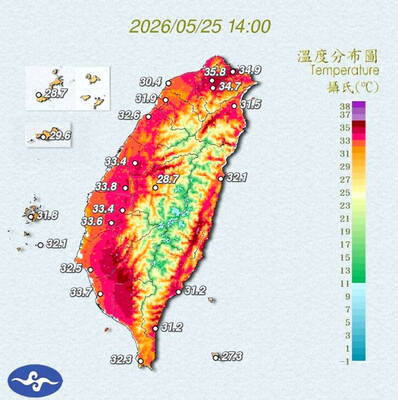
STAY COOL: The HPA recommended that people stay hydrated, use air-conditioning or fans while indoors, wear loose-fitting clothes and walk in the shade while outdoors Employers must implement measures such as installing cooling equipment, and providing drinking water and rest breaks for outdoor workers starting from Monday next week, the Taipei Department of Labor said on Sunday. Employers who fail to comply could face fines of NT$30,000 to NT$300,000 under the Occupational Safety and Health Act (職業安全衛生法), the department said. Businesses in Taipei employing fewer than 100 workers, as well as registered self-employed workers with labor insurance coverage, could receive on-site assessments and guidance from occupational safety consultants to help them apply for central government subsidies to implement or improve heat-protection measures, it said. Under the Ministry of
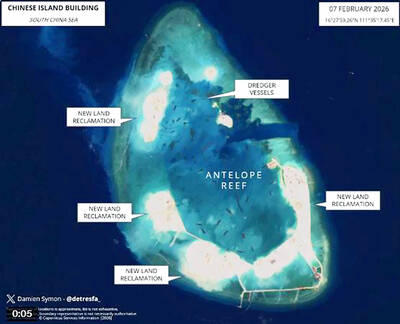
ISOLATION: The outposts would serve as support and backup bases, forcing US forces to either face China head-on or reroute, increasing travel time and operational costs China’s outposts in the South China Sea could be used to delay and constrain foreign forces during a conflict in the Taiwan Strait, giving Beijing a critical window to carry out amphibious landing and blockade operations, a report said. The Chinese Communist Party’s (CCP) forward operating bases on islands and reclaimed features in the South China Sea could delay foreign forces long enough for the Chinese People’s Liberation Army (PLA) to secure a key 48-to-72-hour window in the Taiwan Strait, a report commissioned by the Mainland Affairs Council found. The report, conducted by the Institute for National Defense and Security Research, examined


 RSS
RSS