


The results of Saturday’s referendums on equal marriage rights has been interpreted by some as a resounding rejection of same-sex marriage by Taiwanese, but rights advocates said the campaign was heavily skewed in favor of the anti-gay rights camp.
Of the five referendums on Saturday that touched on gay issues, three reached the required threshold of more than 4.94 million “yes” votes, a quarter of eligible voters, needed to pass.
Referendum #10 — which asked “Do you agree that the Civil Code should define marriage as the union between a man and a woman?” — garnered 7,658,008 “yes” votes and 2,907,429 “no” votes.
There were 7,083,379 votes in favor of referendum #11 — which asked: Do you agree that in the course of mandatory public education (in junior-high schools and elementary schools), the Ministry of Education and schools at various levels should not teach classes regarding gay people that are stipulated by the Gender Equity Education Act (性別平等教育法)?” — and 3,419,624 votes against it.
Referendum #12 — which asked: “Do you agree that the right to persons of the same sex to create a permanent union should be guaranteed by an institution other than marriage as defined by the Civil Code?” — garnered 6,401,748 votes in favor of it and 4,072,471 against.
The proposals that did not pass were No. 14, which asked: “Do you agree that the right to marriage of persons of the same sex should be protected by legislation under the chapter on marriage of the Civil Code?” — and No. 15, which asked: “Do you agree that mandatory education should, as stipulated by the Gender Equity Education Act (性別平等教育法), implement gender equality education, which includes emotional, sexual and gay and lesbian education?”
There were 6,949,697 votes against No. 14 and 3,382,286 in favor of it, while No. 15 garnered 6,805,171 votes against it and 3,507,665 in favor.
Chinese Regional Bishops’ Conference secretary-general Chen Ko (陳科) yesterday said the referendum results were “an indication that the position of Taiwanese society is that same-sex marriage is unacceptable.”
Chen said the results of the pro-gay referendums were a surprise.
Based on the way society has reacted to annual gay pride parades, acceptance of gay people did not seem to be a problem, but the results on the question about same-sex marriage suggest Taiwan is not ready for such a change, Chen said.
“Taiwanese tend to be more conservative when it comes to marriage, finding it hard to accept changes made to the definition of marriage,” Chen said.
Happiness Alliance president Tseng Hsien-ying (曾獻瑩), one of the initiators of Referendum #11, said: “People used their ballots to make their voice heard. Family values and inclusion of those values in the education of the next generation are mainstream public opinion that the government should heed.”
Taiwan Alliance to Promote Civil Partnership Rights, an LGBTIQ rights group, on Saturday reminded the government it is obliged to put the Council of Grand Justices’ Constitutional Interpretation No. 748 in favor of same-sex marriage into law despite the referendum results.
The grand justices on May 24 last year ruled that the Civil Code’s definition of marriage as being between one man and one woman was unconstitutional and ordered that the law be amended or another law legalizing same sex-marriage be introduced within two years.
The anti-gay rights camp poured hundreds of millions of New Taiwan dollars into advertisements to brainwash society with propaganda aimed at inciting fear, hatred, prejudice and bias against gay people, the Taiwan Alliance to Promote Civil Partnership Rights said in a statement.
“We will not give up our fight and we believe that justice will come to society,” it said, adding: “We would like to remind the government that the referendum results do not alter the fact that the grand justices’ ruling must be acted on before May 24, 2019.”
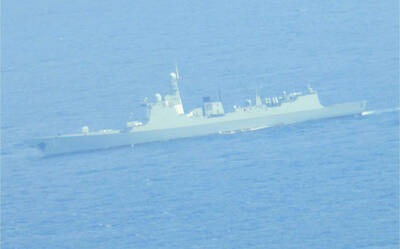
The military has spotted two Chinese warships operating in waters near Penghu County in the Taiwan Strait and sent its own naval and air forces to monitor the vessels, the Ministry of National Defense (MND) said. Beijing sends warships and warplanes into the waters and skies around Taiwan on an almost daily basis, drawing condemnation from Taipei. While the ministry offers daily updates on the locations of Chinese military aircraft, it only rarely gives details of where Chinese warships are operating, generally only when it detects aircraft carriers, as happened last week. A Chinese destroyer and a frigate entered waters to the southwest
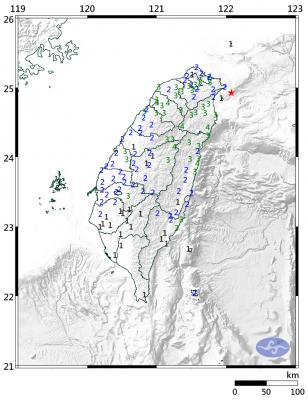
A magnitude 6.1 earthquake struck off the coast of Yilan County at 8:39pm tonight, the Central Weather Administration (CWA) said, with no immediate reports of damage or injuries. The epicenter was 38.7km east-northeast of Yilan County Hall at a focal depth of 98.3km, the CWA’s Seismological Center said. The quake’s maximum intensity, which gauges the actual physical effect of a seismic event, was a level 4 on Taiwan’s 7-tier intensity scale, the center said. That intensity level was recorded in Yilan County’s Nanao Township (南澳), Hsinchu County’s Guansi Township (關西), Nantou County’s Hehuanshan (合歡山) and Hualien County’s Yanliao (鹽寮). An intensity of 3 was

Japanese Prime Minister Sanae Takaichi’s comment last year on Tokyo’s potential reaction to a Taiwan-China conflict has forced Beijing to rewrite its invasion plans, a retired Japanese general said. Takaichi told the Diet on Nov. 7 last year that a Chinese naval blockade or military attack on Taiwan could constitute a “survival-threatening situation” for Japan, potentially allowing Tokyo to exercise its right to collective self-defense. Former Japan Ground Self-Defense Force general Kiyofumi Ogawa said in a recent speech that the remark has been interpreted as meaning Japan could intervene in the early stages of a Taiwan Strait conflict, undermining China’s previous assumptions
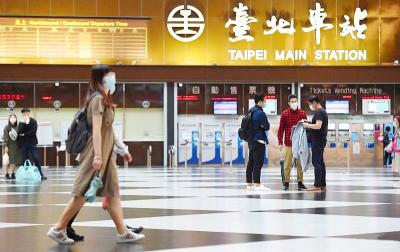
Taiwan Railways Corp (TRC) today announced that Shin Kong Mitsukoshi has been selected as the preferred bidder to operate the Taipei Railway Station shopping mall, replacing the current operator, Breeze Development Co Ltd. Among eight qualified firms that delivered presentations and were evaluated by a review committee, Shin Kong Mitsukoshi was ranked first, while Breeze was named the runner-up, the rail company said in a statement. Contract negotiations are to proceed in accordance with regulations, it said, adding that if negotiations with the top bidder fail, it could invite the second-ranked applicant to enter talks. Breeze in a statement today expressed doubts over


 RSS
RSS