


The Chinese Nationalist Party (KMT) caucus yesterday filed malfeasance charges against Central Election Commission (CEC) Chairman Chen In-chin (陳英鈐) and Vice Chairman Chen Chao-chien (陳朝建) for ignoring a deadline on publishing the opinions of government agencies on a referendum.
The caucus mainly took issue with the Executive Yuan’s opinions on a referendum initiated by KMT Vice Chairman Hau Lung-bin (郝龍斌) that asks people for their stance on continuing an import ban on food products from five Japanese prefectures that was initiated after the 2011 Fukushima Dai-ichi nuclear power plant disaster.
The referendum proposal was passed by the commission last month.
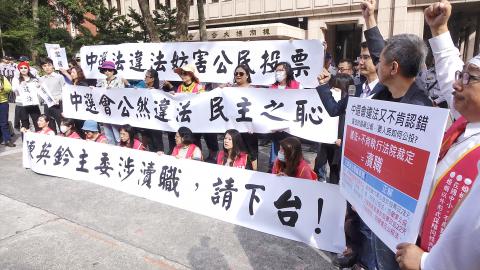
Photo: George Tsorng, Taipei Times
The commission on Oct. 24 uploaded the Executive Yuan’s opinions on the referendum to its Web site and on Nov. 2 uploaded a revision to the opinions.
The Taipei High Administrative Court on Wednesday last week issued a cease-and-desist order to the commission over its revisions.
The commission breached the Referendum Act (公民投票法), which stipulates that government agencies’ opinions on referendums must be published at least 28 days before voting takes place, KMT caucus secretary-general William Tseng (曾銘宗) told a news conference at the Control Yuan in Taipei.
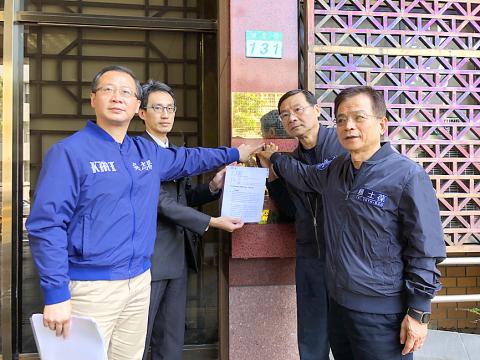
Photo: Chien Li-chung, Taipei Times
Chen In-chin’s contravention of the act was malfeasance, and the caucus has urged the Control Yuan to impeach him after an investigation, Tseng said.
Although it has appealed to the Supreme Administrative Court, the commission should have complied with the court order, but instead mailed out revised referendum gazettes to district offices nationwide after receiving the ruling, KMT Legislator John Wu (吳志揚) said.
The commission should “clean up its own mess” and shoulder the compensation for any losses suffered by the nation as a result of its actions, he said.
It would cost the government about NT$150 million (US$4.86 million) to print the original version of the gazettes and send them to constituents nationwide, KMT Legislator Lai Shyh-bao (賴士葆) said.
Accusing Chen In-chin of breaking the law and malfeasance, Lai asked how he has the nerve to stay in his position.
Aside from the referendum on Japanese food products, the commission on Nov. 2 also uploaded the Executive Yuan’s revised opinions on six other referendums, including some asking for people’s opinion on same-sex marriage and gender education, drawing public protests.
Citing the Administrative Appeals Act (行政訴訟法), the commission on Tuesday said that the Taipei High Administrative Court should have given it a chance to testify before passing down the order, but did not, leading it to appeal.
The commission said that the ruling was issued on Wednesday last week and that by the time it received the verdict on Friday, it had already finished printing the gazettes and had mailed some of them.
The legislators later filed charges against the commission over alleged malfeasance and contraventions of the act with the Taipei District Court.


Kenting National Park service technician Yang Jien-fon (楊政峰) won a silver award in World Grand Prix Photography Awards Spring Season for his photograph of two male rat snakes intertwined in combat. Yang’s colleagues at Kenting National Park said he is a master of nature photography who has been held back by his job in civil service. The awards accept entries in all four seasons across six categories: architectural and urban photography, black-and-white and fine art photography, commercial and fashion photography, documentary and people photography, nature and experimental photography, and mobile photography. Awards are ranked according to scores and divided into platinum, gold and
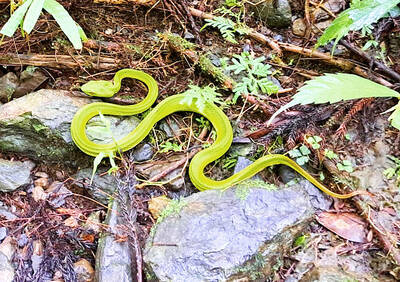
More than half of the bamboo vipers captured in Tainan in the past few years were found in the city’s Sinhua District (新化), while other districts had smaller catches or none at all. Every year, Tainan captures about 6,000 snakes which have made their way into people’s homes. Of the six major venomous snakes in Taiwan, the cobra, the many-banded krait, the brown-spotted pit viper and the bamboo viper are the most frequently captured. The high concentration of bamboo vipers captured in Sinhua District is puzzling. Tainan Agriculture Bureau Forestry and Nature Conservation Division head Chu Chien-ming (朱健明) earlier this week said that the
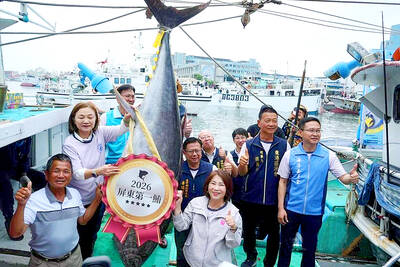
The first bluefin tuna of the season, brought to shore in Pingtung County and weighing 190kg, was yesterday auctioned for NT$10,600 (US$333.5) per kilogram, setting a record high for the local market. The auction was held at the fish market in Donggang Fishing Harbor, where the Siaoliouciou Island-registered fishing vessel Fu Yu Ching No. 2 delivered the “Pingtung First Tuna” it had caught for bidding. Bidding was intense, and the tuna was ultimately jointly purchased by a local restaurant and a local company for NT$10,600 per kilogram — NT$300 ,more than last year — for a total of NT$2.014 million. The 67-year-old skipper
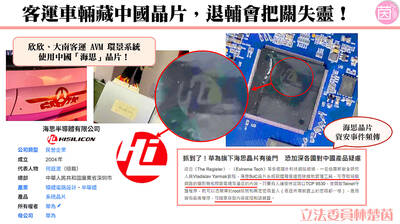
BREACH OF CONTRACT: The bus operators would seek compensation and have demanded that the manufacturer replace the chips with ones that meet regulations Two bus operators found to be using buses with China-made chips are to demand that the original manufacturers replace the systems and provide compensation for breach of contract, the Veterans Affairs Council said yesterday. Democratic Progressive Party Legislator Michelle Lin (林楚茵) yesterday said that Da Nan Bus Co and Shin-Shin Bus Co Ltd have fielded a total of 82 buses that are using Chinese chips. The bus models were made by Tron-E, while the systems provider was CYE Electronics, Lin said. Lin alleged that the buses were using chips manufactured by Huawei subsidiary HiSilicon Co, which presents a national security risk if the


 RSS
RSS