


Taipei Mayor Ko Wen-je (柯文哲) yesterday for the first time met with the advisory group for his re-election campaign and touted the city’s investment potential.
About 400 people from the business sector, including from the tourism, information technology and environmental services industries, attended the meeting.
Ko’s opponents have said that he has a poor record of attracting investment to the capital.

Photo: Fang Pin-chao, Taipei Times
Ko said that although he did not sign any build-operate-transfer (BOT) development projects in the first two years of his term, Ma Ying-jeou (馬英九) and Hau Lung-bin (郝龍斌) also did not sign any in their first two years as Taipei mayor.
Investors tend to just watch a new city administration for the first two years, Ko said, adding that Taipei attracted the most projects of any city from his third year and he expects the capital to attract the most investment for at least the next three years.
Total investment in BOT projects and other development projects in Taipei was about NT$29.9 billion (US$964.3 million) in his third year and reached a cumulative total of NT$39.8 billion this year, he said, adding that the Taipei Twin Towers project is expected to attract even more investment next year.

Photo: Chen Pei-yao, Taipei Times
Foreign nationals invest in projects in Taipei because the city government is “very clean” and has clear regulations, Ko said.
Separately yesterday, Chinese Nationalist Party (KMT) Taipei mayoral candidate Ting Shou-chung (丁守中) was joined by former president Ma and KMT Vice Chairman Hau Lung-bin (郝龍斌) in Taipei’s Gongguan (公館) area, while Democratic Progressive Party (DDP) Taipei mayoral candidate Pasuya Yao (姚文智) held a parade in Daan Forest Park (大安森林公園) in the afternoon.
Speaking on the sidelines, Yao said that Ko had “adopted a belittling attitude toward social justice, viewing it as trash, to butter up members of the National Women’s League and gain their votes.”

Photo: Chen Pei-yao, Taipei Times
Ko on Saturday spoke at a veterans’ village cultural symposium on transitional justice alongside league chairwoman Joanna Lei (雷倩).
He said that transitional justice “should be about solving current problems first, followed by preventing them from happening again, while investigating liability for past incidents should be last,” as calling people to account for historical crimes first would create a litany of problems.
He also defended the league and the China Youth Corps — both of which the Cabinet’s Ill-gotten Party Assets Settlement Committee ruled to be KMT affiliates — saying: “They are operating properly now.”
The groups illegally profited from so-called “donations” during the former KMT regime, but that “will not happen again, so why do you [the asset committee] care about what it did in the past?” he said.
Committee spokeswoman Shih Chin-fang (施錦芳) yesterday said that Ko’s remarks seemed to indicate that murderers could be freed from prison as long as they repent.
Politicians with such core belief “seem very dangerous,” Shih said.
Ko said his remarks were to highlight “the order of importance for issues of justice.”
A conversation with former Polish president and Nobel Peace Prize laureate Lech Walesa this year taught him the importance of “sequence” when dealing with issues of justice, he said.
Walesa taught him to deal with the problems at hand first, then prevent matters from happening again and investigate liability last, Ko said.
The city government’s dealings with the China Youth Corps made that advice relevant, he said.
Confrontation between the pan-blue and pan-green camps seems to be especially intense before elections, so his remarks are often overinterpreted, Ko said.
Additional reporting by Chung Hung-liang and Shen Pei-yao

More than half of the bamboo vipers captured in Tainan in the past few years were found in the city’s Sinhua District (新化), while other districts had smaller catches or none at all. Every year, Tainan captures about 6,000 snakes which have made their way into people’s homes. Of the six major venomous snakes in Taiwan, the cobra, the many-banded krait, the brown-spotted pit viper and the bamboo viper are the most frequently captured. The high concentration of bamboo vipers captured in Sinhua District is puzzling. Tainan Agriculture Bureau Forestry and Nature Conservation Division head Chu Chien-ming (朱健明) earlier this week said that the

NAMING SPAT: The foreign ministry called on Denmark to propose an acceptable solution to the erroneous nationality used for Taiwanese on residence permits Taiwan has revoked some privileges for Danish diplomatic staff over a Danish permit that lists “Taiwan” as “China,” Eric Huang (黃鈞耀), head of the Ministry of Foreign Affairs’ Department of European Affairs, told a news conference in Taipei yesterday. Reporters asked Huang whether the Danish government had responded to the ministry’s request that it correct the nationality on Danish residence permits of Taiwanese, which has been listed as “China” since 2024. Taiwan’s representative office in Denmark continues to communicate with the Danish government, and the ministry has revoked some privileges previously granted to Danish representatives in Taiwan and would continue to review
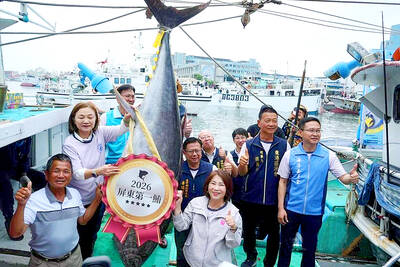
The first bluefin tuna of the season, brought to shore in Pingtung County and weighing 190kg, was yesterday auctioned for NT$10,600 (US$333.5) per kilogram, setting a record high for the local market. The auction was held at the fish market in Donggang Fishing Harbor, where the Siaoliouciou Island-registered fishing vessel Fu Yu Ching No. 2 delivered the “Pingtung First Tuna” it had caught for bidding. Bidding was intense, and the tuna was ultimately jointly purchased by a local restaurant and a local company for NT$10,600 per kilogram — NT$300 ,more than last year — for a total of NT$2.014 million. The 67-year-old skipper

China has reserved offshore airspace over the Yellow Sea and East China Sea from March 27 to May 6, issuing alerts that are usually used to warn of military exercises, although no such exercises have been announced, the Wall Street Journal (WSJ) reported on Sunday. Reserving such a large area for 40 days without explanation is an “unusual step,” as military exercises normally only last a few days, the paper said. The alerts, known as notice to air missions (NOTAMs), “are intended to inform pilots and aviation authorities of temporary airspace hazards or restrictions,” the article said. The airspace reserved in the alert


 RSS
RSS