


Taiwan should keep a close eye on the possible repercussions to it from the deteriorating US-China relationship, former American Institute in Taiwan (AIT) chairman Richard Bush said on Friday in an article posted on the Brookings Institution’s Web site.
Now the director of the think tank’s Center for Northeast Asian Policy Studies, Bush said that while US Vice President Mike Pence’s recent rhetoric on China was harsh, “Taiwan might become a victim of ‘friendly fire’ in a US-China trade war,” due to its close economic ties with China.
In an Oct. 4 speech to the conservative Hudson Institute, Pence condemned Beijing for threatening cross-strait stability and accused it of resorting to economic aggression to extend its global reach.
Some observers in Taiwan and elsewhere in Asia might conclude from Pence’s speech that US-China relations would become zero-sum, Bush wrote in “What Taiwan can take from Mike Pence’s speech on China.”
“China would have a lot to lose from all-out competition with America, but US allies and partners in the region also might be at risk from both the current trade war and from wider Washington-Beijing rivalry,” Bush wrote. “Taiwan’s situation is particularly complex.”
Since the early 1990s, Taiwanese firms have been exporting goods to China, and as a result, Taiwan has become a critical link in supply and value chains that run from the US, he wrote.
“But for purposes of US customs, the finished products are treated as Chinese goods, so a US decision to increase tariffs on those goods would hurt the Taiwan companies and perhaps wipe out the narrow profit margins on which they operate,” he wrote.
The US last month announced a 10 percent tariff against US$250 billion worth of China goods, which would increase to 25 percent by the end of this year, after a 25 percent tariff was imposed on US$60 billion worth of Chinese merchandise earlier this year.
Some in Taiwan are likely to believe that deteriorating US-China relations would provide it with a chance to seek benefits that Washington was previously unwilling to grant, Bush wrote.
However, the nuclear threats posed by Iran and North Korea are still top issues, he wrote.
“If previous [US] administrations chose not to extend those benefits because it badly needed Beijing’s cooperation on issues like North Korea, Iran and climate change, the reduction or disappearance of cooperation would obviate the need for American restraint on Taiwan,” Bush wrote.

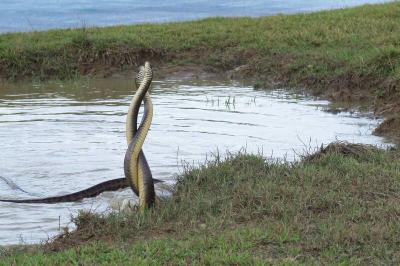
Kenting National Park service technician Yang Jien-fon (楊政峰) won a silver award in World Grand Prix Photography Awards Spring Season for his photograph of two male rat snakes intertwined in combat. Yang’s colleagues at Kenting National Park said he is a master of nature photography who has been held back by his job in civil service. The awards accept entries in all four seasons across six categories: architectural and urban photography, black-and-white and fine art photography, commercial and fashion photography, documentary and people photography, nature and experimental photography, and mobile photography. Awards are ranked according to scores and divided into platinum, gold and
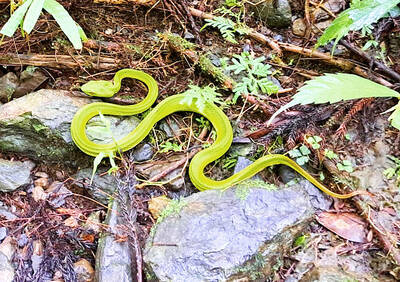
More than half of the bamboo vipers captured in Tainan in the past few years were found in the city’s Sinhua District (新化), while other districts had smaller catches or none at all. Every year, Tainan captures about 6,000 snakes which have made their way into people’s homes. Of the six major venomous snakes in Taiwan, the cobra, the many-banded krait, the brown-spotted pit viper and the bamboo viper are the most frequently captured. The high concentration of bamboo vipers captured in Sinhua District is puzzling. Tainan Agriculture Bureau Forestry and Nature Conservation Division head Chu Chien-ming (朱健明) earlier this week said that the
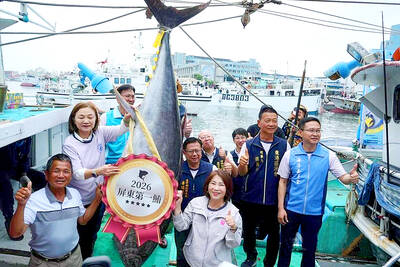
The first bluefin tuna of the season, brought to shore in Pingtung County and weighing 190kg, was yesterday auctioned for NT$10,600 (US$333.5) per kilogram, setting a record high for the local market. The auction was held at the fish market in Donggang Fishing Harbor, where the Siaoliouciou Island-registered fishing vessel Fu Yu Ching No. 2 delivered the “Pingtung First Tuna” it had caught for bidding. Bidding was intense, and the tuna was ultimately jointly purchased by a local restaurant and a local company for NT$10,600 per kilogram — NT$300 ,more than last year — for a total of NT$2.014 million. The 67-year-old skipper
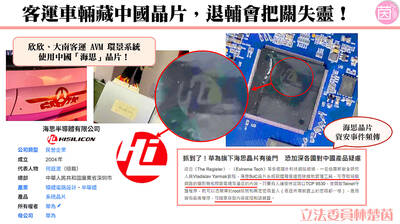
BREACH OF CONTRACT: The bus operators would seek compensation and have demanded that the manufacturer replace the chips with ones that meet regulations Two bus operators found to be using buses with China-made chips are to demand that the original manufacturers replace the systems and provide compensation for breach of contract, the Veterans Affairs Council said yesterday. Democratic Progressive Party Legislator Michelle Lin (林楚茵) yesterday said that Da Nan Bus Co and Shin-Shin Bus Co Ltd have fielded a total of 82 buses that are using Chinese chips. The bus models were made by Tron-E, while the systems provider was CYE Electronics, Lin said. Lin alleged that the buses were using chips manufactured by Huawei subsidiary HiSilicon Co, which presents a national security risk if the


 RSS
RSS