


Many clusters of coral off the northern coast have bleached due to higher seawater temperatures this year, an unprecedented occurrence in the area, Academia Sinica researcher Allen Chen (陳昭倫) said yesterday.
The large-scale coral bleaching documented off the coast of Yehliu (野柳) in New Taipei City’s Wanli District (萬里) is unusual, given that the area is generally considered a “shelter” for coral, with a relatively low seawater temperature of 27°C to 28°C in summer, he said.
A researcher at the institution’s Biodiversity Research Center, Chen and his laboratory members have monitored coral in the area since 2000.
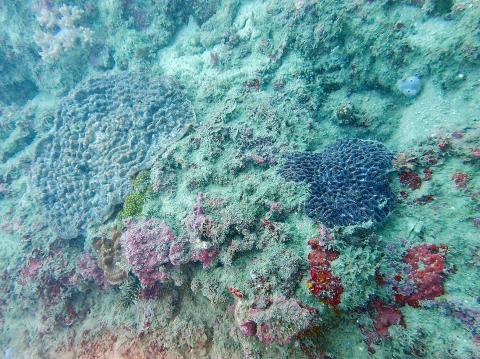
Photo courtesy of Tsai Yung-chun
Coral bleaching is caused by rising water temperatures and can be fatal for coral, Chen said.
Coral bleaching incidents in Taiwan have previously occurred at lower latitudes, such as off Kenting (墾丁) in Pingtung County, Green Island (綠島), Orchid Island (Lanyu, 蘭嶼) and the Pratas Islands (Dongsha Islands, 東沙群島), where the seawater is warmer, he said.
The average seawater temperature at 3m depth off Yehliu was 27.38°C from May to August in 2005, but in the same period this year, it was 28.36°C, Chen said.
The temperature last month even rose to 33°C, a 15-year record, he said.
“Even a 0.5°C temperature increase can make coral sick,” Chen said, adding that reefs at higher latitudes are more sensitive to warming.
Researchers found that 11 types of stony coral and soft coral in the area had bleached, with lace coral and hood coral most seriously affected, he said.
The bleaching might reverse as the weather becomes cooler and his team would keep monitoring the corals to see whether they show any signs of recovery, Chen said, adding that the team would publish its findings.
In related news, the coral off Pingtung has been reported to be more muddy than usual, with senior diving instructor Tsai Yung-chun (蔡永春) saying that he has never seen so much sediment in the area.
The Kenting National Park Management Office on Friday said that the mud was washed offshore by heavy rain last month, but would be swept away by sea currents.
The office said it would conduct an underwater inspection after the weather stabilizes and would continue to monitor land conservation efforts in neighboring areas.
Additional reporting by Tsai Tsung-hsien

Taipei and Kaohsiung have extended an open invitation to Japanese pop star Ayumi Hamasaki after Chinese authorities abruptly canceled her scheduled concert in Shanghai. Hamasaki, 47, had been slated to perform on Saturday before organizers pulled the show at the last minute, citing “force majeure,” a move widely viewed as retaliation for Japanese Prime Minister Sanae Takaichi’s recent remark that a Chinese attack on Taiwan could draw a military response from Tokyo. Taipei Mayor Chiang Wan-an (蔣萬安) yesterday said the city “very much welcomes” Hamasaki’s return and would continue to “surprise” her. Hamasaki, who has a large global fan base, including

Starting next month, people who signed up for the TPass 2.0 program can receive a 15 percent rebate for trips on mid to long-distance freeway buses or on buses headed to the east coast twice every month, the Highway Bureau said. Bureau Director-General Lin Fu-shan (林福山) said the government started TPass 2.0 to offer rebates to frequent riders of public transportation, or people who use city buses, highway buses, trains or MRTs at least 11 times per month. As of Nov. 12, 265,000 people have registered for TPass 2.0, and about 16.56 million trips between February and September qualified for
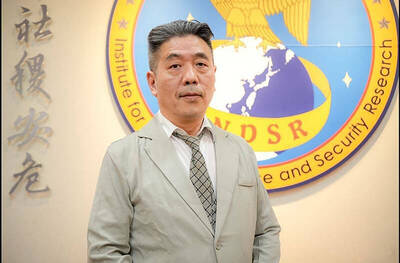
The year 2027 is regarded as the year China would likely gain the capability to invade Taiwan, not the year it would launch an invasion, Taiwanese defense experts said yesterday. The experts made the remarks after President William Lai (賴清德) told a news conference on Wednesday that his administration would introduce a NT$1.25 trillion (US$39.8 billion) special defense budget bill to boost Taiwan’s overall defense posture over the next eight years. Lai said that Beijing aims for military unification of Taiwan by 2027. The Presidential Office later clarified that what Lai meant was that China’s goal is to “prepare for military unification

HOW RUDE: Joe Biden’s Indo-Pacific defense chief condemned China’s response to Takaichi’s remarks as inappropriate and heavy-handed, while praising Japan’s nerve A former US defense official under former US president Joe Biden has voiced support for Japanese Prime Minister Sanae Takaichi for her remarks suggesting that Japan could help defend Taiwan, while describing Beijing’s response as “inappropriate.” Ely Ratner, who served as assistant secretary of defense for Indo-Pacific security affairs from 2021 to this year, said in a CNA interview that Takaichi’s comments on Taiwan simply reflected Japan’s position and stance on Taiwan. On Nov. 7, the Japanese prime minister commented in a parliamentary session that a Chinese attack on Taiwan could constitute “a situation threatening Japan’s survival” that could trigger a military


 RSS
RSS