


The US Department of State’s decision to summon its envoys to three Latin American nations signified growing concern over China’s influence in the region and the greater importance that Washington attaches to Taiwan, but it might complicate matters, two Taiwanese academics said on Sunday, adding that the outcome of the move was still uncertain.
US State Department spokesperson Heather Nauert in a statement on Friday said the department had summoned US Ambassador to the Dominican Republic Robin Bernstein, US Ambassador to El Salvador Jean Manes and US Charge d’Affaires in Panama Roxanne Cabral for “consultations related to recent decisions to no longer recognize Taiwan.”
The recall of an ambassador usually signifies that the situation is serious, said Ding Shuh-fan (丁樹範), an adjunct research fellow at National Chengchi University’s Institute of International Relations.
The department’s move reflects the US’ concerns over the expansion of China’s influence in Latin America, but it also shows that the US Congress’ interest in Latin America and its proposals in support of Taiwan have created pressure on the department, he said.
Taiwan’s relationships with each of the Latin American nations, as well as US-China relations, would become more complicated after US involvement, Ding said.
If China is willing to pay a higher price and continue poaching Taiwan’s Latin American allies, it would anger Congress, which might ask the State Department to consider establishing diplomatic relations with Taiwan, he added.
That would increase the possibility of the US and China entering into a new cold war and engaging in full-scale confrontation, Ding said.
However, if China slows its efforts to gain influence in Latin America, such a scenario would not develop, Ding said.
The department’s move shows that the US is attaching greater importance to Taiwan than it has in the past, said Soong Hseik-wen (宋學文), a professor at National Chung Cheng University’s Institute of Strategic and International Affairs.
Taiwan and China’s economies and national power are unequal and China has chosen to treat Taiwan aggressively, so the US would support Taiwan from the standpoint of a democratic ally, he said.
However, the most important reason for the US’s involvement is China’s influence stretching into its backyard, Soong said.
The US ordered the recall to protect its national interest, and tell China and Latin American nations that Washington would intervene against China’s bullying, he added.
However, Taiwan should not rely on the US or be pleased to see Washington and Beijing clash, he said.
Soong said he still hopes that Taiwan and China would resume dialogue and move in a peaceful direction.
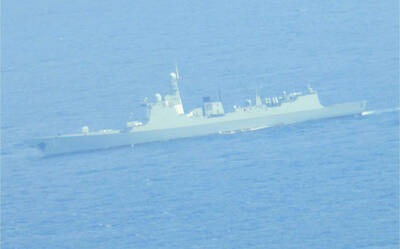
The military has spotted two Chinese warships operating in waters near Penghu County in the Taiwan Strait and sent its own naval and air forces to monitor the vessels, the Ministry of National Defense (MND) said. Beijing sends warships and warplanes into the waters and skies around Taiwan on an almost daily basis, drawing condemnation from Taipei. While the ministry offers daily updates on the locations of Chinese military aircraft, it only rarely gives details of where Chinese warships are operating, generally only when it detects aircraft carriers, as happened last week. A Chinese destroyer and a frigate entered waters to the southwest
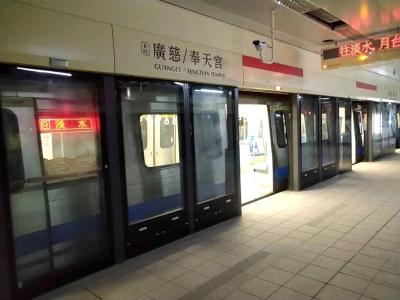
The eastern extension of the Taipei MRT Red Line could begin operations as early as late June, the Taipei Department of Rapid Transit Systems said yesterday. Taipei Rapid Transit Corp said it is considering offering one month of free rides on the new section to mark its opening. Construction progress on the 1.4km extension, which is to run from the current terminal Xiangshan Station to a new eastern terminal, Guangci/Fengtian Temple Station, was 90.6 percent complete by the end of last month, the department said in a report to the Taipei City Council's Transportation Committee. While construction began in October 2016 with an
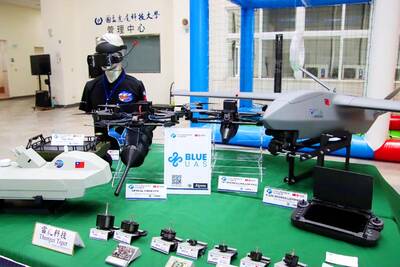
NON-RED SUPPLY: Boosting the nation’s drone industry is becoming increasingly urgent as China’s UAV dominance could become an issue in a crisis, an analyst said Taiwan’s drone exports to Europe grew 41.7-fold from 2024 to last year, with demand from Ukraine’s fight against Russian aggression the most likely driver of growth, a study showed. The Institute for Democracy, Society and Emerging Technology (DSET) in a statement on Wednesday said it found that many of Taiwan’s uncrewed aerial vehicle (UAV) sales were from Poland and the Czech Republic. These countries likely transferred the drones to Ukraine to aid it in its fight against the Russian invasion that started in 2022, it said. Despite the gains, Taiwan is not the dominant drone exporter to these markets, ranking second and fourth
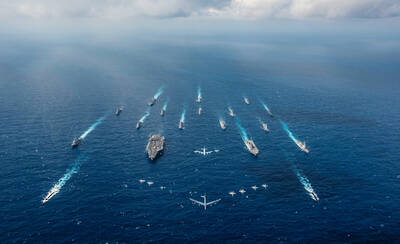
Japanese Prime Minister Sanae Takaichi’s comment last year on Tokyo’s potential reaction to a Taiwan-China conflict has forced Beijing to rewrite its invasion plans, a retired Japanese general said. Takaichi told the Diet on Nov. 7 last year that a Chinese naval blockade or military attack on Taiwan could constitute a “survival-threatening situation” for Japan, potentially allowing Tokyo to exercise its right to collective self-defense. Former Japan Ground Self-Defense Force general Kiyofumi Ogawa said in a recent speech that the remark has been interpreted as meaning Japan could intervene in the early stages of a Taiwan Strait conflict, undermining China’s previous assumptions


 RSS
RSS