


The Transitional Justice Commission has submitted its fiscal 2019 budget for legislative review, with items including overseas travel expenses to research transitional justice.
Budgets for all departments were submitted last week, with the Legislative Yuan scheduled to discuss them when it convenes this month.
The commission’s proposed budget of NT$160 million (US$5.21 million) includes NT$24.32 million for work related to the reconstruction of historical facts, NT$15.19 million for the elimination of authoritarian symbols, NT$23.17 million for reparations for judicial abuses and NT$18.95 million to rebuild public trust.
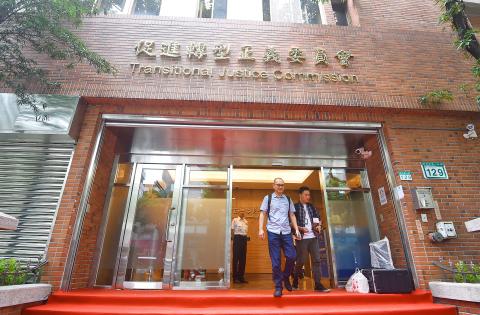
Photo: Liao Chen-huei, Taipei Times
A budget of NT$3.65 million was proposed for travel expenses related to the commission’s work, it said, adding that visits are planned to South Africa, the Czech Republic, Slovakia and Argentina, among others.
Among places to be visited are the Constitutional Court of South Africa, South Africa’s Institute for Justice and Reconciliation and the Argentine Supreme Court, which the commission hopes will help it understand the working of transitional justice laws and to apply the ideas in Taiwan, commission members said.
The commission has 70 members, including 51 regular committee members, nine supervisory staff members and 10 temporarily transferred employees.
Labor expenses are expected to be NT$58.23 million for next year.
Operational expenses would be NT$6.7 million, with one commission member each building one case file related to a political issue from 1945 to 1991.
The Ill-gotten Party Assets Settlement Committee also submitted a fiscal 2019 budget, requesting NT$52.9 million.
The committee has frozen NT$72.5 billion in allegedly ill-gotten assets held by the Chinese Nationalist Party (KMT) and its affiliated organizations, which Premier William Lai (賴清德) has said is one of the administration’s four major achievements.
The committee is to employ 25 members, whose combined salaries for 2019 are budgeted at NT$30.68 million, the committee said.
“The assets committee’s budget is extremely low, even lower than the Ministry of National Defense’s budget for maintaining Chiang Kai-shek’s (蔣介石) Cihu Mausoleum (慈湖陵寢),” a committee member said, speaking on condition of anonymity.
The member said they hoped the public would not think the estimated labor expenses mean that each member would earn more than NT$1 million on average.
That would be unfair to junior committee members, they said, adding that if the committee encounters more organizations that need to be investigated, then it would not have enough employees to handle the case load.
The “small increase” in the committee’s budget this year over that submitted last year is due to the unavailability of alternative service conscripts next year, as well as a planned trip to Germany to learn about effective measures to investigate and handle ill-gotten assets, they said.

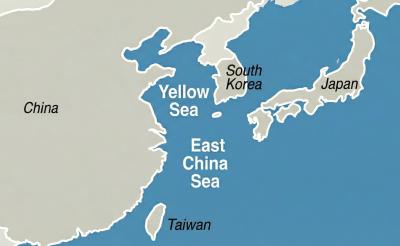
China has reserved offshore airspace in the Yellow Sea and East China Sea from March 27 to May 6, issuing alerts usually used to warn of military exercises, although no such exercises have been announced, the Wall Street Journal (WSJ) reported yesterday. Reserving such a large area for 40 days without explanation is an “unusual step,” as military exercises normally only last a few days, the paper said. These alerts, known as Notice to Air Missions (Notams), “are intended to inform pilots and aviation authorities of temporary airspace hazards or restrictions,” the article said. The airspace reserved in the alert is

South Korea is planning to revise its controversial electronic arrival card, a step Taiwanese officials said prompted them to hold off on planned retaliatory measures, a South Korean media report said yesterday. A Yonhap News Agency report said that the South Korean Ministry of Foreign Affairs is planning to remove the “previous departure place” and “next destination” fields from its e-arrival card system. The plan, reached after interagency consultations, is under review and aims to simplify entry procedures and align the electronic form with the paper version, a South Korean ministry official said. The fields — which appeared only on the electronic form
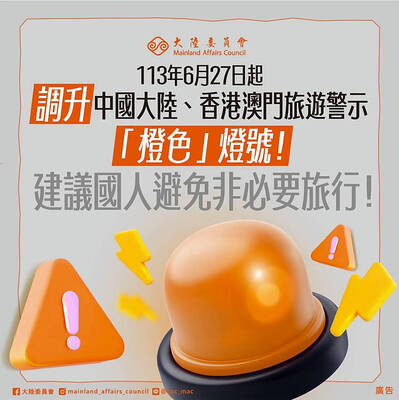
More than 6,000 Taiwanese students have participated in exchange programs in China over the past two years, despite the Mainland Affairs Council’s (MAC) “orange light” travel advisory, government records showed. The MAC’s publicly available registry showed that Taiwanese college and university students who went on exchange programs across the Strait numbered 3,592 and 2,966 people respectively. The National Immigration Agency data revealed that 2,296 and 2,551 Chinese students visited Taiwan for study in the same two years. A review of the Web sites of publicly-run universities and colleges showed that Taiwanese higher education institutions continued to recruit students for Chinese educational programs without

A bipartisan group of US senators has introduced a bill to enhance cooperation with Taiwan on drone development and to reduce reliance on supply chains linked to China. The proposed Blue Skies for Taiwan Act of 2026 was introduced by Republican US senators Ted Cruz and John Curtis, and Democratic US senators Jeff Merkley and Andy Kim. The legislation seeks to ease constraints on Taiwan-US cooperation in uncrewed aerial systems (UAS), including dependence on China-sourced components, limited access to capital and regulatory barriers under US export controls, a news release issued by Cruz on Wednesday said. The bill would establish a "Blue UAS


 RSS
RSS