


The Ministry of Health and Welfare yesterday said it is planning to set up 72 community dementia care centers in accordance with its policy document Taiwan Dementia Policy: A Framework for Prevention and Care 2.0.
The Taiwan Alzheimer Disease Association yesterday on the first day of World Alzheimer’s Month held its annual academic conference in Taipei, with Dementia Alliance International chairperson Kate Swaffer delivering a keynote speach.
According to alliance data, about 9.9 million people worldwide are diagnosed with dementia each year.
A study commissioned by the ministry between 2011 and 2013 said that more than 260,000 people in Taiwan have dementia.
The National Development Council has predicted that the number will continue to increase, doubling to about 550,000 people by 2036.
“As one of the estimated 50 billion people in the world living with dementia, my mission has become to ensure people with dementia are not told to go home and prepare to die, but are supported to live positively,” said Swaffer, who was diagnosed with the condition at age 49.
“It is imperative that we focus on the human rights of people with dementia and their families,” she said, adding that governments, healthcare practitioners and communities should not just provide care for people with dementia, but also help increase their quality of life and reduce stigma, shame and discrimination.
Citing her own experience of having her driver’s license revoked, and healthcare practitioners advising her to quit her job and prepare for long-term care at a specialized care center, Swaffer said that those who advised her might have had good intentions, but they showed a common bias, assuming that people with dementia cannot make decisions on their own.
Taiwan has made efforts to protect the rights of people with dementia and the ministry launched its dementia policy in December last year, but dementia policies must be made in consideration of patients’ abilities and rights, helping them live positively and contribute to the society, she said.
Deputy Minister of Health and Welfare Hsueh Jui-yuan (薛瑞元) said the Taiwan Dementia Policy 2.0 would reference the Convention on the Rights of Persons with Disabilities to establish proper action plans.
The ministry is also planning to establish 72 dementia care centers so that people in early stages of dementia can receive care and counseling services in their communities, he said.
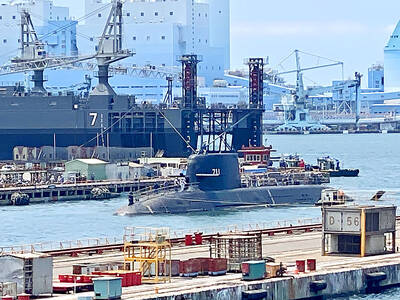
AGING: While Japan has 22 submarines, Taiwan only operates four, two of which were commissioned by the US in 1945 and 1946, and transferred to Taiwan in 1973 Taiwan would need at least 12 submarines to reach modern fleet capabilities, CSBC Corp, Taiwan chairman Chen Cheng-hung (陳政宏) said in an interview broadcast on Friday, citing a US assessment. CSBC is testing the nation’s first indigenous defense submarine, the Hai Kun (海鯤, Narwhal), which is scheduled to be delivered to the navy next month or in July. The Hai Kun has completed torpedo-firing tests and is scheduled to undergo overnight sea trials, Chen said on an SET TV military affairs program. Taiwan would require at least 12 submarines to establish a modern submarine force after assessing the nation’s operational environment and defense

A white king snake that frightened passengers and caused a stir on a Taipei MRT train on Friday evening has been claimed by its owner, who would be fined, Taipei Rapid Transit Corp (TRTC) said yesterday. A person on Threads posted that he thought he was lucky to find an empty row of seats on Friday after boarding a train on the Bannan (Blue) Line, only to spot a white snake with black stripes after sitting down. Startled, he jumped up, he wrote, describing the encounter as “terrifying.” “Taipei’s rat control plan: Release snakes on the metro,” one person wrote in reply, referring
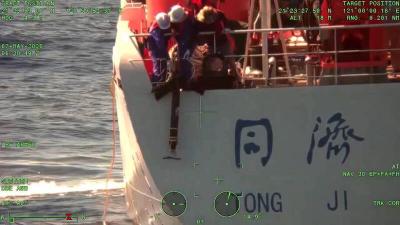
The coast guard today said that it had disrupted "illegal" operations by a Chinese research ship in waters close to the nation and driven it away, part of what Taipei sees a provocative pattern of China's stepped up maritime activities. The coast guard said that it on Thursday last week detected the Chinese ship Tongji (同濟號), which was commissioned only last year, 29 nautical miles (54km) southeast of the southern tip of Taiwan, although just outside restricted waters. The ship was observed lowering ropes into the water, suspected to be the deployment of scientific instruments for "illegal" survey operations, and the coast
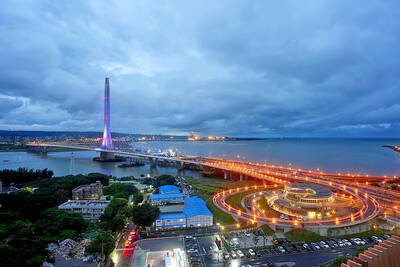
An inauguration ceremony was held yesterday for the Danjiang Bridge, the world’s longest single-mast asymmetric cable-stayed bridge, ahead of its official opening to traffic on Tuesday, marking a major milestone after nearly three decades of planning and construction. At the ceremony in New Taipei City attended by President William Lai (賴清德), Premier Cho Jung-tai (卓榮泰), Minister of Transportation and Communications Chen Shih-kai (陳世凱) and New Taipei City Mayor Hou Yu-ih (侯友宜), the bridge was hailed as both an engineering landmark and a long-awaited regional transport link connecting Tamsui (淡水) and Bali (八里)


 RSS
RSS