


Taichung Bo-Ai Elementary School principal Ku Chin-yi (古金益) on Monday spoke about sharing Aboriginal culture through an exhibition of his ink-wash paintings at George Washington University in Washington.
The “Taiwan, a Beautiful Landscape” solo exhibition featuring 23 of Ku’s paintings was hosted from July 26 to Aug. 3 by the Global Taiwan Institute, a US non-profit policy incubator.
Also known by his Aboriginal name, Temi Minu, Ku has studied painting for more than 20 years and is one of the few ink-wash painters in Taiwan who focuses on Aboriginal subjects.
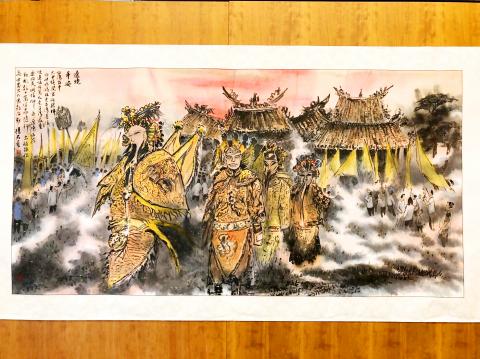
Photo courtesy of Ku Chin-yi
Among the paintings that were exhibited at the university’s Elliott School of International Affairs was Dajia Matsu Pilgrimage (大甲媽祖遶境), a painting inspired by the annual nine-day event.
In Bu Jian Shan Lin (不見山林), Ku portrays the struggles with identity and adaptation that Aborigines face when they attend schools outside their communities, while in Ode to Kinmen (金門頌), Ku highlights the county’s culture through its history as a former battleground.
Ku said he has always believed that a so-called “international perspective” is simply an extension of local culture.
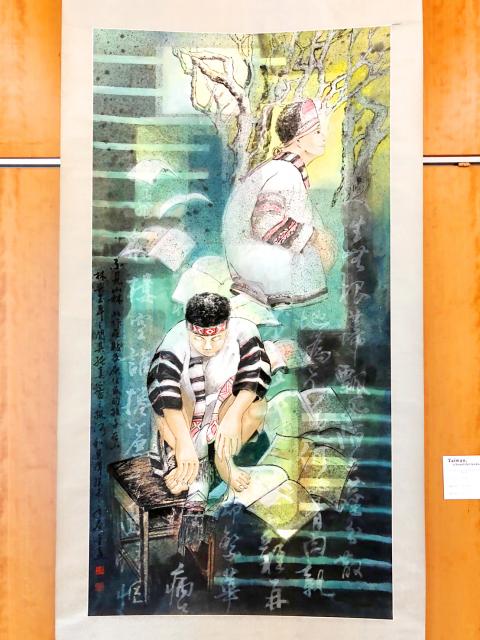
Photo courtesy of Ku Chin-yi
He has always been proud of being a Taiwanese Aborigine and considers it a responsibility to bring his artwork, which represents local art and culture, to the US, he said.
He is pleased that through the exhibition, people from other nations were able to witness the beauty of Taiwan and learn about the nation’s “most beautiful minority group,” he said, adding that he hopes to focus on uniquely Aboriginal topics.
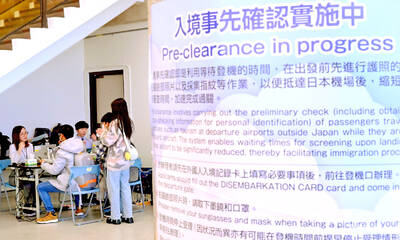
A preclearance service to facilitate entry for people traveling to select airports in Japan would be available from Thursday next week to Feb. 25 at Taiwan Taoyuan International Airport, Taoyuan International Airport Corp (TIAC) said on Tuesday. The service was first made available to Taiwanese travelers throughout the winter vacation of 2024 and during the Lunar New Year holiday. In addition to flights to the Japanese cities of Hakodate, Asahikawa, Akita, Sendai, Niigata, Okayama, Takamatsu, Kumamoto and Kagoshima, the service would be available to travelers to Kobe and Oita. The service can be accessed by passengers of 15 flight routes operated by

Chinese spouse and influencer Guan Guan’s (關關) residency permit has been revoked for repeatedly posting pro-China videos that threaten national security, the National Immigration Agency confirmed today. Guan Guan has said many controversial statements in her videos posted to Douyin (抖音), including “the red flag will soon be painted all over Taiwan” and “Taiwan is an inseparable part of China,” and expressing hope for expedited reunification. The agency last year received multiple reports alleging that Guan Guan had advocated for armed reunification. After verifying the reports, the agency last month issued a notice requiring her to appear and explain her actions. Guan

GIVE AND TAKE: Blood demand continues to rise each year, while fewer young donors are available due to the nation’s falling birthrate, a doctor said Blood donors can redeem points earned from donations to obtain limited edition Formosan black bear travel mugs, the Kaohsiung Blood Center said yesterday, as it announced a goal of stocking 20,000 units of blood prior to the Lunar New Year. The last month of the lunar year is National Blood Donation Month, when local centers seek to stockpile blood for use during the Lunar New Year holiday. The blood demand in southern Taiwan — including Tainan and Kaohsiung, as well as Chiayi, Pingtung, Penghu and Taitung counties — is about 2,000 units per day, the center said. The donation campaign aims to boost
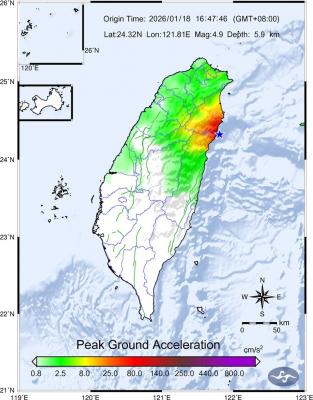
The Central Weather Administration (CWA) said a magnitude 4.9 earthquake that struck off the coast of eastern Taiwan yesterday was an independent event and part of a stress-adjustment process. The earthquake occurred at 4:47pm, with its epicenter at sea about 45.4km south of Yilan County Hall at a depth of 5.9km, the CWA said. The quake's intensity, which gauges the actual effects of a temblor, was highest in several townships in Yilan and neighboring Hualien County, where it measured 4 on Taiwan's seven-tier intensity scale, the CWA said. Lin Po-yu (林柏佑), a division chief at the CWA's Seismological Center, told a news conference


 RSS
RSS