


A system to supply water to Kinmen from China’s Fujian Province is to begin operations today with two simultaneous ceremonies, following a national security official’s remarks yesterday that China is trying to split Taiwanese apart using carrot-and-stick tactics.
The Mainland Affairs Council (MAC) late last month asked the Kinmen County Government to delay its ceremony after Beijing pressured the East Asian Olympic Committee into revoking Taichung’s right to host the first East Asian Youth Games next year.
The county government decided to hold the ceremony as scheduled, but said that it would tone down the event’s political effects by downgrading it to a “ritual.”
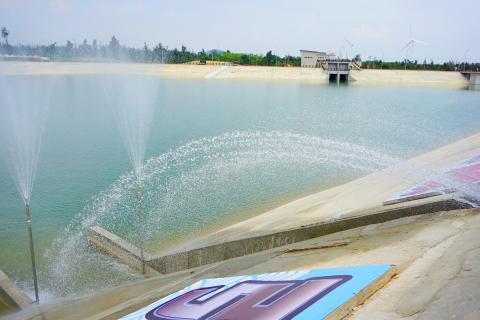
Photo: CNA
While the central government does not plan to send any officials to the event, China’s Taiwan Affairs Office Minister Liu Jieyi (劉結一) is reportedly planning to attend the counterpart ceremony in Fujian’s Jinjiang, along with nearly 100 members of the Chinese media.
“Who needs a ceremony? Who needs propaganda? The answers to those questions are obvious,” a national security official said yesterday on condition of anonymity, adding that China surely timed the ceremony to fit in with its strategy to restrict Taiwan’s international space.
The ceremony is a good opportunity for Beijing to extend its goodwill to Taiwanese after it stripped Taichung of the right to host the Games, the official said.
Raising concern about Kinmen’s increasing reliance on China, the official suggested that more national security measures be implemented in the county.
Separately, the Ministry of Economic Affairs’ Water Resources Agency said in a statement on Friday that the water supply system is a commercial arrangement between Kinmen and Jinjiang, and that staging a ceremony would not affect its operations.
The project was approved by the Executive Yuan in 2014, the agency said, adding that its underwater pipelines cost NT$1.35 billion (US$43.97 million), 85 percent of which was provided by the central government, while the county government paid for the remainder.
The contract between Kinmen County Waterworks and Fujian Water Supply Co stipulates that the county would purchase water at NT$9.86 per cubic meter, but it does not say anything about a ceremony, the agency said.
The council said that it shares the same stance as the county government regarding the water supply system, but it cannot accept Beijing’s “united front” tactics to split Taiwanese party.
To defend the nation’s interests and dignity, the county government should still postpone the ceremony, given that it is not directly related to the water supply, it added.

LOUD AND PROUD Taiwan might have taken a drubbing against Australia and Japan, but you might not know it from the enthusiasm and numbers of the fans Taiwan might not be expected to win the World Baseball Classic (WBC) but their fans are making their presence felt in Tokyo, with tens of thousands decked out in the team’s blue, blowing horns and singing songs. Taiwanese fans have packed out the Tokyo Dome for all three of their games so far and even threatened to drown out home team supporters when their team played Japan on Friday. They blew trumpets, chanted for their favorite players and had their own cheerleading squad who dance on a stage during the game. The team struggled to match that exuberance on the field, with
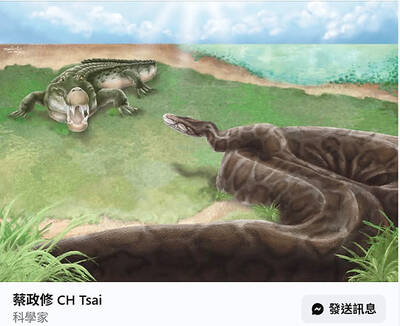
Taiwanese paleontologists have discovered fossil evidence that pythons up to 4m long inhabited Taiwan during the Pleistocene epoch, reporting their findings in the international scientific journal Historical Biology. National Taiwan University (NTU) Institute of Ecology and Evolutionary Biology associate professor Tsai Cheng-hsiu (蔡政修) led the team that discovered the largest snake fossil ever found in Taiwan. The single trunk vertebra was discovered in Tainan at the Chiting Formation, dated to between 400,000 and 800,000 years ago in the Middle Pleistocene, the paper said. The area also produced Taiwan’s first avian fossil, as well as crocodile, mammoth, saber-toothed cat and rhinoceros fossils, it said. Discoveries

Taiwanese paleontologists have discovered fossil evidence that pythons up to 4m long inhabited Taiwan during the Pleistocene epoch, reporting their findings in the international scientific journal Historical Biology. National Taiwan University (NTU) Institute of Ecology and Evolutionary Biology associate professor Tsai Cheng-hsiu (蔡政修) led the team that discovered the largest snake fossil ever found in Taiwan. A single trunk vertebra was discovered in Tainan at the Chiting Formation, dated to between 800,000 to 400,000 years ago in the Middle Pleistocene, the paper said. The area also produced Taiwan’s first avian fossil, as well as crocodile, mammoth, sabre-toothed cat and rhinoceros fossils, it said. Discoveries

Whether Japan would help defend Taiwan in case of a cross-strait conflict would depend on the US and the extent to which Japan would be allowed to act under the US-Japan Security Treaty, former Japanese minister of defense Satoshi Morimoto said. As China has not given up on the idea of invading Taiwan by force, to what extent Japan could support US military action would hinge on Washington’s intention and its negotiation with Tokyo, Morimoto said in an interview with the Liberty Times (sister paper of the Taipei Times) yesterday. There has to be sufficient mutual recognition of how Japan could provide


 RSS
RSS