


The Executive Yuan’s Ill-gotten Party Assets Settlement Committee will continue its normal operations and do its utmost to defend the Act Governing the Handling of Ill-gotten Properties by Political Parties and Their Affiliate Organizations (政黨及其附隨組織不當取得財產處理條例) after the Supreme Administrative Court on Thursday ordered a constitutional interpretation to proceed, it said.
The court dismissed the committee’s appeal of a ruling by the Taipei High Administrative Court in June that questioned the constitutionality of the committee’s foundational act.
The Taipei High Administrative Court suspended legal proceedings in three cases brought by Central Investment Co (中央投資), Hsinyutai Co (欣裕台) and the Chinese Nationalist Party (KMT) against the committee’s November 2016 finding that the two companies are KMT affiliates until a constitutional interpretation on the matter is issued.
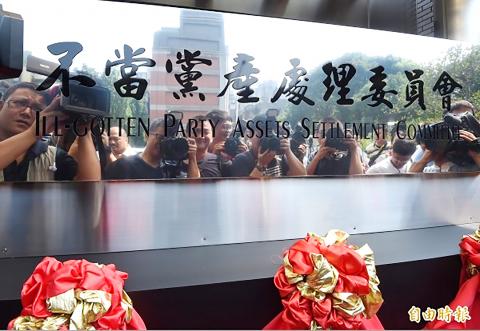
Photo: Chen Yu-fu, Taipei Times
The high administrative court issued the ruling as it finished preparing the cases petitioning the court to revoke the committee’s finding.
“We will actively confront this constitutional interpretation case. We will prepare to defend the act and continue to do what is expected of the committee before a conclusion is reached in the case,” committee spokeswoman Shih Chin-fang (施錦芳) said.
The KMT has full ownership of both Central Investment Co and Hsinyutai Co, Shih said, adding: “If those are not affiliates of the party, then what is?”
The committee filed its appeal in protest against the high administrative court’s decision to suspend proceedings without giving it a chance to present its views and arguments by requesting a constitutional interpretation, Shih said.
“That said, we respect the court’s authority and its right to seek a constitutional interpretation,” she added.
Asked whether the committee has prepared itself for the possibility that the act could be ruled unconstitutional, Shih answered in the negative.
“The act is part of the government’s effort to achieve transitional justice and is designed to ensure a level playing field for all parties,” Shih said.
Since the committee’s establishment in August 2016, it has uncovered historical documents that shed light on how the KMT intervened in the government during the authoritarian period and how it managed to illegitimately obtain assets in the process, Shih said.
“These investigative findings will be made public at future public hearings. We will also present them in lawsuits and during the procedure of a possible constitutional interpretation case,” she said, adding that the committee would not stop what it is doing simply because of this legal predicament.
With regard to a request for a constitutional interpretation in March by Control Yuan members, Shih said that the Council of Grand Justices is still mulling whether to accept the case, as it could go against the principle of the separation of powers between the government’s five branches.
In addition to Central Investment Co and Hsinyutai Co, the committee has so far also identified the National Women’s League, the National Development Foundation (國家發展基金會), the Minchuan Foundation (民權基金會) and the Mintsu Foundation (民族基金會) as KMT-affiliated organizations.
The league was founded in 1950 by former president Chiang Kai-shek’s (蔣介石) wife Soong Mayling (宋美齡), who led it for decades, while the three foundations were founded in 2015 under then-KMT chairman Eric Chu (朱立倫), who funded each with NT$30 million (US$977,008) from Hsinyutai Co.
The committee has also ordered the KMT to pay about NT$2 billion in compensation, including NT$1.139 billion for selling its former headquarters on Taipei’s Zhongshan S Road, facing the Presidential Office Building, to the Chang Yung-fa Foundation, and NT$864 million for selling 458 properties appropriated from the Japanese colonial government.

FUKUOKA SITUATION: Japanese media reported that the pathogen is expected to be identified by the summer, while the CDC downplayed the idea that it was hMPV A “mysterious cold-like illness” reported in Japan’s Fukuoka Prefecture does not seem to be a new disease, but Japanese authorities have been asked about the situation, the Centers for Disease Control (CDC) said yesterday. The Fukuoka Prefectural Medical Association on Wednesday told a news conference that a “mystery cold” that has become a hot topic on social media is “highly likely to be caused by some kind of viral infection,” Japan’s KBC News reported. “Many people are experiencing symptoms starting with a sore throat, followed by a runny nose, phlegm and a severe cough,” KBC News reported, citing association officials. Health authorities are

Nvidia Corp CEO Jensen Huang (黃仁勳) arrived in Taiwan yesterday ahead of upcoming AI and technology events, saying he plans to meet with clients and Taiwan Semiconductor Manufacturing Co Chairman C.C. Wei (魏哲家) during his visit. After landing at Taipei Songshan Airport, Huang posed for photos with fans and handed out Yakult drinks to reporters and supporters waiting at the scene, saying he has “a lot to do” during the trip. Asked about reports that Nvidia’s planned headquarters site in Taipei’s Beitou Shilin Technology Park could break ground on May 27, Huang said that if the company holds an event, he would

Carrefour Taiwan is to begin using a new name from the start of July, but it cannot divulge the name until then, the chairman of the supermarket chain's parent company said today. President Chain Store Co chairman Lo Chih-hsien (羅智先) was asked by reporters after a shareholders' meeting to confirm whether the company has settled on a new name for the supermarket brand. In March, the government-registered name of two Carrefour Taiwan branches was quietly changed to "Le Chia Kang" (樂家康) in Chinese, raising speculation that has been selected as the name. Lo said that because of local regulations and contractual obligations, the
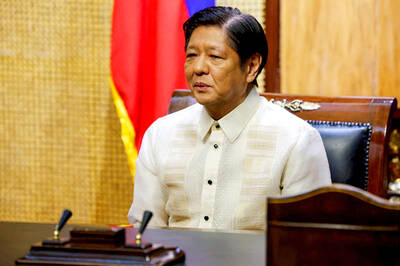
The Philippines would likely be involved in any conflict over Taiwan due to its proximity to the democracy claimed by China, President Ferdinand Marcos Jr said, reiterating a stance that risks angering Beijing. “In the Philippines, we do not have a choice because Taiwan is so close to the Philippines and we have almost 200,000 Filipino nationals living and working in Taiwan,” Marcos said in an interview with Japanese media in Manila on Monday. The Philippine leader’s comments come ahead of a state visit to Japan next week, where he is to meet with Japanese Prime Minister Sanae Takaichi to discuss security


 RSS
RSS