


A series of services and applications to facilitate the development of the nation’s green energy industry were launched by the Central Weather Bureau (CWB) and the Bureau of Energy yesterday.
The Meteorological Information-based Green Energy Operations Center Web site, which allows green energy operators to try the applications, was also launched.
The government has been actively promoting the use of solar energy, offshore wind energy and other renewable energy sources, CWB technology center director Lin Hsi-ming said.
Last year, 46.8 percent of electricity in the nation was generated by burning coal, followed by natural gas at 34.7 percent, Lin said, adding that renewable energy accounted for only 4.5 percent.
The government wants to elevate the contribution from renewable energy sources to 20 percent by 2025, Lin said.
Among renewable energy sources, 44.5 percent is generated by hydroelectric facilities, while wind and solar energy account for 14 percent and 13.9 percent respectively, so there is plenty of room to grow, Lin said.
Weather plays an important role in how wind and solar energy operators choose sites for power generators and how they forecast the amount of electricity needed to be generated, Lin said, adding that such information is also critical in helping operators dispatch power.
“The services developed by the two government agencies include an application to help green energy operators identify the locations with the highest green power density, which can be used as a reference when they need to choose sites for power generators,” Lin said.
Another app forecasts the green power that can be generated, which is used to assess the reliability of solar and wind energy over the subsequent three to seven days, Lin said.
This would also help the operators dispatch power and provide value-added services using smart grids, Lin said.
Industrial Technology Research Institute senior researcher Yen Chieh-cheng (顏厥正) said that the Bureau of Energy has developed an offshore power assessment system for different models of wind power generators to help operators decide how they want to arrange power generators in a wind farm.
It has also developed a system that allows power operators to dispatch and track wind power maintenance ships by combining information on the weather and shipping to help operators reduce maintenance costs, Yen said.
The Web site provides three types of information on wind and solar energy: historical averages, surveillance analyses and forecasts, the weather bureau said.
Preliminary analyses found that the ideal places to develop solar energy in the nation are the coastal areas in Yunlin and Chiayi counties as well as Tainan, which is the optimal location, the CWB said.
Wind energy can be developed off the coasts of Taichung and Miaoli and Changhua counties, as well as Oluanpi (鵝鑾鼻) in Pingtung County, it said.

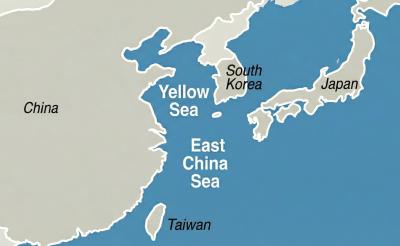
China has reserved offshore airspace in the Yellow Sea and East China Sea from March 27 to May 6, issuing alerts usually used to warn of military exercises, although no such exercises have been announced, the Wall Street Journal (WSJ) reported yesterday. Reserving such a large area for 40 days without explanation is an “unusual step,” as military exercises normally only last a few days, the paper said. These alerts, known as Notice to Air Missions (Notams), “are intended to inform pilots and aviation authorities of temporary airspace hazards or restrictions,” the article said. The airspace reserved in the alert is

NAMING SPAT: The foreign ministry called on Denmark to propose an acceptable solution to the erroneous nationality used for Taiwanese on residence permits Taiwan has revoked some privileges for Danish diplomatic staff over a Danish permit that lists “Taiwan” as “China,” Eric Huang (黃鈞耀), head of the Ministry of Foreign Affairs’ Department of European Affairs, told a news conference in Taipei yesterday. Reporters asked Huang whether the Danish government had responded to the ministry’s request that it correct the nationality on Danish residence permits of Taiwanese, which has been listed as “China” since 2024. Taiwan’s representative office in Denmark continues to communicate with the Danish government, and the ministry has revoked some privileges previously granted to Danish representatives in Taiwan and would continue to review

More than 6,000 Taiwanese students have participated in exchange programs in China over the past two years, despite the Mainland Affairs Council’s (MAC) “orange light” travel advisory, government records showed. The MAC’s publicly available registry showed that Taiwanese college and university students who went on exchange programs across the Strait numbered 3,592 and 2,966 people respectively. The National Immigration Agency data revealed that 2,296 and 2,551 Chinese students visited Taiwan for study in the same two years. A review of the Web sites of publicly-run universities and colleges showed that Taiwanese higher education institutions continued to recruit students for Chinese educational programs without
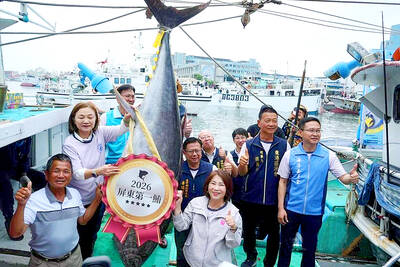
The first bluefin tuna of the season, brought to shore in Pingtung County and weighing 190kg, was yesterday auctioned for NT$10,600 (US$333.5) per kilogram, setting a record high for the local market. The auction was held at the fish market in Donggang Fishing Harbor, where the Siaoliouciou Island-registered fishing vessel Fu Yu Ching No. 2 delivered the “Pingtung First Tuna” it had caught for bidding. Bidding was intense, and the tuna was ultimately jointly purchased by a local restaurant and a local company for NT$10,600 per kilogram — NT$300 ,more than last year — for a total of NT$2.014 million. The 67-year-old skipper


 RSS
RSS