


Taiwan’s lack of free-trade agreements (FTA) with several Southeast Asian countries, including Thailand, has been seen as a challenge for President Tsai Ing-wen’s (蔡英文) New Southbound Policy. What do you think could be done to facilitate the signing of an FTA between Taiwan and Thailand?
Thongchai Chasawath: This matter concerns many political factors, so it is a bit tricky for us to sign an FTA with Taiwan. That does not only go for Thailand; you also face a similar problem with many other countries.
So what should we do? There are actually many other things that we can do. We should not limit our ideas to a fixed framework or box.
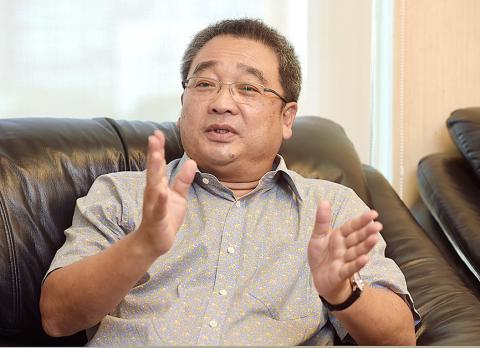
Photo: Huang Yao-cheng, Taipei Times
Despite the lack of an FTA with us, Taiwan can still take advantage of the platform provided by APEC or invest in Thailand. If you think it is beneficial to you, you can also consider offering one-way incentives.
Why hold back from this option simply because Thailand cannot offer you the same thing in return? There should be some flexibility.
Taiwan recently extended its trial period of visa-free privileges for Thai nationals for another year. Your predecessor last year indicated that there was a possibility of a reciprocal measure. What is the latest development?
Chasawath: Many people have asked me about this, but we have our considerations. To be honest, Taiwan is also benefiting from its measure to grant Thai citizens visa-free entry.
You must have come to that decision after realizing the potential benefits. If that is the case, why make Thailand offer reciprocal treatment? Why [say that] the visa-free arrangement could be canceled next year if we do not? If you cancel it, the number of Thai tourists to Taiwan could plummet by 150,000.
You should simply do what you think is best for your people and there is no need to ask for reciprocity.
The same is the case in Thailand: We offer visa-free privileges to more than 70 nations, while our own people enjoy visa-free entry to just more than 30 countries, but we do not make a fuss about this.
Another thing I want to point out is that the provision of visa-free privileges will inevitably have some downsides, such as illegal immigrants and undocumented workers. However, those only account for a fraction of the whole and we should avoid giving up the entire forest just for one tree.
Is Thailand mulling offering alternative visa privileges to Taiwanese?
Chasawath: Taiwanese can expect a huge change in the application process for Thai visas in September.
Starting in early or mid-September, while the application times at my office will remain the same, we will begin outsourcing the work to a private firm. The firm is to set up service centers in Taipei and Kaohsiung, where they will accept applications from 9am to 5pm.
They will charge a service fee of about NT$400 to NT$500 per case, but it is certainly better than taking a leave of absence to come down here [to the Thailand Trade and Economic Office] and waiting in line for hours.
We are also going digital. The firm to which we are outsourcing the process is also building a system, that is expected to be ready by the end of this year, but I am hoping for September. The system will allow applicants to fill out their applications online and then mail their passports to us. They will also be able to track the location of their passport and the status of their application.
You assumed the post in Taipei in April. Could you tell us a bit about your background?
Chasawath: I started learning Mandarin in college and I was posted to China for 12 years.
I actually requested the posting to Taiwan. One of the reasons was that I believed Taiwan would be an interesting place to work in, given the longstanding relationship between Taiwan and Thailand.
Also, Taiwan is further than Thailand in its development, so it would be nice to come here and see what we can learn from Taiwan. At the same time, there are also issues where our Taiwanese friends can benefit from Thailand’s experiences.
Take the tourism industry, for example: your convenient public transportation system and all-in-one travel cards, something Thailand has yet to have.
I have told many high-level Taiwanese officials that Taiwan is also a food paradise and they should promote it as one of your strong suits.
In my “outside in” view, air travel could be another one of Taiwan’s strong suits, considering its important geographical location. This is probably an advantage that we share. Thailand is the most suitable transit hub between Europe and Asia and I think Taiwan can be an extremely convenient hub between Asia and the US.
In what other areas could Taiwan and Thailand learn from each other?
Chasawath: I think agricultural technology is another area. For example, although Thailand and Taiwan do not produce exactly the same kinds of fruits, I would say that 70 percent of them are identical. We also both produce rice, albeit different varieties.
Taiwan has been doing well in the area of [agricultural] technology development, especially technologies used for preservation, which is something that Thailand really needs.
We can also have exchanges on the livestock industry. Taiwan has a clear policy direction regarding this industry, while Thailand needs to make some changes.
For instance, the meat quality of the cattle we rear can hardly compete with that of Australian or Japanese cattle. So when we try to sell our meat to them, the wealthy do not buy it, because they are after the prime cuts, and the less well-off also do not buy it, because they still consider it too expensive.
Taiwanese know about this and you came up with something called “warm beef” (溫體牛) [beef from Taiwanese cattle served on the day of slaughter, with the meat still warm from the cow’s natural body temperature]. This kind of flexible adjustment is something that we should learn from.
What are your goals for Taiwan-Thailand ties?
Chasawath: We should further promote our ties and enhance our mutual understanding of each other. We should not let certain factors drive us apart. We should also focus on the big picture, while exploring ways to bring people on both sides closer together and forging closer interactions in all areas.
However, words alone are ideological, so we must walk the talk. It is not difficult to realize these ideas, but we must learn to let certain things slide in the process.
Sometimes we tend to focus on our expenses and forget that we are also making money.
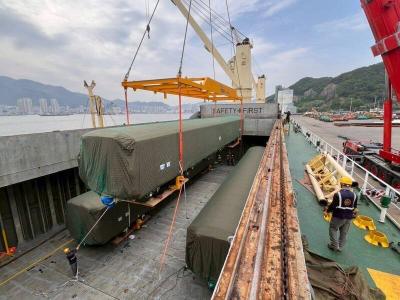
The first of 10 new high-capacity trains purchased from South Korea’s Hyundai Rotem arrived at the Port of Taipei yesterday to meet the demands of an expanding metro network, Taipei Rapid Transit Corp (TRTC) said yesterday. The train completed a three-day, 1,200km voyage from the Port of Masan in South Korea, the company said. Costing NT$590 million (US$18.79 million) each, the new six-carriage trains feature a redesigned interior based on "human-centric" transportation concepts, TRTC said. The design utilizes continuous longitudinal seating to widen the aisles and optimize passenger flow, while also upgrading passenger information displays and driving control systems for a more comfortable
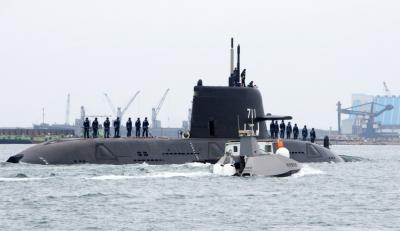
Taiwan's first indigenous defense submarine, the SS-711 Hai Kun (海鯤, or Narwhal), departed for its 13th sea trial at 7am today, marking its seventh submerged test, with delivery to the navy scheduled for July. The outing also marked its first sea deployment since President William Lai (賴清德) boarded the submarine for an inspection on March 19, drawing a crowd of military enthusiasts who gathered to show support. The submarine this morning departed port accompanied by CSBC Corp’s Endeavor Manta (奮進魔鬼魚號) uncrewed surface vessel and a navy M109 assault boat. Amid public interest in key milestones such as torpedo-launching operations and overnight submerged trials,
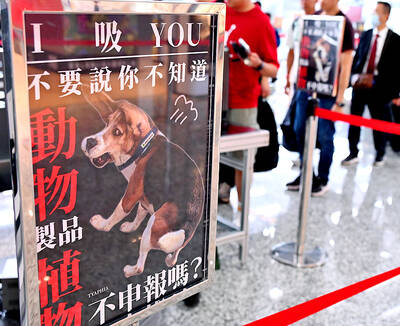
Quarantine awareness posters at Taiwan Taoyuan International Airport have gone viral for their use of wordplay. Issued by the airport branch of the Animal and Plant Health Inspection Agency, the posters feature sniffer dogs making a range of facial expressions, paired with advisory messages built around homophones. “We update the messages for holidays and campaign needs, periodically refreshing materials to attract people’s attention,” quarantine officials said. “The aim is to use the dogs’ appeal to draw focus to quarantine regulations.” A Japanese traveler visiting Taiwan has posted a photo on X of a poster showing a quarantine dog with a
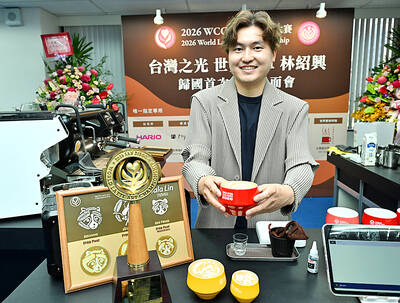
Taiwan’s coffee community has launched a “one-person-one-e-mail” campaign, calling for people to send a protest-e-mail to the World Coffee Championships (WCC) urging it to redesignate Taiwanese competitors as from “Taiwan,” rather than “Chinese Taipei.” The call followed sudden action last week after the WCC changed all references to Taiwanese competitors from “Taiwan” to “Chinese Taipei,” including recent World Latte Art champion Bala (林紹興), who won the World Latte Art Championship in San Diego earlier this month. When Bala received the trophy, he was referred to as representing Taiwan, as well as in the announcement on the WCC’s Web site, until it


 RSS
RSS