


Former premier Liu Chao-shiuan’s (劉兆玄) new book, Phantom (阿飄), marks the politician-writer’s first foray into science fiction and takes readers to “the dark side of Taiwan’s politics,” he said.
Liu has written several martial arts fiction series under the pseudonym Shang Kuan Ting (上官鼎).
“Having such topics introduced by, or in the presence of, an alien being, which represents a civilization with greater technology, can help with the delivery of otherwise sensitive information,” Liu said of his new book on an episode of CTV’s Change that aired yesterday.
He chose the book’s title hoping to match the “vibe” of the younger generation, so that they could reflect upon society instead of being politically apathetic, Liu said.
The book uses Liu’s experiences as premier from 2008 to 2009 under then-president Ma Ying-jeou’s (馬英九) administration and takes the reader through “the dark side of Taiwan’s politics,” the Chinese-language China Times quoted Liu as saying.
At its core, Phantom addresses concerns about the democratic system of governance.
“We as humans need to consider certain problems that come with the embrace of the democratic system, and the novel hopes to achieve that goal,” Liu said.
The loss of neutral voters’ rationality leads to a bipolar society of clashing populism, he added.
“What causes such bifurcation of society? Votes. The most effective method to bring about votes is money. Where does money come from? The last election?” Liu said.
Democracy has become a vicious cycle of voting and wealth, he said.
The biggest problem facing Taiwan’s democracy is “ballots in exchange for money, and money in exchange for ballots,” he said.
The characters in the novel are not meant to be an otherworldly reflection or shadow of actual politicians; rather, the familiarity of the characters is intentional, Liu said, adding that it makes for a better read as the disturbing aspects of reality that society takes for granted can be reflected upon.
Separately yesterday, an anonymous member of the Executive Yuan’s Ill-gotten Party Assets Settlement Committee said that the Chinese Nationalist Party’s (KMT) ill-gotten assets were the same as the “money in exchange for ballots” that Liu lamented in his book.
After the KMT’s retreat to Taiwan from China in 1949, its acquisition of assets formerly owned by the Japanese colonial government was what enabled the party to engage in the practice of “money in exchange for ballots,” the member said.
The KMT’s ill-gotten assets have tainted the nation’s democratic system of government and should be returned to the state as soon as possible, the member added.
Additional reporting by Chen Yu-fu

SECURITY: Starlink owner Elon Musk has taken pro-Beijing positions, and allowing pro-China companies to control Taiwan’s critical infrastructure is risky, a legislator said Starlink was reluctant to offer services in Taiwan because of the nation’s extremely high penetration rates in 4G and 5G services, the Ministry of Digital Affairs said yesterday. The ministry made the comments at a meeting of the legislature’s Transportation Committee, which reviewed amendments to Article 36 of the Telecommunications Management Act (電信管理法). Article 36 bans foreigners from holding more than 49 percent of shares in public telecommunications networks, while shares foreigners directly and indirectly hold are also capped at 60 percent of the total, unless specified otherwise by law. The amendments, sponsored by Chinese Nationalist Party (KMT) Legislator Ko
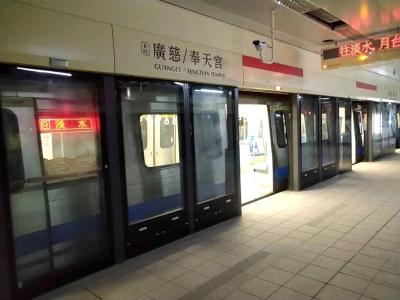
The eastern extension of the Taipei MRT Red Line could begin operations as early as late June, the Taipei Department of Rapid Transit Systems said yesterday. Taipei Rapid Transit Corp said it is considering offering one month of free rides on the new section to mark its opening. Construction progress on the 1.4km extension, which is to run from the current terminal Xiangshan Station to a new eastern terminal, Guangci/Fengtian Temple Station, was 90.6 percent complete by the end of last month, the department said in a report to the Taipei City Council's Transportation Committee. While construction began in October 2016 with an
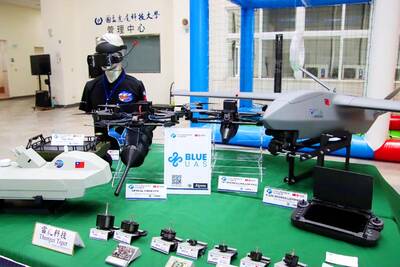
NON-RED SUPPLY: Boosting the nation’s drone industry is becoming increasingly urgent as China’s UAV dominance could become an issue in a crisis, an analyst said Taiwan’s drone exports to Europe grew 41.7-fold from 2024 to last year, with demand from Ukraine’s fight against Russian aggression the most likely driver of growth, a study showed. The Institute for Democracy, Society and Emerging Technology (DSET) in a statement on Wednesday said it found that many of Taiwan’s uncrewed aerial vehicle (UAV) sales were from Poland and the Czech Republic. These countries likely transferred the drones to Ukraine to aid it in its fight against the Russian invasion that started in 2022, it said. Despite the gains, Taiwan is not the dominant drone exporter to these markets, ranking second and fourth
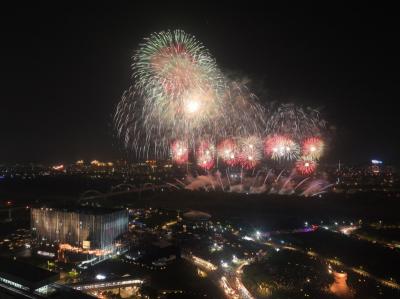
The New Taipei City Art Museum this weekend plans to celebrate its first anniversary with a two-day extravaganza featuring live concerts and a large-scale synchronized fireworks and drone display, the New Taipei City Cultural Affairs Department said. The two-day celebrations are to take place in the museum’s outdoor park, with markets and live performances by singers including Ann Bai (白安), Bii (畢書盡) and the Cosmos People (宇宙人), the department said. The highlight on both evenings would be the "Echoes of Light" show, an aerial spectacle combining fireworks and drone performances designed around the concept of "dual stages in the sky," it


 RSS
RSS