


The Transitional Justice Commission is reportedly targeting five cases for investigation: the murder of former Democratic Progressive Party (DPP) chairman Lin I-hsiung’s (林義雄) mother and twin daughters, the death of democracy advocate Chen Wen-chen (陳文成), the Lei Chen (雷震) incident, the Wuhan Hotel incident and the self-immolation of democracy advocate Deng Nan-jung (鄭南榕).
Before the commission was established, the National Archives Administration (NAA) was often denied access to politically sensitive documents by the Ministry of Justice’s Investigation Bureau (MJIB), the Criminal Investigation Bureau and other agencies, an unnamed government official said.
When the NAA requested documents relating to the murder of Lin’s family members, it was told that those documents did not exist, the source said.
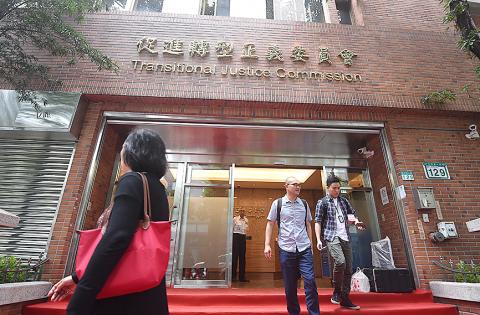
Photo: Liao Chen-huei, Taipei Times
After the commission stepped up, the MJIB handed over documents from the case for the first time since the murders took place in 1980, the source said.
However, the 20 boxes of documents had suffered water damage, the source said.
The bureau’s file room was flooded when Typhoon Nari hit Taiwan in 2001, but the commission is investigating whether the damage was really caused by the floods or whether they underwent “special treatment,” the source added.
Lin’s family members were stabbed to death at his house on Feb. 28, 1980. The murder remains unsolved, but is often thought to have been politically motivated because Lin was a leader of the democracy movement and was at the time detained following the Kaohsiung Incident.
A government official involved in the case said that the commission has also received a letter from an unidentified source providing clues in the case of Chen’s death.
The commission believes that the letter has a high degree of credibility, the official said, speaking on condition of anonymity.
The mailer appears to have information about the inner workings of the former Taiwan Garrison Command that the public does not know, the source said.
On July 3, 1981, Chen, a 31-year-old associate professor at Carnegie Mellon University, was found dead on a lawn at National Taiwan University a day after being detained for questioning by Taiwan Garrison Command officers.
Then-spokesperson of the Taiwan Garrison Command Hsu Mei-lin (徐梅鄰) and then-director of the Executive Yuan’s Department of Information Services Chu Tsung-ko (朱宗軻) said at a news conference at the time that garrison command officers sent Chen home after questioning and believed that he had committed suicide.
However, others said that Chen had died at the hands of the garrison command.
New clues have emerged that point to murder by the command, commission investigators said, adding that the case is awaiting further investigation.
Meanwhile, an investigation into the Wuhan Hotel incident, which occurred during the White Terror era, is to be opened at the request of the victims’ family.
In July 1959, Wuhan Hotel manager Yao Chia-chen (姚嘉薦) was found dead inside the hotel.
Police and prosecutors originally ruled it a suicide, but months later, the MJIB decided that Yao had been killed and seven people, including Huang Hsueh-wen (黃學文), Yang Hsun-chun (楊薰春) and National Taiwan University professor Chen Hua-chou (陳華洲) — who stayed at the hotel — were arrested and charged with murder.
The bureau allegedly tortured the seven to extract confessions that they were communist spies or murderers. Despite being convicted of murder and jailed, all seven repeatedly stated their innocence and appealed the sentence between 1960 and 1976.
The death, which started as a suicide case, became a murder case after the bureau became involved, former Control Yuan member Tao Pai-chuan (陶百川) said.
Research by Tao showed that then-president Chiang Kai-shek (蔣介石) targeted Lei’s friends to prevent Lei from forming a political party, he said.
Chen Hua-chou was reportedly a close ally of Lei, a high-ranking Chinese Nationalist Party (KMT) official and adviser to Chiang who was imprisoned for treason after he supported democratic reforms.
The commission’s investigations of cases that occurred under authoritarian rule would not be limited to these five cases, it said in a statement.
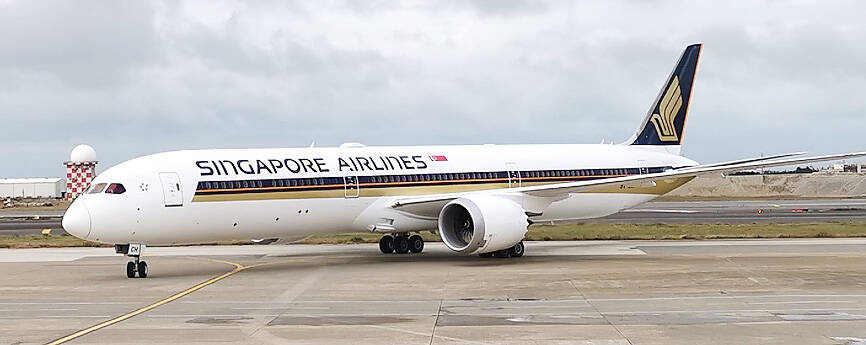
INCREASED CAPACITY: The flights on Mondays, Wednesdays, Fridays and Sundays would leave Singapore in the morning and Taipei in the afternoon Singapore Airlines is adding four supplementary flights to Taipei per week until May to meet increased tourist and business travel demand, the carrier said on Friday. The addition would raise the number of weekly flights it operates to Taipei to 18, Singapore Airlines Taiwan general manager Timothy Ouyang (歐陽漢源) said. The airline has recorded a steady rise in tourist and business travel to and from Taipei, and aims to provide more flexible travel arrangements for passengers, said Ouyang, who assumed the post in July last year. From now until Saturday next week, four additional flights would depart from Singapore on Monday, Wednesday, Friday
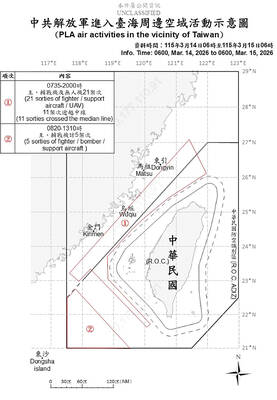
The Ministry of National Defense yesterday reported the return of large-scale Chinese air force activities after their unexplained absence for more than two weeks, which had prompted speculation regarding Beijing’s motives. China usually sends fighter jets, drones and other military aircraft around the nation on a daily basis. Interruptions to such routine are generally caused by bad weather. The Ministry of National Defense said it had detected 26 Chinese military aircraft in the Taiwan Strait over the previous 24 hours. It last reported that many aircraft on Feb. 25, when it spotted 30 aircraft, saying Beijing was carrying out another “joint combat
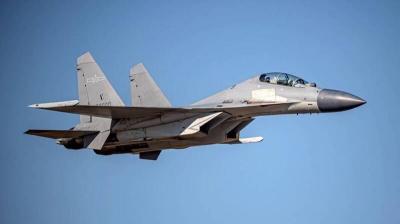
Eight Chinese naval vessels and 24 military aircraft were detected crossing the median line of the Taiwan Strait between 6am yesterday and 6am today, the Ministry of National Defense said this morning. The aircraft entered Taiwan’s northern, central, southwestern and eastern air defense identification zones, the ministry said. The armed forces responded with mission aircraft, naval vessels and shore-based missile systems to closely monitor the situation, it added. Eight naval vessels, one official ship and 36 aircraft sorties were spotted in total, the ministry said.

Taiwan successfully defended its women’s 540 kilogram title and won its first-ever men’s 640 kg title at the 2026 World Indoor Tug of War Championships in Taipei yesterday. In the women’s event, Taiwan’s eight-person squad reached the final following a round-robin preliminary round and semifinals featuring teams from Ukraine, Japan, Thailand, Vietnam, the Basque Country and South Korea. In the finals, they swept the Basque team 2-0, giving the team composed mainly of National Taiwan Normal University students and graduates its second championship in a row, and its fourth in five years. Team captain


 RSS
RSS