


If Chinese President Xi Jinping (習近平) genuinely wants to ease cross-strait tensions, he should talk directly with President Tsai Ing-wen (蔡英文), not through an opposition party figure who has long left public service, Taiwanese academics said.
Former vice president Lien Chan (連戰) met with Xi on Friday.
Xi said that “as long as the coordinates are correctly set in history, the ship carrying the hope of a peaceful cross-strait unification will eventually sail to the side of victory,” while Lien proposed four ideas to improve cross-strait ties, including that both sides “find common ground on the ‘one China’ principle, while maintaining their different opinions on the meaning of ‘one China.’”
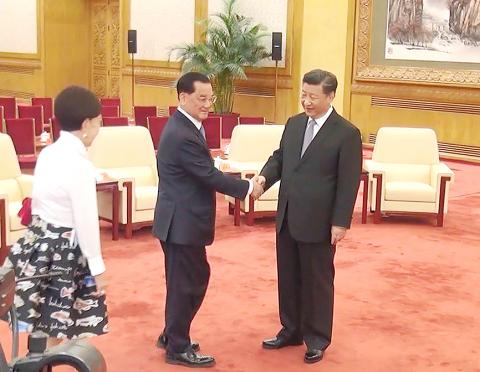
Photo: CNA
Lin Wen-cheng (林文程), a China and Asia-Pacific regional studies professor at National Sun Yat-sen University, said that despite the rhetoric about providing economic benefits to Taiwanese, Xi must be aware that Bejing’s efforts to strong-arm the country — including poaching Taiwan’s diplomatic allies and forcing airlines to call it a part of China — have angered them.
The fraught situation across the Taiwan Strait is Beijing’s doing, and while Xi mentioned “seeking common ground while shelving differences (求同存異),” this concession is offset by his insistence on using Beijing’s “one China” principle as a precondition for dialogue, Lin said.
The refusal to appreciate the Tsai administration’s position makes the resumption of dialogue between the two governments unlikely, Lin added.
Xi chose to meet Lien, because troubles with Taiwan could further complicate the US-China trade war, he said.
Whether cross-strait tensions continue in the second half of this year could depend on whether the trade war escalates, Lin added without elaborating.
Taiwan Thinktank researcher Tung Li-wen (董立文) said that Xi mentioned the phrases “correct direction” and “correct path” repeatedly during his speech as a defense of his Taiwan policy, which he intended both Taiwan and China to hear.
That Xi mentioned the phrases repeatedly during his speech indicates defensiveness, Tung said.
Xi’s avoidance of naming Tsai or the Democratic Progressive Party government and his remark that “differences in opinion should not obstruct normal exchange across the Strait” could be an invitation for dialogue and de-escalation, Tung said.
Xi had said he would respect Taiwan’s social institutions and way of life, but Beijing still went forward with jailing Taiwanese human rights advocate Lee Ming-che (李明哲), as well as its air force and navy drills, he said.
As a result, Taiwanese do not feel the respect that Xi professed to have for Taiwan, and while Taiwanese hope for the best in him, they should continue to “listen to his words, but observe his actions,” Tung said.
During the meeting with Xi, Lien sparked controversy by saying that “cross-strait relations are not state-to-state relations and there is no room for Taiwanese independence.”
When asked to respond, Taipei Mayor Ko Wen-je (柯文哲) said both Lien and Chinese Nationalist Party (KMT) Chairman Wu Den-yih (吳敦義) have said Lien does not represent the party.
“If that is the case, Lien represents one opinion out of 23 million, which is his own personal opinion; we should take it for what it is,” Ko said.
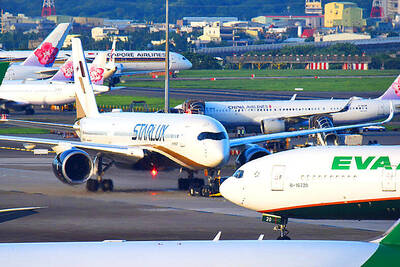
Trips for more than 100,000 international and domestic air travelers could be disrupted as China launches a military exercise around Taiwan today, Taiwan’s Civil Aviation Administration (CAA) said yesterday. The exercise could affect nearly 900 flights scheduled to enter the Taipei Flight Information Region (FIR) during the exercise window, it added. A notice issued by the Chinese Civil Aviation Administration showed there would be seven temporary zones around the Taiwan Strait which would be used for live-fire exercises, lasting from 8am to 6pm today. All aircraft are prohibited from entering during exercise, it says. Taipei FIR has 14 international air routes and
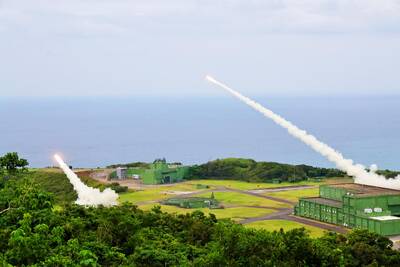
Taiwan lacks effective and cost-efficient armaments to intercept rockets, making the planned “T-Dome” interception system necessary, two experts said on Tuesday. The concerns were raised after China’s military fired two waves of rockets during live-fire drills around Taiwan on Tuesday, part of two-day exercises code-named “Justice Mission 2025.” The first wave involved 17 rockets launched at 9am from Pingtan in China’s Fujian Province, according to Lieutenant General Hsieh Jih-sheng (謝日升) of the Office of the Deputy Chief of the General Staff for Intelligence at the Ministry of National Defense. Those rockets landed 70 nautical miles (129.6km) northeast of Keelung without flying over Taiwan,
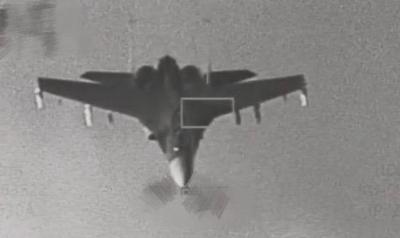
The Ministry of National Defense (MND) today released images of the military tracking China’s People's Liberation Army (PLA) movements during the latest round of Chinese drills around Taiwan. The PLA began "Justice Mission 2025" drills today, carrying out live-fire drills, simulated strikes on land and maritime targets, and exercises to blockade the nation's main ports. The exercises are to continue tomorrow, with the PLA announcing sea and air space restrictions for five zones around Taiwan for 10 hours starting from 8:30am. The ministry today released images showing a Chinese J-16 fighter jet tracked by a F-16V Block 20 jet and the
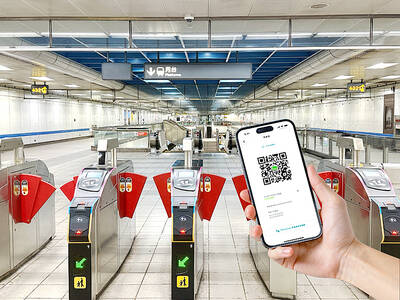
City buses in Taipei and New Taipei City, as well as the Taipei MRT, would on Saturday begin accepting QR code payments from five electronic payment providers, the Taipei Department of Transportation said yesterday. The new option would allow passengers to use the “transportation QR code” feature from EasyWallet, iPass Money, iCash Pay, Jkopay or PXPay Plus. Passengers should open their preferred electronic payment app, select the “transportation code” — not the regular payment code — unlock it, and scan the code at ticket readers or gates, General Planning Division Director-General Liu Kuo-chu (劉國著) said. People should move through the


 RSS
RSS