


Government efforts to promote start-ups and innovative technology is seeing some success, with AP Plasma Corp applying plasma technology to shoe manufacturing, and PicSee becoming a must-have tool for uploading one’s daily life onto social networking platforms.
The traditional shoe industry has long used a highly toxic chemical to glue the sole to the shoe, a practice that is very damaging to the environment, AP Plasma manager Wang Hung-yi (王弘壹) said on Thursday.
By using plasma to treat the original materials, their base characteristics are changed, altering the chemical bonds, Wang said, adding that applying non-toxic resin to shoes removes the need for highly toxic chemical glues.
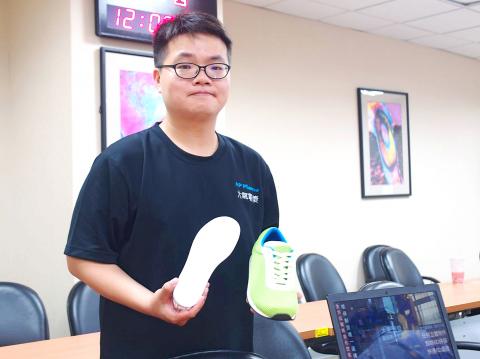
Photo: Chien Hui-ju, Taipei Times
The company is collaborating with Pou Chen Industry and hopes to apply the same technology to all macromolecule rubber products, Wang said.
The introduction of the technology could make the traditional shoemaking industry cleaner and more eco-friendly, as well as more competitive, Wang said.
PicSee cofounder Ray Wei (方選) said there is great market potential in Southeast Asia for his firm.
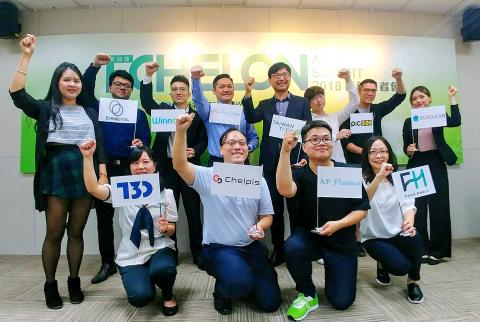
Photo: Chien Hui-ju, Taipei Times
PicSee’s services shorten the length of Web addresses for easier sharing on social Web sites and can help increase the amount of “likes” on social networking services, Ray said.
Vietnam has 45 million Internet users, 2.6 times that of Taiwan at 17 million, Ray said, adding that Taiwanese YouTube channel This Group of People has about 2 million subscribers, while the most popular YouTube channel in Thailand has more than 10 million subscribers.
Meanwhile, the Ministry of Science and Technology is scheduled to take nine leading start-ups to the Echelon Asia Summit at the Singapore Expo on Thursday and Friday.
Both AP Plasma and PicSee are to attend.
The ministry is to have a Taiwan pavilion at the expo for the first time this year and hopes to break into Southeast Asia’s innovative technology industry, ministry official Chiu Chiu-hui (邱求慧) said.
The nine companies would include start-ups in the fields of smart technology in medicine, artificial intelligence, smart manufacturing and statistical analysis, Chiu said.

Kenting National Park service technician Yang Jien-fon (楊政峰) won a silver award in World Grand Prix Photography Awards Spring Season for his photograph of two male rat snakes intertwined in combat. Yang’s colleagues at Kenting National Park said he is a master of nature photography who has been held back by his job in civil service. The awards accept entries in all four seasons across six categories: architectural and urban photography, black-and-white and fine art photography, commercial and fashion photography, documentary and people photography, nature and experimental photography, and mobile photography. Awards are ranked according to scores and divided into platinum, gold and
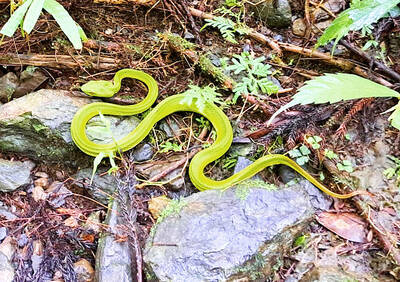
More than half of the bamboo vipers captured in Tainan in the past few years were found in the city’s Sinhua District (新化), while other districts had smaller catches or none at all. Every year, Tainan captures about 6,000 snakes which have made their way into people’s homes. Of the six major venomous snakes in Taiwan, the cobra, the many-banded krait, the brown-spotted pit viper and the bamboo viper are the most frequently captured. The high concentration of bamboo vipers captured in Sinhua District is puzzling. Tainan Agriculture Bureau Forestry and Nature Conservation Division head Chu Chien-ming (朱健明) earlier this week said that the
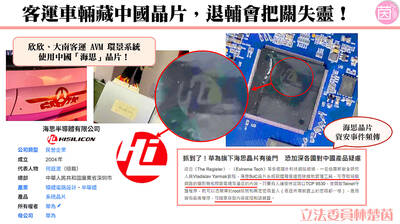
BREACH OF CONTRACT: The bus operators would seek compensation and have demanded that the manufacturer replace the chips with ones that meet regulations Two bus operators found to be using buses with China-made chips are to demand that the original manufacturers replace the systems and provide compensation for breach of contract, the Veterans Affairs Council said yesterday. Democratic Progressive Party Legislator Michelle Lin (林楚茵) yesterday said that Da Nan Bus Co and Shin-Shin Bus Co Ltd have fielded a total of 82 buses that are using Chinese chips. The bus models were made by Tron-E, while the systems provider was CYE Electronics, Lin said. Lin alleged that the buses were using chips manufactured by Huawei subsidiary HiSilicon Co, which presents a national security risk if the

The National Immigration Agency has banned two Chinese from returning to Taiwan, after they published social media content it described as disrespectful to national sovereignty. The agency imposed a two-month ban on a Chinese man surnamed Liang (梁) and a permanent ban on a woman surnamed Yang (楊), an influencer with 23 million followers, in October last year and last week respectively. Minister of the Interior Liu Shyh-fang (劉世芳) yesterday said on the sidelines of a legislative meeting that Chinese visitors to Taiwan are required to comply with the rules and regulations governing their entry permits. The government has handled the ban and


 RSS
RSS