


Cyberattacks from China on government computers are becoming more difficult to detect, as hackers increasingly use online platforms, such as search engines, to break into systems, a source close to government discussions said.
While the frequency of attacks by China’s cyberarmy has declined, the success rate of such incursions is rising, the source said.
“Taiwan’s official departments suffer from hundreds of successful Internet attacks each year, more than half of which come from assaults by China’s cyberarmy,” said the person, who is not authorized to speak to the media and declined to be identified.
China has denied accusations of engaging in cyberwarfare or hacking and has said that it is itself one of the world’s biggest victims of such incidents.
Neither China’s Taiwan Affairs Office nor the Chinese Cyberspace Administration immediately responded to a request for comment.
The alleged cyberattacks come as Beijing has been increasing diplomatic and economic pressure on Taiwan.
The source said hackers are adopting new techniques to conceal their activities.
“They frequently go through online platforms such as Google and blogs to hide and give investigators the impression that they are a normal platform or tool so that the investigators ignore background actions,” the person said.
Government agencies face “frequent cyberattacks and scanning of their vulnerabilities, with the attack volume reaching 10 million a month,” the source said.
Most attacks targeted non-core service systems, were low-level in nature and included activities such as changing Web sites and tampering with information, but there have also been more serious attacks on core systems, they said.
The government has evidence that some of the attacks targeted agencies and their Web sites by intruding into servers and stealing account passwords, the source added.
The nation’s representative offices abroad have also been targeted using methods such as taking screen snapshots, keylogging and unpacking related information, the source said.
Since President Tsai Ing-wen (蔡英文) took office in 2016, China’s hostility toward Taiwan has increased. Analysts expect cyberattacks will continue to cause a headache for the government.
“Taiwan has very good cyberdefense and investigation skills and capacity. However, under such a huge number of attacks and the special relationship across the Strait, it is really difficult to prevent 100 percent of the attacks,” said Lennon Chang, a senior lecturer in criminology at Monash University in Melbourne.

Actor Darren Wang (王大陸) was sentenced to six months in prison, commutable to a fine, by the New Taipei District Court today for contravening the Personal Data Protection Act (個人資料保護法) in a case linked to an alleged draft-dodging scheme. Wang allegedly paid NT$3.6 million (US$114,380) to an illegal group to help him evade mandatory military service through falsified medical documents, prosecutors said. He transferred the funds to Chen Chih-ming (陳志明), the alleged mastermind of a draft-evasion ring, although he lost contact with him as he was already in detention on fraud charges, they said. Chen is accused of helping a

SECURITY: Starlink owner Elon Musk has taken pro-Beijing positions, and allowing pro-China companies to control Taiwan’s critical infrastructure is risky, a legislator said Starlink was reluctant to offer services in Taiwan because of the nation’s extremely high penetration rates in 4G and 5G services, the Ministry of Digital Affairs said yesterday. The ministry made the comments at a meeting of the legislature’s Transportation Committee, which reviewed amendments to Article 36 of the Telecommunications Management Act (電信管理法). Article 36 bans foreigners from holding more than 49 percent of shares in public telecommunications networks, while shares foreigners directly and indirectly hold are also capped at 60 percent of the total, unless specified otherwise by law. The amendments, sponsored by Chinese Nationalist Party (KMT) Legislator Ko
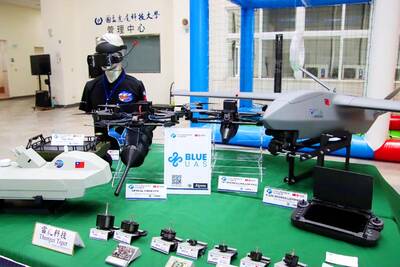
NON-RED SUPPLY: Boosting the nation’s drone industry is becoming increasingly urgent as China’s UAV dominance could become an issue in a crisis, an analyst said Taiwan’s drone exports to Europe grew 41.7-fold from 2024 to last year, with demand from Ukraine’s fight against Russian aggression the most likely driver of growth, a study showed. The Institute for Democracy, Society and Emerging Technology (DSET) in a statement on Wednesday said it found that many of Taiwan’s uncrewed aerial vehicle (UAV) sales were from Poland and the Czech Republic. These countries likely transferred the drones to Ukraine to aid it in its fight against the Russian invasion that started in 2022, it said. Despite the gains, Taiwan is not the dominant drone exporter to these markets, ranking second and fourth

The eastern extension of the Taipei MRT Red Line could begin operations as early as late June, the Taipei Department of Rapid Transit Systems said yesterday. Taipei Rapid Transit Corp said it is considering offering one month of free rides on the new section to mark its opening. Construction progress on the 1.4km extension, which is to run from the current terminal Xiangshan Station to a new eastern terminal, Guangci/Fengtian Temple Station, was 90.6 percent complete by the end of last month, the department said in a report to the Taipei City Council's Transportation Committee. While construction began in October 2016 with an


 RSS
RSS