


US technical assistance would help Taiwan upgrade its indigenous missile systems and could provide key technologies needed to develop a vertical launch system for warships, a defense official said on condition of anonymity.
Commenting on the Taiwan-US cooperative agreement in defense-related research, the official said that US technical assistance is expected to speed up the nation’s ongoing efforts to upgrade the Hsiung Feng, Tien Chien and Tien Kung families of missiles.
Moreover, US know-how could facilitate the military’s program to develop a vertical launch system for the navy’s planned next-generation frigate and the principal surface warfare combatant, which has struck a technical bottleneck, the official said.
Although US officials have suggested directly selling vertical launch systems, Taiwanese officials have expressed a preference to obtain the necessary technologies and develop a system locally through visits to US research facilities and joint research programs, the official said.
The Hsiung Feng family of missiles is Taiwan’s most important means of defense against the People’s Liberation Army Navy’s large warships and the nation’s main strategic deterrent, the official said.
The military fields three variants of Hsiung Feng missiles: the Hsiung Feng II subsonic anti-ship missile, the Hsiung Feng III supersonic anti-ship missile and the Hsiung Feng IIE land attack cruise missile, the official said.
While the military is confident in the missiles’ ability to strike Chinese ships and installations, the Chungshan Institute of Science and Technology believes that it is both desirable and practicable to improve their effective range and precision, the official said.
The Tien Kung III surface-to-air missile is mainly used as an anti-aircraft weapon, but can also be used as a missile defense interceptor, the official said.
However, the missiles’ top operational altitude is deemed insufficient and the institute is focusing on boosting the maximum altitude of effective interception for its next round of upgrades, the official said.
The Tien Chien II air-to-air missile has met all of the military’s operational requirements and it is the main anti-fighter armament of Indigenous Defense Fighter jets, which are undergoing upgrades to carry more Tien Chien missiles, the official said.
The navy has adopted the naval variant of the Tien Chien II missile for use on all new Tuo Jiang-class corvettes slated for production, while the land-based variant has been fully tested and can be fielded, should the army decide to adopt the weapon, the official said.
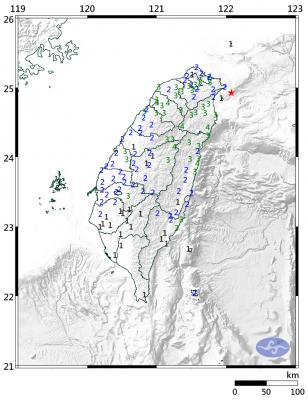
A magnitude 6.1 earthquake struck off the coast of Yilan County at 8:39pm tonight, the Central Weather Administration (CWA) said, with no immediate reports of damage or injuries. The epicenter was 38.7km east-northeast of Yilan County Hall at a focal depth of 98.3km, the CWA’s Seismological Center said. The quake’s maximum intensity, which gauges the actual physical effect of a seismic event, was a level 4 on Taiwan’s 7-tier intensity scale, the center said. That intensity level was recorded in Yilan County’s Nanao Township (南澳), Hsinchu County’s Guansi Township (關西), Nantou County’s Hehuanshan (合歡山) and Hualien County’s Yanliao (鹽寮). An intensity of 3 was
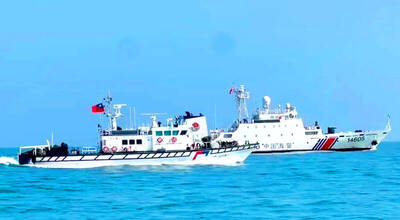
Instead of focusing solely on the threat of a full-scale military invasion, the US and its allies must prepare for a potential Chinese “quarantine” of Taiwan enforced through customs inspections, Stanford University Hoover fellow Eyck Freymann said in a Foreign Affairs article published on Wednesday. China could use various “gray zone” tactics in “reconfiguring the regional and ultimately the global economic order without a war,” said Freymann, who is also a nonresident research fellow at the US Naval War College. China might seize control of Taiwan’s links to the outside world by requiring all flights and ships entering or leaving Taiwan
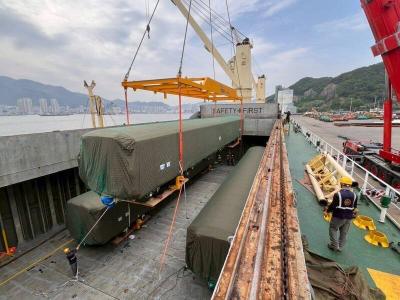
The first of 10 new high-capacity trains purchased from South Korea’s Hyundai Rotem arrived at the Port of Taipei yesterday to meet the demands of an expanding metro network, Taipei Rapid Transit Corp (TRTC) said yesterday. The train completed a three-day, 1,200km voyage from the Port of Masan in South Korea, the company said. Costing NT$590 million (US$18.79 million) each, the new six-carriage trains feature a redesigned interior based on "human-centric" transportation concepts, TRTC said. The design utilizes continuous longitudinal seating to widen the aisles and optimize passenger flow, while also upgrading passenger information displays and driving control systems for a more comfortable
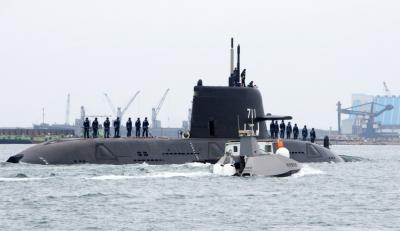
Taiwan's first indigenous defense submarine, the SS-711 Hai Kun (海鯤, or Narwhal), departed for its 13th sea trial at 7am today, marking its seventh submerged test, with delivery to the navy scheduled for July. The outing also marked its first sea deployment since President William Lai (賴清德) boarded the submarine for an inspection on March 19, drawing a crowd of military enthusiasts who gathered to show support. The submarine this morning departed port accompanied by CSBC Corp’s Endeavor Manta (奮進魔鬼魚號) uncrewed surface vessel and a navy M109 assault boat. Amid public interest in key milestones such as torpedo-launching operations and overnight submerged trials,


 RSS
RSS