


A coalition of unions yesterday protested outside the Ministry of Labor in Taipei to demand that it include industrial and trade union members in labor inspections.
The protest was organized by a dozen unions, including the Taiwan Higher Education Union, the Taiwan High Speed Rail Corp (THSRC) Labor Union and the Taoyuan Flight Attendants Union.
At present, before conducting labor inspections at a company, authorities must invite members of the company’s union to take part, but not those in industrial and trade unions, the groups said in a statement.
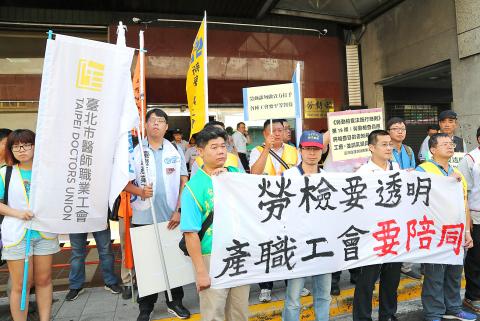
Photo: CNA
Only 58,000 Taiwanese are members of their companies’ unions, which account for just 5.4 percent of the nation’s workers, they said.
“However, industrial and trade unions have a total of 2.8 million members. If only company union members are allowed to participate in labor inspections, how would the government ensure that the rights of those 2.8 million workers are protected,” the statement said.
Industrial or trade union members have occasionally been allowed to take part in such inspections and have helped uncover breaches of labor law, they said.
“The ministry should require authorities to invite industrial and labor union representatives to participate in inspections. Currently, less than 6 percent of companies in Taiwan have their own unions. Only by improving the participation of industrial and trade unions in labor inspections can the government effectively prevent tragedies in workplaces,” they said.
The unions also demanded that the authorities issue invitations to union representatives at least seven days in advance to ensure that they could attend.
“There have been many cases where union representatives were unable to go because they were given short notice,” the statement said.
However, Minister of Labor Hsu Ming-chun (許銘春) said current regulations can handle the problem.
Article 22 of the Labor Inspection Act (勞動檢查法) stipulates that labor inspectors should invite company union representatives to join inspections, but in situations where it is necessary to have industrial or trade union representatives present, the latter can also be invited, as stipulated by Article 23, she said.
Article 23 also states that when necessary, a labor inspector can invite academics, experts, doctors, officials from the regulatory authority of the company under inspection, as well as representatives from related groups to participate in an inspection after reporting to the labor inspection agency and obtaining approval, she said.
The company being inspected cannot refuse, she said.
The ministry said in a statement that it would encourage local governments to use the mechanism in the law more often to make inspections more effective.

LOUD AND PROUD Taiwan might have taken a drubbing against Australia and Japan, but you might not know it from the enthusiasm and numbers of the fans Taiwan might not be expected to win the World Baseball Classic (WBC) but their fans are making their presence felt in Tokyo, with tens of thousands decked out in the team’s blue, blowing horns and singing songs. Taiwanese fans have packed out the Tokyo Dome for all three of their games so far and even threatened to drown out home team supporters when their team played Japan on Friday. They blew trumpets, chanted for their favorite players and had their own cheerleading squad who dance on a stage during the game. The team struggled to match that exuberance on the field, with
Taiwanese paleontologists have discovered fossil evidence that pythons up to 4m long inhabited Taiwan during the Pleistocene epoch, reporting their findings in the international scientific journal Historical Biology. National Taiwan University (NTU) Institute of Ecology and Evolutionary Biology associate professor Tsai Cheng-hsiu (蔡政修) led the team that discovered the largest snake fossil ever found in Taiwan. The single trunk vertebra was discovered in Tainan at the Chiting Formation, dated to between 400,000 and 800,000 years ago in the Middle Pleistocene, the paper said. The area also produced Taiwan’s first avian fossil, as well as crocodile, mammoth, saber-toothed cat and rhinoceros fossils, it said. Discoveries

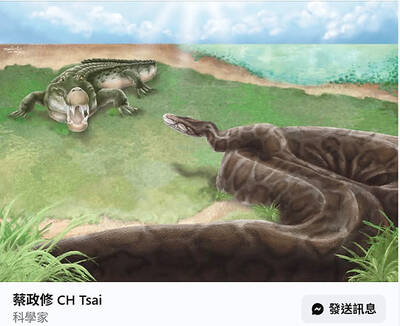
Taiwanese paleontologists have discovered fossil evidence that pythons up to 4m long inhabited Taiwan during the Pleistocene epoch, reporting their findings in the international scientific journal Historical Biology. National Taiwan University (NTU) Institute of Ecology and Evolutionary Biology associate professor Tsai Cheng-hsiu (蔡政修) led the team that discovered the largest snake fossil ever found in Taiwan. A single trunk vertebra was discovered in Tainan at the Chiting Formation, dated to between 800,000 to 400,000 years ago in the Middle Pleistocene, the paper said. The area also produced Taiwan’s first avian fossil, as well as crocodile, mammoth, sabre-toothed cat and rhinoceros fossils, it said. Discoveries

Whether Japan would help defend Taiwan in case of a cross-strait conflict would depend on the US and the extent to which Japan would be allowed to act under the US-Japan Security Treaty, former Japanese minister of defense Satoshi Morimoto said. As China has not given up on the idea of invading Taiwan by force, to what extent Japan could support US military action would hinge on Washington’s intention and its negotiation with Tokyo, Morimoto said in an interview with the Liberty Times (sister paper of the Taipei Times) yesterday. There has to be sufficient mutual recognition of how Japan could provide


 RSS
RSS