


For decades, Taiwanese diplomats focused on sharpening their skill at using the languages most commonly used around the world, such as English, Spanish, French and Japanese.
However, most of them have little knowledge of languages spoken in Southeast Asia, even though tens of thousands of people from the region have come to work in Taiwan or are married to Taiwanese.
So when President Tsai Ing-wen (蔡英文) took office in May 2016 and initiated the New Southbound Policy to reduce Taiwan’s economic dependence on China and bolster ties with ASEAN members, there was a new urgency to build up the proficiency of Taiwanese diplomats in ASEAN languages.
The Ministry of Foreign Affairs, which is responsible for cultivating the nation’s top diplomats, has taken up the challenge to address the language gap.
Its most important initiative came last month, when it added two new language categories — Vietnamese and Indonesian — to the Civil Service Special Examination for Diplomatic and Consular Personnel, the national test used by the ministry to select its diplomats.
The examination used to test candidates on 13 possible languages, but among them only two — Thai and Malay — were exclusively spoken by ASEAN members.
When the new languages were added last year, 13 candidates took the Indonesian exam and four took the Vietnamese exam, with a candidate for each landing a job at the ministry, it said.
Beyond recruiting new personnel, the ministry has since last year required Taiwanese staff at all of its offices in ASEAN member nations to study the local language, and a total of 73 people are now participating in language classes.
Young diplomats are also being sent to ASEAN members for language training, an initiative that precedes the New Southbound Policy.
The ministry has been sending people abroad for language training since 1997, but it was only in 2013 that training in ASEAN member nations become an annual routine, ministry spokesman Andrew Lee (李憲章) said.
By August, the ministry will have sent nine diplomats to Indonesia for language training, and six each to Thailand and Vietnam.
Twelve of them were sent before 2016, while the remaining nine will have been sent since the launch of the New Southbound Policy.
Lee said the ministry is increasing the frequency at which it is sending staff to ASEAN members.
Aside from learning the local language, the trainees also take courses on the laws, trade issues, international relations and diplomatic matters related to the nation that they are visiting to sharpen their professional skills.
Fenny Chiang (江瑜婷), a young diplomat who joined the ministry two years ago, is one of three personnel who are to travel overseas for training in August.
She is to study at Thailand’s prestigious Chulalongkorn University for 10 months to improve her Thai.
Chiang said she studied Thai in college because of her personal interest in a Thai TV drama and the beauty of Thai script.
She took two semesters of Thai and decided after joining the foreign service in 2016 to apply for the overseas language training program.
With her familiarity with the language and the renewed emphasis on relations with ASEAN members, she was a perfect candidate for the project in Bangkok.
Such language training has proven invaluable for Taiwanese diplomats, and Frank Yen (顏銘男), a secretary at Taiwan’s representative office in Hanoi who studied Vietnamese from 2012 to 2013, might know that better than anyone else.
“Being able to speak Vietnamese with local officials and diplomats gives me an edge in my work,” he said.
“It’s like in Taiwan, if a foreigner can speak some Taiwanese, local people will have a more favorable impression of you and feel closer to you,” he said.
Yen said he was one of the first Taiwanese diplomats to receive language training in a Southeast Asian country when he was sent to Vietnam soon after he passed the entrance exam to be a diplomat earlier in 2012.
Having originally joined the diplomatic corps because of his proficiency in English, Yen said he always wanted to learn another language to give him an advantage at work.
His first choice was Portuguese, but then he learned that he could be sent to Thailand or Vietnam. He opted for Vietnam and went to a language center in Hanoi for 10 months of one-on-one sessions.
After completing his training, he returned to Taipei before being dispatched to Taiwan’s representative office in Hanoi in July 2015 for his first overseas assignment as a diplomat.
He was grateful for the training, because unlike in Thailand, where most diplomats speak English, making it unnecessary for foreign diplomats to speak Thai, most diplomats in Vietnam cannot speak English, Yen said.
There are more than 20 Taiwanese personnel at the Hanoi office and only five of them can speak Vietnamese, he said.
The office has arranged local teachers to teach its staff Vietnamese during lunch breaks or off hours to bolster their communication skills, he said.
Yen expects that with the launch of the New Southbound Policy, the ministry will train more diplomats in local languages, and suggested that the ministry offer more incentives to diplomats to encourage them to learn new languages.

NATIONAL SECURITY: Authorities are working to confirm the identities of the military personnel involved and investigating possible illegal conduct and regulatory violations Authorities are probing possible national security implications after Kinmen police and immigration officers on Sunday found a Chinese woman allegedly posing as a tourist while engaging in prostitution involving more than 10 military personnel. The woman, surnamed Chen (陳), has since been deported, authorities said, adding that investigators are still working to confirm the identities of those implicated, as the records only listed code names and aliases. The case stemmed from a report received by the Kinmen District Prosecutors’ Office on Friday last week from the Jinhu Precinct of the Kinmen County Police Bureau. On Sunday, police, along with the National Immigration

GLOBALGIVING: ‘ Caving to external pressure is not acceptable for an organization that has cultivated justice reform and human rights for 30 years,’ one NGO said A slew of non-government organizations (NGOs) have withdrawn from the GlobalGiving fundraising platform after it announced it would use “Chinese Taipei” instead of “Taiwan” from next month. The Taiwan Good Rice Association wrote on Facebook on Friday that it was informed on April 28 via a teleconference call of the change, which was made because the platform wanted to operate in China. Taiwan Good Rice is to terminate all cooperative relationships with GlobalGiving in response to the platform’s “unilateral and non-negotiable” decision to remove references to Taiwan, the NGO said. “Taiwan is in the official name of Taiwan Good Rice Association and the

HEAVY WEATHER: Typhoon Jangmi is due to crash straight into the Ryukyus as airlines look to shift flights to larger aircraft or cancel flights to Okinawa entirely Taiwan’s international air carriers announced flight adjustments over the weekend as Typhoon Jangmi is forecast to hit the Ryukyu Islands today and tomorrow. The Central Weather Administration (CWA) upgraded Jangmi from a tropical storm to a typhoon at 8am yesterday, with the eye located 580km south of Naha city. It was moving north at 19kph. Today, China Airlines’ CI-120, CI-121, CI-122 and CI-123 flights between Taoyuan and Naha, Okinawa, have been canceled as well as CI-132 and CI-133 between Kaohsiung and Naha. EVA Air’s BR-112, BR-113, BR-186 and BR-185 flights between Taoyuan and Naha are also canceled. Low-cost carrier Tigerair Taiwan canceled IT-230,
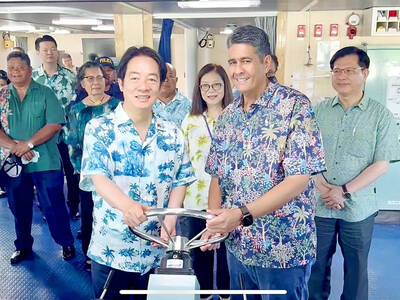
MULTIPRONGED APPROACH: China has sought to pressure Palau across a number of fronts, but the island nation has staunchly resisted overtures to ditch Taiwan Palau has been firm in backing Taiwan despite Chinese pressure that uses tourism economics, cyberattacks and criminal infiltration as tools to threaten the Pacific ally into renouncing its recognition of Taiwan as a sovereign state. The Presidential Office yesterday announced that Vice President Hsiao Bi-khim (蕭美琴) would visit Palau from Saturday to Wednesday next week at the invitation of Palauan President Surangel Whipps Jr. Whipps in April said in an interview that China had outspokenly asked Palau to “denounce Taiwan.” “And we have said: ‘We have no enemies, but nobody tells us who our friends are,’” he said. Whipps has told reporters multiple times


 RSS
RSS