


China’s continued saber rattling toward Taiwan will not be successful, but will only trigger resentment among Taiwanese, Minister of National Defense Yen De-fa (嚴德發) said on Saturday.
“I do not know whether you feel the same as I do. I believe that China doing so will have almost no effect, but will only stir up resentment among Taiwanese,” Yen told a forum on national security strategy organized by Tamkang University to mark the second anniversary of President Tsai Ing-wen’s (蔡英文) inauguration today.
The ever-changing international situation poses risky challenges for Taiwan, Yen said.
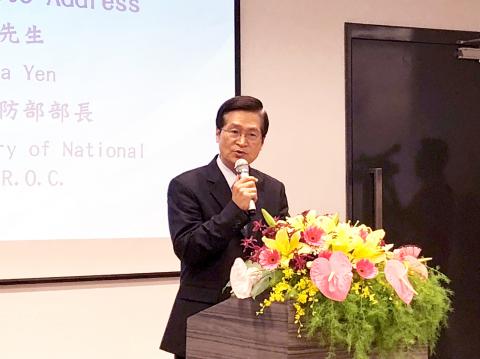
Photo: CNA
“The complex situation on the Korean Peninsula, in which the US, Japan, China and Russia are also involved, will indirectly affect the situation across the Taiwan Strait,” he said.
“In the disputed waters of the South China Sea, China’s deployment of anti-ship and surface-to-air missile systems on the Yongshu Reef [永暑島, Fiery Cross Reef] and Jhubi Reef [渚碧礁, Subi Reef] has reflected its ambition in the region, posing a threat and challenge to Taiwan’s security,” Yen added.
China’s removal of a two-term limit on the presidency will effectively allow Chinese President Xi Jinping (習近平) to remain in power for life, making him a strongman capable of exerting greater pressure on Taiwan, Yen said.
At a time when China has been stepping up its military intimidation toward Taiwan, while offering more incentives to attract Taiwanese businesses, professionals and students to go to China, Taiwan faces tremendous risks in negotiating Beijing’s “carrot and stick” approach, he said.
As long as Taiwan upholds its core democratic values, the nation would win recognition from other nations in the region due to its strategic location, he said.
“Taiwan’s military is absolutely capable of defending the nation while facing various challenges,” Yen added.
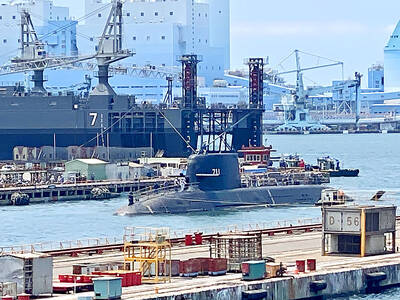
AGING: While Japan has 22 submarines, Taiwan only operates four, two of which were commissioned by the US in 1945 and 1946, and transferred to Taiwan in 1973 Taiwan would need at least 12 submarines to reach modern fleet capabilities, CSBC Corp, Taiwan chairman Chen Cheng-hung (陳政宏) said in an interview broadcast on Friday, citing a US assessment. CSBC is testing the nation’s first indigenous defense submarine, the Hai Kun (海鯤, Narwhal), which is scheduled to be delivered to the navy next month or in July. The Hai Kun has completed torpedo-firing tests and is scheduled to undergo overnight sea trials, Chen said on an SET TV military affairs program. Taiwan would require at least 12 submarines to establish a modern submarine force after assessing the nation’s operational environment and defense

A white king snake that frightened passengers and caused a stir on a Taipei MRT train on Friday evening has been claimed by its owner, who would be fined, Taipei Rapid Transit Corp (TRTC) said yesterday. A person on Threads posted that he thought he was lucky to find an empty row of seats on Friday after boarding a train on the Bannan (Blue) Line, only to spot a white snake with black stripes after sitting down. Startled, he jumped up, he wrote, describing the encounter as “terrifying.” “Taipei’s rat control plan: Release snakes on the metro,” one person wrote in reply, referring
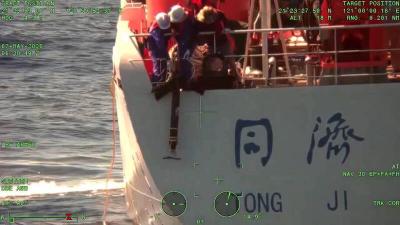
The coast guard today said that it had disrupted "illegal" operations by a Chinese research ship in waters close to the nation and driven it away, part of what Taipei sees a provocative pattern of China's stepped up maritime activities. The coast guard said that it on Thursday last week detected the Chinese ship Tongji (同濟號), which was commissioned only last year, 29 nautical miles (54km) southeast of the southern tip of Taiwan, although just outside restricted waters. The ship was observed lowering ropes into the water, suspected to be the deployment of scientific instruments for "illegal" survey operations, and the coast
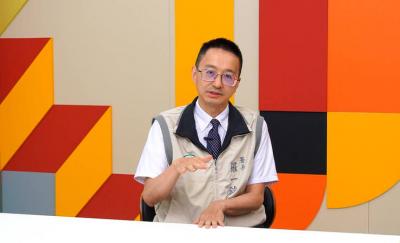
Taiwan’s two cases of hantavirus so far this year are on par with previous years’ case numbers, and the government is coordinating rat extermination work, so there should not be any outbreaks, Centers for Disease Control (CDC) Director-General Philip Lo (羅一鈞) said today in an interview with the Liberty Times (the Taipei Times’ sister newspaper). An increase in rat sightings in Taipei and New Taipei City has raised concerns about the spread of hantavirus, as rats can carry the disease. In January, a man in his 70s who lived in Taipei’s Daan District (大安) tested positive posthumously for hantavirus, Taiwan’s


 RSS
RSS