

The Taiwan High Court yesterday released convicted Chinese spy Zhou Hongxu (周泓旭) after his legal team appealed for him to be freed, but barred him from leaving the country and ordered him to report daily to the police.
The Taipei District Court on Sept. 15 last year convicted Zhou of espionage and breaching the National Security Act (國家安全法) and sentenced him to 14 months, a ruling that was criticized by many people as too lenient.
The High Court yesterday agreed with Zhou’s lawyers, who argued that he had effectively served his sentence since he had been held in detention since Taipei prosecutors took him into custody on March 9 last year for questioning into allegations he had been recruiting people to spy for China.
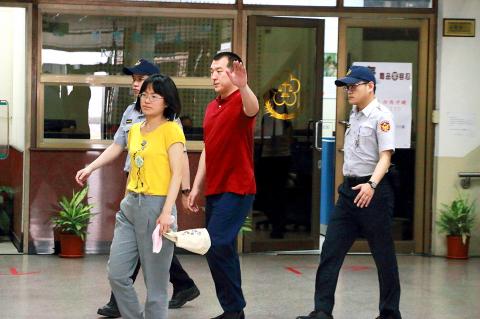
Photo: CNA
The court cited Code of Criminal Procedure (刑事訴訟法) provisions for its ruling, but it imposed travel restrictions and limits on public statements, and required him to report daily to the Liuzhangli Police Station, the nearest station to his Taipei residence.
As Zhou walked out of the court yesterday, he told reporters: “I will appeal my case, because I am innocent of the charges.”
Zhou said he needed to be careful with his words, because he needed to obey the restrictions the court had imposed on his public statements about his case.
The 31-year-old Zhou first came to Taiwan in 2009 to study at Tamkang University in New Taipei City’s Tamsui District (淡水) and later returned to study for a graduate degree in management at Chengchi University from 2012 to 2016.
In a related development, New Party spokesman Wang Ping-chung (王炳忠) has been listed as a defendant in Zhou’s espionage case.
Prosecutors suspect that Zhou recruited Wang to help him develop a spy network as a means of penetrating important government ministries and to source classified materials to pass on to Chinese authorities.
In their ongoing investigation into separate charges in the case, Taipei prosecutors last week summoned Wang and several of his associates for questioning, including New Party youth wing executives Ho Han-ting (侯漢廷) and Lin Ming-cheng (林明正), and a party accountant surnamed Tseng (曾).
Wang failed to appear last week, but presented himself on Monday, when he was listed as a defendant on charges of violating the National Security Act.
Ho, Lin, Tseng and Wang’s father, Wang Chin-pu (王進步), did appear for questioning and were later released, but with travel restrictions.
Wang Ping-chung is known for his pro-China views and has made frequent trips to China, often appearing as a political commentator on Chinese state media.
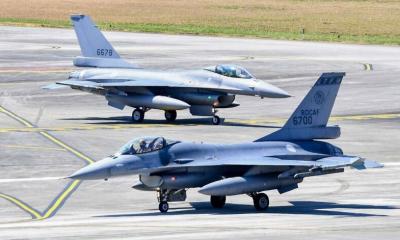
The first two F-16V Block 70 jets Taiwan purchased from the US were spotted unexpectedly turning back after departing from Hawaii yesterday, potentially further delaying delivery of the aircraft. Taiwan has purchased 66 of the F-16 C/D Block 70 jets to be deployed at Chihhang Air Base (志航基地) in Taitung County and operated by the air force's 7th Tactical Fighter Wing to defend Taiwan’s eastern region. Two single-seat jets, bearing serial No. 6727 and 6728, were spotted taking off from Hickam Field in Hawaii yesterday, observers said. Based on the precedent set during the delivery of Taiwan's older F-16 Block 20s, the new

Taiwan’s growing defense preparations might be sending a stronger signal to the US than to Beijing, highlighting the need for Taipei to tailor its deterrence efforts to different audiences, a US security academic said yesterday. Stanford University Freeman Spogli Institute for International Studies fellow Oriana Skylar Mastro made the comment during a Taipei Security Dialogue panel examining lessons Taiwan could draw from the wars in Ukraine and the Middle East. Mastro said she was impressed by Taiwan’s increased defense spending, emphasis on asymmetric capabilities and efforts to prepare society for conflict, but questioned whom those initiatives were influencing. She said when she asked
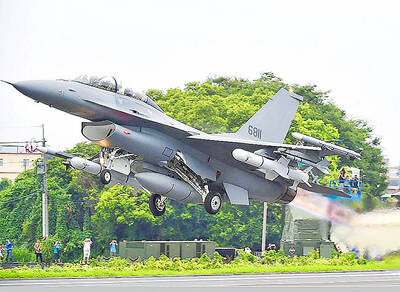
A sharp rise in compensation to be paid by air force officers who leave before completing their required service could indicate an increase in pilots leaving the military early, an analyst said on Friday, warning that the trend could worsen a shortage of experienced personnel. Chieh Chung (揭仲), a researcher at the Association for Strategic Foresight, issued the warning even though the number of volunteer military personnel is expected to increase next year. The planned headcount for volunteer military personnel, covering officers, noncommissioned officers (NCO) and enlisted soldiers, is 158,223 for next year, up 4,258 from 153,965 this year, Chieh said. The increase
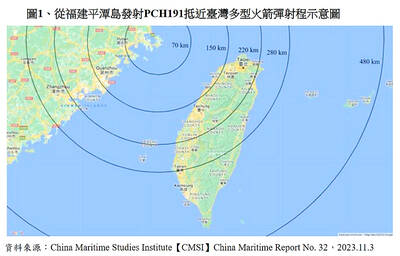
Potential improvements to munitions used by China’s long-range rocket-artillery units could extend their range to cover the entire Miyako Strait, which might give the Chinese People’s Liberation Army (PLA) the ability to secure the strategic waterway, the Mainland Affairs Council (MAC) said in a report. The PLA’s long-range rocket-artillery units deployed along the Taiwan Strait are concentrated along the coast of Fujian Province, including Changle, Pingtan and Shishi, the quarterly report on China said. The artillery brigades of the PLA’s 71st, 72nd and 73rd group armies have been deployed, with preparations for potential battlefield operations under way since August 2022, the report


 RSS
RSS