


Building a new Shenao Power Plant (深澳電廠) in New Taipei City would increase air pollution in Taipei, Taipei Mayor Ko Wen-je (柯文哲) said yesterday, expressing hope that Taiwan Power Co (Taipower) could be more open about its energy plans, so that the city government could evaluate whether the heightened pollution is an unavoidable cost.
Ko made the remarks in a special report to the Taipei City Council on the city’s environmental protection, transportation and consumer rights protection issues.
Taipower is planning to build a coal-fired power plant on the site of the old plant and passed its environmental impact assessment (EIA) in 2006. However, the project was suspended for years due to controversy over its coal unloading dock, so Taipower proposed a modified plan, which passed its EIA last year.
While Taipower’s EIA report estimated that concentrations of PM2.5 — fine particulate matter measuring 2.5 micrometers or smaller — in Taipei would increase by 1.733 milligrams per cubic meter (mg/m3) per 24-hour period after the new plant begins operation, National Chung Hsing University environmental engineering professor Tsuang Ben-jei (莊秉潔) estimated that it would increase by 3.043mg/m3, Ko said. “The estimated values are different, but it is a certainty that Taipei’s air pollution would worsen.”
Taipower’s report did not include statistical data on emissions of heavy metals and dioxins from the plant, nor did it conduct a health risk evaluation to analyze the increased risks, the mayor said.
The state utility has not explained its nuclear power plant plans — whether they would be shut down and when, how the other power plants would supply electricity in northern Taiwan, or whether distributing electricity from the south to make up for the shortfall in the north is feasible, he added.
PM2.5 pollution in Taipei was reduced to 15.3mcg/m3 last year from 19.6mcg/m3 in 2014, which is close to the national standard of 15mcg/m3 and is the lowest among the nation’s six special municipalities, he said.
“If the Shenao Power Plant operates, our efforts to reduce PM2.5 in the past three years would be negated,” Ko said. “So the main question is: Is our nation’s energy policy reliable and is the increased pollution an unavoidable cost for Taipei? We need a clearer explanation from Taipower so we can make decisions.”

SECURITY: Starlink owner Elon Musk has taken pro-Beijing positions, and allowing pro-China companies to control Taiwan’s critical infrastructure is risky, a legislator said Starlink was reluctant to offer services in Taiwan because of the nation’s extremely high penetration rates in 4G and 5G services, the Ministry of Digital Affairs said yesterday. The ministry made the comments at a meeting of the legislature’s Transportation Committee, which reviewed amendments to Article 36 of the Telecommunications Management Act (電信管理法). Article 36 bans foreigners from holding more than 49 percent of shares in public telecommunications networks, while shares foreigners directly and indirectly hold are also capped at 60 percent of the total, unless specified otherwise by law. The amendments, sponsored by Chinese Nationalist Party (KMT) Legislator Ko
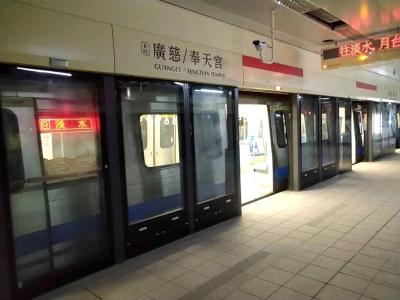
The eastern extension of the Taipei MRT Red Line could begin operations as early as late June, the Taipei Department of Rapid Transit Systems said yesterday. Taipei Rapid Transit Corp said it is considering offering one month of free rides on the new section to mark its opening. Construction progress on the 1.4km extension, which is to run from the current terminal Xiangshan Station to a new eastern terminal, Guangci/Fengtian Temple Station, was 90.6 percent complete by the end of last month, the department said in a report to the Taipei City Council's Transportation Committee. While construction began in October 2016 with an
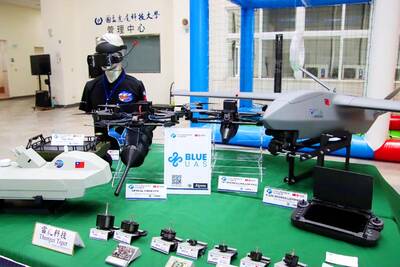
NON-RED SUPPLY: Boosting the nation’s drone industry is becoming increasingly urgent as China’s UAV dominance could become an issue in a crisis, an analyst said Taiwan’s drone exports to Europe grew 41.7-fold from 2024 to last year, with demand from Ukraine’s fight against Russian aggression the most likely driver of growth, a study showed. The Institute for Democracy, Society and Emerging Technology (DSET) in a statement on Wednesday said it found that many of Taiwan’s uncrewed aerial vehicle (UAV) sales were from Poland and the Czech Republic. These countries likely transferred the drones to Ukraine to aid it in its fight against the Russian invasion that started in 2022, it said. Despite the gains, Taiwan is not the dominant drone exporter to these markets, ranking second and fourth

Japanese Prime Minister Sanae Takaichi’s comment last year on Tokyo’s potential reaction to a Taiwan-China conflict has forced Beijing to rewrite its invasion plans, a retired Japanese general said. Takaichi told the Diet on Nov. 7 last year that a Chinese naval blockade or military attack on Taiwan could constitute a “survival-threatening situation” for Japan, potentially allowing Tokyo to exercise its right to collective self-defense. Former Japan Ground Self-Defense Force general Kiyofumi Ogawa said in a recent speech that the remark has been interpreted as meaning Japan could intervene in the early stages of a Taiwan Strait conflict, undermining China’s previous assumptions


 RSS
RSS