


Beijing’s increased pressure on Taiwan has raised concerns among observers in the US, which could be the reason for the US Congress’ unanimous passage of the Taiwan Travel Act in March, American Institute in Taiwan (AIT) Chairman James Moriarty said.
At a time of impressive growth in Taiwan-US ties, development in cross-strait relations over the past year has told a much less positive story, Moriarty said at a seminar, titled “The US and Taiwan: An Enduring Partnership,” at Stanford University on Thursday.
“Observers in the US, both outside and inside the government, including a broad spectrum of members of Congress, are deeply troubled that China has increased pressure on Taiwan,” Moriarty said. “Recent congressional actions on Taiwan, like the unanimous passage of the Taiwan Travel Act, reflect those concerns.”
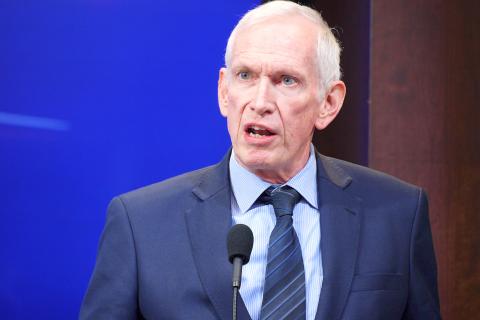
Photo: CNA
The act, which encourages high-level visits by US and Taiwanese officials, was signed into law by US President Donald Trump on March 16, following its unanimous passage in the US House of Representatives on Jan. 9 and the US Senate on Feb. 28.
Citing some examples, Moriarty said that Washington is concerned by the Chinese People’s Liberation Army’s increased activities around Taiwan, its lack of transparency about its growing military capabilities and strategic intentions, and its continuing unwillingness to renounce the use of force against Taiwan.
Equally alarming is Beijing’s unilateral launch of northbound flights on the M503 route in January, as well as the Dominican Republic’s sudden switch of diplomatic recognition to China this week, which suggested that the “diplomatic truce” between the two sides no longer exists, Moriarty said.
Turning to China’s growing efforts to diminish Taiwan’s international presence, Moriarty said that the WHO’s decision last year not to invite Taiwan to participate in its annual World Health Assembly (WHA) as an observer was “deeply troubling.”
“This and other attempts by China to exclude Taiwan from international organizations prevents the international community from benefiting from Taiwan’s expertise, harms cross-strait relations and runs counter to Beijing’s own professed goal of winning the support of the people of Taiwan,” he said.
Taiwan had participated in the WHA as an observer between 2009 and 2016, but it failed to receive an invitation last year due to Chinese pressure.
According to the student-run Stanford Daily, Moriarty also said that China’s crackdown on companies and Web sites that “improperly” characterize Taiwan was “bullying and childish,” and “does not accomplish anything.”
Despite reiterating the US’ commitment to adhere to the Taiwan Relations Act, under which Washington is required to provide Taiwan with defensive weaponry, Moriarty called on Taiwan to step up efforts to strengthen its security.
“That commitment alone will not secure Taiwan against the backdrop of an increasingly complex cross-strait environment,” he said. “Taiwan must do its part to invest in capabilities that deter aggression and help Taiwan mount an effective defense should deterrence fail.”
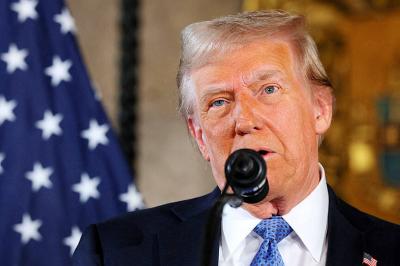
US President Donald Trump said "it’s up to" Chinese President Xi Jinping (習近平) what China does on Taiwan, but that he would be "very unhappy" with a change in the "status quo," the New York Times said in an interview published yesterday. Xi "considers it to be a part of China, and that’s up to him what he’s going to be doing," Trump told the newspaper on Wednesday. "But I’ve expressed to him that I would be very unhappy if he did that, and I don’t think he’ll do that," he added. "I hope he doesn’t do that." Trump made the comments in
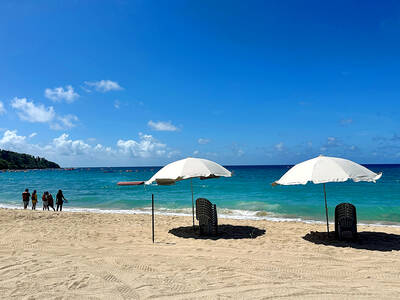
Tourism in Kenting fell to a historic low for the second consecutive year last year, impacting hotels and other local businesses that rely on a steady stream of domestic tourists, the latest data showed. A total of 2.139 million tourists visited Kenting last year, down slightly from 2.14 million in 2024, the data showed. The number of tourists who visited the national park on the Hengchun Peninsula peaked in 2015 at 8.37 million people. That number has been below 2.2 million for two years, although there was a spike in October last year due to multiple long weekends. The occupancy rate for hotels
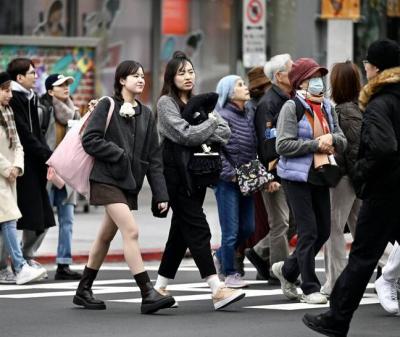
A cold surge advisory was today issued for 18 cities and counties across Taiwan, with temperatures of below 10°C forecast during the day and into tonight, the Central Weather Administration (CWA) said. New Taipei City, Taipei, Taoyuan and Hsinchu, Miaoli and Yilan counties are expected to experience sustained temperatures of 10°C or lower, the CWA said. Temperatures are likely to temporarily drop below 10°C in most other areas, except Taitung, Pingtung, Penghu and Lienchiang (Matsu) counties, CWA data showed. The cold weather is being caused by a strong continental cold air mass, combined with radiative cooling, a process in which heat escapes from
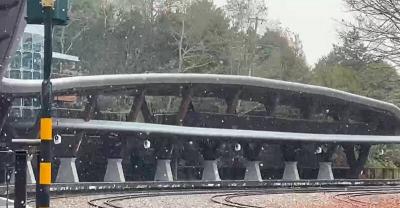
Snow this morning fell on Alishan for the first time in seven years, as a strong continental cold air mass sent temperatures plunging across Taiwan, the Central Weather Administration (CWA) said. The Alishan weather station, located at an elevation of about 2,200m in central Taiwan, recorded snowfall from 8:55am to 9:15am, when the temperature dropped to about 1°C, the CWA said. With increased moisture and low temperatures in the high-altitude Alishan area, the conditions were favorable for snow, CWA forecaster Tsai Yi-chi (蔡伊其) said. The last time snow fell at the Alishan weather station was on Jan. 10, 2018, while graupel fell there


 RSS
RSS