


The severance of diplomatic ties between Taiwan and the Dominican Republic can help Taiwanese better understand cross-strait relations and might also be conducive for forging a Taiwan-centric consensus on the issue of independent sovereignty, an academic said yesterday.
“The suspension of diplomatic ties with the Dominican Republic could turn out to be a good thing for Taiwan, because it could help clarify the relationship between the two sides of the Taiwan Strait,” Taiwan Foundation for Democracy vice president Yan Jiann-fa (顏建發) said at a seminar in Taipei.
“People who harbored unrealistic expectations regarding China should have gained a better understanding,” Yan said. “There is no need to have fantasies about cross-strait ties, which simply cannot be achieved unilaterally by Taiwan.”
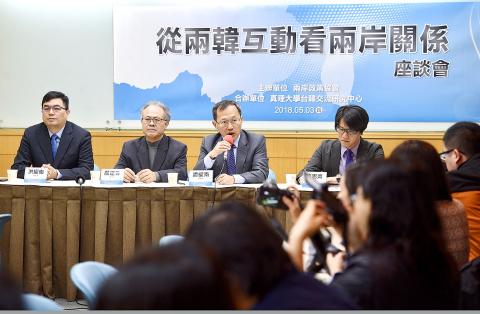
Photo: Peter Lo, Taipei Times
Taiwan has chosen to side with the “alliance,” which is led by the US and includes Europe and Japan, at a time when competition has erupted between China and the US, he said.
What Taiwan should do now is to strengthen itself and diversify its risk by reaching out to the rest of the world and walking away from the framework established by China, Yan said.
In the face of pressure from China, maintaining the “status quo” is the best scenario that can be visualized in cross-strait relations, he added.
Taiwan should also turn its sights on the global picture instead of looking only at China, “unless Beijing one day begins internal reform,” he said.
Another academic, National Taiwan Normal University professor Fan Shih-ping (范世平), expressed a similar view, saying that the severance of diplomatic ties between Taiwan and the Dominican Republic would only make Taiwan stronger and push it closer to the US and Japan.
“Although it was regrettable, the development will have no effect on Taiwanese,” Fan said.
“The number of diplomatic allies carries some symbolic significance, but does not mean anything substantial to Taiwanese, given the limited amount of bilateral trade and commercial ties,” Fan said.
China will continue its efforts to lure Taiwan’s diplomatic allies, but Taiwanese have become used to China’s bullying tactics and are not ruffled by them, he said.
Beijing’s actions will only serve to stir up antagonism among Taiwanese toward China, and make President Tsai Ing-wen (蔡英文) more resilient in her leadership of Taiwan, he added.
As Taiwan and the US prepare to hold their annual defense industry conference this month — in Taiwan for the first time in 16 years — China timed its diplomatic move to show Chinese that it can punish Taiwan and the US, and to bolster internal unity around Chinese President Xi Jinping (習近平), Fan said.
The termination of formal diplomatic relations between Taiwan and the Dominican Republic on Monday has left Taiwan with only 19 diplomatic allies, including the Vatican and others in Latin America, the Caribbean, Africa and the Pacific.

SECURITY: Starlink owner Elon Musk has taken pro-Beijing positions, and allowing pro-China companies to control Taiwan’s critical infrastructure is risky, a legislator said Starlink was reluctant to offer services in Taiwan because of the nation’s extremely high penetration rates in 4G and 5G services, the Ministry of Digital Affairs said yesterday. The ministry made the comments at a meeting of the legislature’s Transportation Committee, which reviewed amendments to Article 36 of the Telecommunications Management Act (電信管理法). Article 36 bans foreigners from holding more than 49 percent of shares in public telecommunications networks, while shares foreigners directly and indirectly hold are also capped at 60 percent of the total, unless specified otherwise by law. The amendments, sponsored by Chinese Nationalist Party (KMT) Legislator Ko
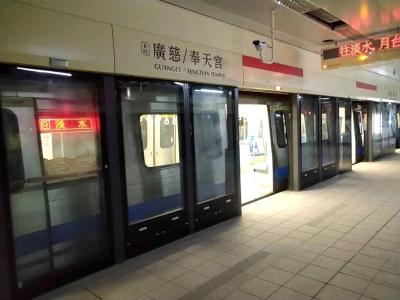
The eastern extension of the Taipei MRT Red Line could begin operations as early as late June, the Taipei Department of Rapid Transit Systems said yesterday. Taipei Rapid Transit Corp said it is considering offering one month of free rides on the new section to mark its opening. Construction progress on the 1.4km extension, which is to run from the current terminal Xiangshan Station to a new eastern terminal, Guangci/Fengtian Temple Station, was 90.6 percent complete by the end of last month, the department said in a report to the Taipei City Council's Transportation Committee. While construction began in October 2016 with an
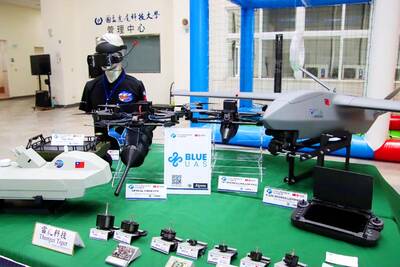
NON-RED SUPPLY: Boosting the nation’s drone industry is becoming increasingly urgent as China’s UAV dominance could become an issue in a crisis, an analyst said Taiwan’s drone exports to Europe grew 41.7-fold from 2024 to last year, with demand from Ukraine’s fight against Russian aggression the most likely driver of growth, a study showed. The Institute for Democracy, Society and Emerging Technology (DSET) in a statement on Wednesday said it found that many of Taiwan’s uncrewed aerial vehicle (UAV) sales were from Poland and the Czech Republic. These countries likely transferred the drones to Ukraine to aid it in its fight against the Russian invasion that started in 2022, it said. Despite the gains, Taiwan is not the dominant drone exporter to these markets, ranking second and fourth

Japanese Prime Minister Sanae Takaichi’s comment last year on Tokyo’s potential reaction to a Taiwan-China conflict has forced Beijing to rewrite its invasion plans, a retired Japanese general said. Takaichi told the Diet on Nov. 7 last year that a Chinese naval blockade or military attack on Taiwan could constitute a “survival-threatening situation” for Japan, potentially allowing Tokyo to exercise its right to collective self-defense. Former Japan Ground Self-Defense Force general Kiyofumi Ogawa said in a recent speech that the remark has been interpreted as meaning Japan could intervene in the early stages of a Taiwan Strait conflict, undermining China’s previous assumptions


 RSS
RSS