


The May 1 Action Alliance on Monday announced that an appeal for a referendum on workers’ rights and wage increases are to be the focus of the Workers’ Day march in Taipei on Tuesday next week.
The annual march is to begin on Ketagalan Boulevard in front of the Presidential Office Building and proceed to the Legislative Yuan a few blocks away, said the alliance, which is comprised of trade unions.
The focus of this year’s event is to be “opposition to overwork and demanding a referendum on higher wages and workers’ rights,” it said.
The alliance opposes this year’s revisions to the Labor Standards Act (勞動基準法), which it has criticized as “backsliding” on workers’ rights.
The alliance is proposing holding a referendum so the “vicious revisions” can be overturned.
Labor Rights Referendum Alliance member Hsieh Yi-hung (謝毅弘) said efforts are being made to solicit endorsement of the proposed referendum, which would also call for a new law that regulates national holidays and returns the seven holidays that were canceled as part of the amended law.
The alliance hopes that 300,000 signatures backing the referendum can be collected before the end of August so that the referendum can be held at the same time as the nine-in-one local elections on Nov. 24, Hsieh said.
Calling for the monthly minimum wage to be raised from NT$22,000 to NT$28,000 over the next three years, Taiwan Higher Education Union researcher Chen Po-chien (陳柏謙) said that the nation experienced accumulated economic growth of more than 20 percent from 2007 to 2016.
During that period, the consumer price index rose 9.1 percent, but the earnings of private-sector workers only grew 8.3 percent.
“Taiwanese workers should be given a 10 percent wage increase every year over the next three years,” Chen said. “This is no more than a basic requirement.”

FUKUOKA SITUATION: Japanese media reported that the pathogen is expected to be identified by the summer, while the CDC downplayed the idea that it was hMPV A “mysterious cold-like illness” reported in Japan’s Fukuoka Prefecture does not seem to be a new disease, but Japanese authorities have been asked about the situation, the Centers for Disease Control (CDC) said yesterday. The Fukuoka Prefectural Medical Association on Wednesday told a news conference that a “mystery cold” that has become a hot topic on social media is “highly likely to be caused by some kind of viral infection,” Japan’s KBC News reported. “Many people are experiencing symptoms starting with a sore throat, followed by a runny nose, phlegm and a severe cough,” KBC News reported, citing association officials. Health authorities are

Nvidia Corp CEO Jensen Huang (黃仁勳) arrived in Taiwan yesterday ahead of upcoming AI and technology events, saying he plans to meet with clients and Taiwan Semiconductor Manufacturing Co Chairman C.C. Wei (魏哲家) during his visit. After landing at Taipei Songshan Airport, Huang posed for photos with fans and handed out Yakult drinks to reporters and supporters waiting at the scene, saying he has “a lot to do” during the trip. Asked about reports that Nvidia’s planned headquarters site in Taipei’s Beitou Shilin Technology Park could break ground on May 27, Huang said that if the company holds an event, he would

The Ministry of Finance this afternoon announced the winning numbers for the March-April uniform invoice lottery. The winning number for the NT$10 million (US$318,060) special prize is 19531471, and the winning number for the NT$2 million grand prize is 85941329. Three numbers were drawn for the NT$200,000 first prize: 07225810, 20231230 and 83518781. Those with receipts matching the last seven digits of any of the first-prize numbers will win the NT$40,000 second prize, while those matching the last six digits will win the NT$10,000 third prize. Those whose receipts match the last five digits of the first-prize numbers can claim the NT$4,000 fourth prize,
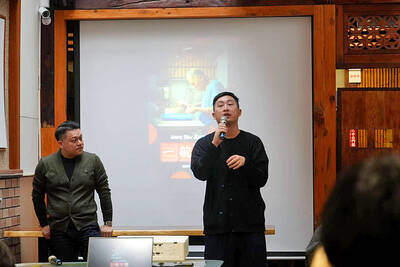
Taiwan Travelogue (臺灣漫遊錄), which earlier this week became the first Taiwanese novel to win the International Booker Prize, is to be adapted into a television series through a Taiwan-Japan coproduction, producer Chang Chen-yu (張辰漁) said yesterday. Chang, a producer at World Softest Production Film Co, wrote on Facebook that the company had been searching for projects with international appeal that retain a strong Taiwanese identity after colleagues and Japanese partners strongly recommended the novel. After reading the book, Chang said he immediately decided to pursue the screen rights. “A great story has the power to transcend time and borders, and connect countless people,”


 RSS
RSS