


Academia Sinica member Wu Maw-kuen (吳茂昆) has been appointed minister of education, Cabinet spokesman Hsu Kuo-yung (徐國勇) announced yesterday.
Hsu praised Wu, who is scheduled to take office on Thursday, for his distinguished contributions and experience in the areas of higher education and scientific research, saying he is “very suitable to serve as education minister.”
The physicist was named to take over the post left vacant by Pan Wen-chung (潘文忠), who resigned last week over a controversy surrounding his alleged interference in the appointment of National Taiwan University (NTU) president-elect Kuan Chung-ming (管中閔).
Premier William Lai (賴清德) approved Pan’s resignation on Saturday.
Lai the next day said that the role of the education minister carries heavy responsibility, and that whoever takes over the position is tasked with far more duties than simply resolving the NTU predicament.
Wu, 68, has a doctorate in physics from the University of Houston and has served as head of the now-defunct National Science Council, at the Institute of Physics at the Academia Sinica and at National Dong Hwa University in Hualien County.
The National Science Council was in 2014 upgraded to the Ministry of Science and Technology.
Pan drew public criticism over his refusal to approve the appointment of Kuan, who was on Jan. 5 elected to succeed Yang Pan-chyr (楊泮池), whose tenure as NTU president ended in June last year.
However, Kuan has since been accused of plagiarism and a conflict of interest, which has cast doubt on the legitimacy of his election and prevented him from taking office on Feb. 1 as scheduled.
Last month, more allegations surfaced accusing Kuan of having illegally taught in China since 2005.
Although the accusations were later resolved, Pan continued to ask Kuan to answer the allegations.
Due to the delay in approving Kuan’s appointment, the education ministry was accused of interfering in NTU’s autonomy.
A group of NTU professors, students and alumni on Thursday last week jointly filed a complaint with the Taipei District Prosecutors’ Office accusing Pan of nonfeasance.
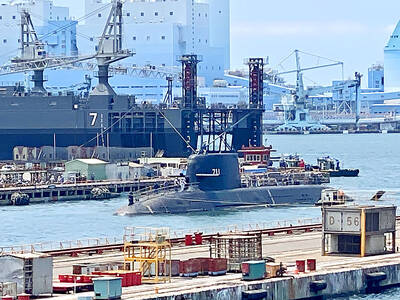
AGING: While Japan has 22 submarines, Taiwan only operates four, two of which were commissioned by the US in 1945 and 1946, and transferred to Taiwan in 1973 Taiwan would need at least 12 submarines to reach modern fleet capabilities, CSBC Corp, Taiwan chairman Chen Cheng-hung (陳政宏) said in an interview broadcast on Friday, citing a US assessment. CSBC is testing the nation’s first indigenous defense submarine, the Hai Kun (海鯤, Narwhal), which is scheduled to be delivered to the navy next month or in July. The Hai Kun has completed torpedo-firing tests and is scheduled to undergo overnight sea trials, Chen said on an SET TV military affairs program. Taiwan would require at least 12 submarines to establish a modern submarine force after assessing the nation’s operational environment and defense

A white king snake that frightened passengers and caused a stir on a Taipei MRT train on Friday evening has been claimed by its owner, who would be fined, Taipei Rapid Transit Corp (TRTC) said yesterday. A person on Threads posted that he thought he was lucky to find an empty row of seats on Friday after boarding a train on the Bannan (Blue) Line, only to spot a white snake with black stripes after sitting down. Startled, he jumped up, he wrote, describing the encounter as “terrifying.” “Taipei’s rat control plan: Release snakes on the metro,” one person wrote in reply, referring
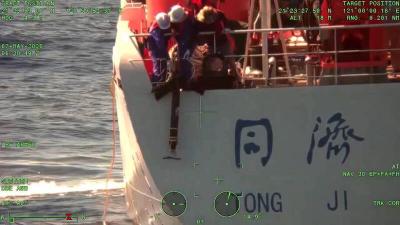
The coast guard today said that it had disrupted "illegal" operations by a Chinese research ship in waters close to the nation and driven it away, part of what Taipei sees a provocative pattern of China's stepped up maritime activities. The coast guard said that it on Thursday last week detected the Chinese ship Tongji (同濟號), which was commissioned only last year, 29 nautical miles (54km) southeast of the southern tip of Taiwan, although just outside restricted waters. The ship was observed lowering ropes into the water, suspected to be the deployment of scientific instruments for "illegal" survey operations, and the coast
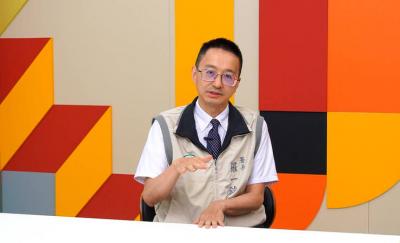
Taiwan’s two cases of hantavirus so far this year are on par with previous years’ case numbers, and the government is coordinating rat extermination work, so there should not be any outbreaks, Centers for Disease Control (CDC) Director-General Philip Lo (羅一鈞) said today in an interview with the Liberty Times (the Taipei Times’ sister newspaper). An increase in rat sightings in Taipei and New Taipei City has raised concerns about the spread of hantavirus, as rats can carry the disease. In January, a man in his 70s who lived in Taipei’s Daan District (大安) tested positive posthumously for hantavirus, Taiwan’s


 RSS
RSS