

Leaders of several religious groups at a public hearing on Monday criticized a proposed draft act governing private foundations, saying transparency of financial information could bring harm to their donors and cause quarrels between couples.
Chinese Nationalist Party (KMT) Legislator John Wu (吳志揚) convened the hearing on the act, which is under review by the legislature’s Judiciary and Organic Laws and Statutes Committee.
Master Ching Yao (淨耀), president of the New Taipei City Buddhist Association, told the hearing that his group’s finances, especially those for religious activities, have always been transparent to its members and were reported to government authorities.
The association would not protest being regulated by the proposed act, but the government should give religious groups more leeway on their finances, Ching Yao said.
Religious doctrines are often far more stringent than secular laws, he added.
Master Chueh Pei (覺培), the secretary-general of the Zhonghua Buddhist Union, said discussing such issues seemed to imply that religion or religious groups were without supervision, which is slandering the name of Buddhism.
As a religion, we have a duty to protect our believers, Chueh Pei said, adding that making information on donations public could lead to donors being kidnapped and held for ransom.
Fan Ssu-yun (范思筠), honorary chairperson of Longshan Temple in Nantou County, said people are asking to borrow money from her after the temple began having to issue receipts for donations.
If all donations must be registered, she might have to file for divorce to continue helping with public welfare work so that her husband would not find out how much she is donating, Fan said.
However, financial transparency and religious freedom are separate issues, Democratic Progressive Party Legislator Yu Mei-nu (尤美女) said.
Without a valid reason for why their finances should not be monitored, religious groups must realize that funding from the public is answerable to the public, Yu said.
The Taiwan Presbyterian Church, its churches and facilities — 1,260 in total — have always been transparent and just in the handling of their finances, Taiwan Presbyterian Church Research and Development Center director Cheng Ying-er (鄭英兒) said.
The church supports the passage of the draft bill, so all private foundations would fall under a common regulatory law.
Religious groups are unique entities in that they provide funding for education and hospitals, such as Mackay Memorial Hospital and Chang Jung Christian University, he said, suggesting that the government consider this aspect and create management loopholes for such entities for the sake of the law.
Deputy Minister of Justice Chen Ming-tang (陳明堂) said the draft act would be the common law regulating all private foundations, but that foundations regulated by the Medical Act (醫療法) and the Private School Act (私立學校法) should observe those laws first.
Whether religious groups should be excluded is up to the Legislative Yuan, he added.
Deputy Minister of the Interior Chiu Chang-yueh (邱昌嶽) said the possibility of drafting a special act for religion is being mulled, but until that time, religion and religious groups, given their unique position, should be exempted from the proposed foundation act.
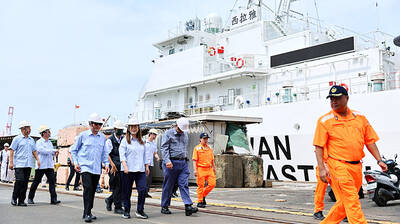
Ocean Affairs Council (OAC) Minister Kuan Bi-ling (管碧玲) on Wednesday said decommissioned coast guard vessels were given to the Philippines to enhance regional rescue capacity and would not affect Taiwanese fishers’ rights and benefits. Kuan made the remarks after confirmation on Tuesday that a 500-tonne Coast Guard Administration (CGA) patrol and rescue vessel would be given to the Philippine Coast Guard. The donation ceremony was reportedly done in Manila, but whether the vessel — previously numbered “CG123” and named Kinmen (金門) — has been handed over has yet to be confirmed. China’s Taiwan Affairs Office (TAO) on Wednesday criticized the donation for “taking

The Ministry of Finance today announced the winning numbers for the July-August uniform invoice lottery. The winning number for the NT$10 million (US$314,663) special prize is 89996565, while the winning number for the NT$2 million grand prize is 91098182. Three numbers were drawn for the NT$200,000 first prize: 54348835, 44991397 and 06595111. Those with receipts matching the last seven digits of any of the first-prize numbers can claim the NT$40,000 second prize, while those matching the last six digits qualify for the NT$10,000 third prize. Those whose receipts match the last five digits of the first-prize numbers are eligible for the NT$4,000 fourth prize,

The National Police Agency’s Third Special Police Corps yesterday said that from May to July, it intercepted five smuggling operations from China, seizing more than 70,000 counterfeit Beyblades with an estimated infringement value of NT$34.45 million (US$1.08 million). It added that any bootleg unit that reached the local market could present hidden health hazards to players. Beyblades, a line of spinning toy tops used in competitive gaming and developed in Japan by toy company Takara Tomy, have become popular in Taiwan, making them a target for fraudsters. The Third Special Police Corps, dedicated to safeguarding maritime borders and trade lines,

Taiwan has upgraded its maritime patrol capacity around the Pratas Islands (Dongsha Islands, 東沙群島) in the disputed South China Sea, including regularly sending larger ships there, the government said on Wednesday, responding to an increase in Chinese activities. Lying roughly between southern Taiwan and Hong Kong, the Taiwan-controlled Pratas Islands are seen by security experts as vulnerable to a Chinese attack due to their distance — more than 400km — from Taiwan. In a statement late on Wednesday, the Coast Guard Administration (CGA) said its overall patrol and enforcement capacity in Pratas waters has been “comprehensively upgraded.” With the completion of a wharf


 RSS
RSS