


The Ministry of Science and Technology yesterday hailed the nation’s “top 10 coolest technology start-ups” — five of which are developing artificial intelligence (AI) — and said that their aggregate funding has reached US$608 million.
The 10 start-ups were selected out of 122 candidates by 22 industrial experts and investors, Deputy Minister of Science and Technology Hsu Yu-chin (許有進) told a news conference in Taipei, adding that the ministry hoped to inspire innovation in local businesses with the selection.
The AI developers in the list are Appier Inc (沛星互動科技), CloudMile Ltd (萬里雲互聯), MoBagel Inc (行動貝果), Umbo CV (盾心科技) and Viscovery Pte Ltd (創意引睛).
The nation’s cumulative strength in local industries, such as semiconductor manufacturing, integrated circuit (IC) design and “smart” machines paves the way for it to participate in the booming AI industry, Hsu said, adding that AI is also the key to the nation’s industrial upgrade.
CloudMile is Google Cloud Platform’s only partner in Asia and its new AI technology for fabric recognition has been introduced in the local textile industry, company founder and executive director Spencer Liu (劉永信) said.
Electric scooter maker Gogoro Inc (睿能創意) and “smart” helmet maker Jarvish’s (酷設工坊) products were heralded as outstanding examples of Internet of Things (IOT) technology.
Despite some people’s doubts about electric vehicles, sales of Gogoro scooters have reached 60,000 over the past three years, company project manager Jason Lin (林立生) said, adding that the vehicles’ accumulated mileage amounts to 322 million kilometers — or 5,000 trips around the Earth.
The remaining three start-ups that were honored are iStaging Corp (愛實境), a developer of augmented reality and virtual reality (VR) applications, and digital medical service suppliers Maisense Inc (美盛醫電) and Health2Sync Co (智抗糖).
In June, the ministry would open a “business incubator base” at the Taipei Arena, named the Taiwan Tech Arena, at which foreign incubators are to help local entrepreneurs explore new business models, Hsu added.
French Tech Taiwan, one of France’s overseas technological hubs, has agreed to enter the base, French Office in Taipei Director Benoit Guidee said on Wednesday, adding that Taiwan and Franceshould increase collaboration on technology.

FUKUOKA SITUATION: Japanese media reported that the pathogen is expected to be identified by the summer, while the CDC downplayed the idea that it was hMPV A “mysterious cold-like illness” reported in Japan’s Fukuoka Prefecture does not seem to be a new disease, but Japanese authorities have been asked about the situation, the Centers for Disease Control (CDC) said yesterday. The Fukuoka Prefectural Medical Association on Wednesday told a news conference that a “mystery cold” that has become a hot topic on social media is “highly likely to be caused by some kind of viral infection,” Japan’s KBC News reported. “Many people are experiencing symptoms starting with a sore throat, followed by a runny nose, phlegm and a severe cough,” KBC News reported, citing association officials. Health authorities are

Nvidia Corp CEO Jensen Huang (黃仁勳) arrived in Taiwan yesterday ahead of upcoming AI and technology events, saying he plans to meet with clients and Taiwan Semiconductor Manufacturing Co Chairman C.C. Wei (魏哲家) during his visit. After landing at Taipei Songshan Airport, Huang posed for photos with fans and handed out Yakult drinks to reporters and supporters waiting at the scene, saying he has “a lot to do” during the trip. Asked about reports that Nvidia’s planned headquarters site in Taipei’s Beitou Shilin Technology Park could break ground on May 27, Huang said that if the company holds an event, he would

The Ministry of Finance this afternoon announced the winning numbers for the March-April uniform invoice lottery. The winning number for the NT$10 million (US$318,060) special prize is 19531471, and the winning number for the NT$2 million grand prize is 85941329. Three numbers were drawn for the NT$200,000 first prize: 07225810, 20231230 and 83518781. Those with receipts matching the last seven digits of any of the first-prize numbers will win the NT$40,000 second prize, while those matching the last six digits will win the NT$10,000 third prize. Those whose receipts match the last five digits of the first-prize numbers can claim the NT$4,000 fourth prize,
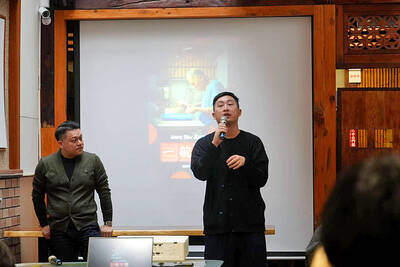
Taiwan Travelogue (臺灣漫遊錄), which earlier this week became the first Taiwanese novel to win the International Booker Prize, is to be adapted into a television series through a Taiwan-Japan coproduction, producer Chang Chen-yu (張辰漁) said yesterday. Chang, a producer at World Softest Production Film Co, wrote on Facebook that the company had been searching for projects with international appeal that retain a strong Taiwanese identity after colleagues and Japanese partners strongly recommended the novel. After reading the book, Chang said he immediately decided to pursue the screen rights. “A great story has the power to transcend time and borders, and connect countless people,”


 RSS
RSS