


Civil groups yesterday urged the Executive Yuan to amend the Environmental Impact Assessment Act (環境影響評估法) during this legislative session, in light of a controversy over the Shenao Power Plant (深澳電廠), which obtained approval from the Environmental Protection Administration (EPA).
The EPA’s environmental impact assessment (EIA) grand assembly on March 14 approved Taiwan Power Co’s (Taipower) project to build a new coal-fired Shenao plant in New Taipei City’s Rueifang District (瑞芳), after the plant was demolished in 2011.
EPA Deputy Minister and assembly chairperson Chan Shun-kuei (詹順貴) has come under fire due to his decisive vote for the project when assembly members were tied 8-8.
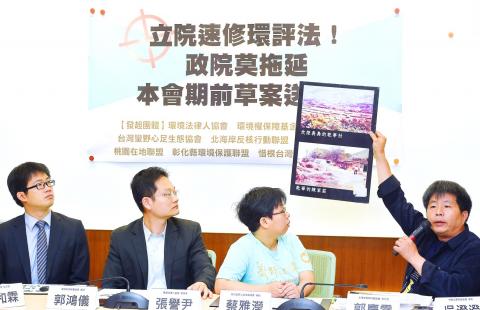
Photo: Liao Chen-huei, Taipei Times
Despite his personal objection to the project, he was not entitled to reject it under the current legal framework, as the project had passed an assessment in 2006, Chan said, calling on the public to turn their fury into calls for amending the act.
Premier William Lai (賴清德) on Tuesday last week promised to send the act’s draft amendment to the Legislative Yuan within six months, but environmental groups yesterday questioned his resolve to reform the assessment system.
The EPA in September last year launched its draft amendment to the act, and the Executive Yuan should forward it to the legislature soon, as the legislature will become idle with the approach of the local elections on Nov. 24, the Environmental Jurists Association said.
The Shenao project highlights a significant defect of the current assessment system, as the utility is not required to re-evaluate local environmental conditions when building the plant, Green Citizens’ Action Alliance researcher Wu Cheng-cheng (吳澄澄) said.
The act should be amended to require project developers to conduct new assessments if they fail to complete construction in a given period, she said.
While Taipower is conducting a second-stage assessment for decommissioning the Jinshan Nuclear Power Plant in New Taipei City’s Shihmen District (石門), it did not provide thorough information to local residents, who now can only argue with the utility about compensation, Northern Coast Anti-Nuclear Action Alliance executive director Kuo Ching-lin (郭慶霖) said.
The government should help residents interpret the difficult information about nuclear power plants, as the utility has to decommission two other nuclear plants and the Institute of Nuclear Energy Research, and tackle the nuclear waste on Orchid Island (Lanyu, 蘭嶼), Kuo said, adding that the act should call for greater public participation during assessments.
Other groups said that the act should also include regulations about strategic environmental assessments for large-scale developments, such as offshore wind farms, confirm an assessment’s effect on a development’s approval and sever the symbiotic relation between developers and consulting firms.

Actor Darren Wang (王大陸) was sentenced to six months in prison, commutable to a fine, by the New Taipei District Court today for contravening the Personal Data Protection Act (個人資料保護法) in a case linked to an alleged draft-dodging scheme. Wang allegedly paid NT$3.6 million (US$114,380) to an illegal group to help him evade mandatory military service through falsified medical documents, prosecutors said. He transferred the funds to Chen Chih-ming (陳志明), the alleged mastermind of a draft-evasion ring, although he lost contact with him as he was already in detention on fraud charges, they said. Chen is accused of helping a

SECURITY: Starlink owner Elon Musk has taken pro-Beijing positions, and allowing pro-China companies to control Taiwan’s critical infrastructure is risky, a legislator said Starlink was reluctant to offer services in Taiwan because of the nation’s extremely high penetration rates in 4G and 5G services, the Ministry of Digital Affairs said yesterday. The ministry made the comments at a meeting of the legislature’s Transportation Committee, which reviewed amendments to Article 36 of the Telecommunications Management Act (電信管理法). Article 36 bans foreigners from holding more than 49 percent of shares in public telecommunications networks, while shares foreigners directly and indirectly hold are also capped at 60 percent of the total, unless specified otherwise by law. The amendments, sponsored by Chinese Nationalist Party (KMT) Legislator Ko

The eastern extension of the Taipei MRT Red Line could begin operations as early as late June, the Taipei Department of Rapid Transit Systems said yesterday. Taipei Rapid Transit Corp said it is considering offering one month of free rides on the new section to mark its opening. Construction progress on the 1.4km extension, which is to run from the current terminal Xiangshan Station to a new eastern terminal, Guangci/Fengtian Temple Station, was 90.6 percent complete by the end of last month, the department said in a report to the Taipei City Council's Transportation Committee. While construction began in October 2016 with an

NON-RED SUPPLY: Boosting the nation’s drone industry is becoming increasingly urgent as China’s UAV dominance could become an issue in a crisis, an analyst said Taiwan’s drone exports to Europe grew 41.7-fold from 2024 to last year, with demand from Ukraine’s fight against Russian aggression the most likely driver of growth, a study showed. The Institute for Democracy, Society and Emerging Technology (DSET) in a statement on Wednesday said it found that many of Taiwan’s uncrewed aerial vehicle (UAV) sales were from Poland and the Czech Republic. These countries likely transferred the drones to Ukraine to aid it in its fight against the Russian invasion that started in 2022, it said. Despite the gains, Taiwan is not the dominant drone exporter to these markets, ranking second and fourth


 RSS
RSS