


Calls for a literary museum to honor and commemorate poet Mo Yun-tuan (莫運端), better known for his pseudonym Lo Fu (洛夫), who passed away on Monday at the age of 89, have prompted the Kinmen County Cultural Affairs Bureau to mull the project’s feasibility.
Born in Hunan Province in 1928, Mo was drafted into military service in 1949 and came to Taiwan with the Nationalist government.
He wrote his first poem while serving in Kinmen and continued to publish throughout his life.
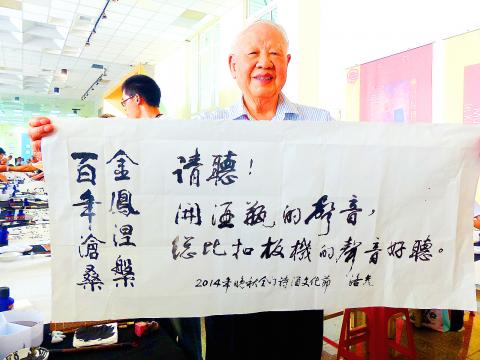
Photo: Wu Cheng-ting, Taipei Times
Bureau Director-General Lu Kun-ho (呂坤和) said the agency had planned to invite Mo to present a talk in Kinmen in July or August last year, but was forced to cancel when he fell ill.
The cancelation forever deprived Kinmen residents of the opportunity to see the great poet, Lu said.
It was in 1959, while Mo was serving as a soldier in the Wu Yang trenches on Taiwushan (太武山) in Kinmen under on-and-off shelling by the People’s Liberation Army after the 823 Artillery Bombardment, that he wrote his first long poem, Death of a Stone Chamber (石室之死), Lu said.
Also in Kinmen, Mo met the woman who would later become his wife, Chen Chiung-fang (陳瓊芳), Lu said, adding that the bureau was planning to hold a music festival to commemorate Mo choosing to reside in the county.
Mo returned to Taiwan in 2016 after emigrating to Canada in 1996.
The bureau had always planned to found the Kinmen Literary Museum, even considering land near Jinsha Township’s (金沙) Jui Yu School, but had canceled the plans after discovering that it was private land, Lu said.
In the past, Kinmen County Councilor Chou Tzu-chieh (周子傑) of the Chinese Nationalist Party (KMT) had also arranged for Mo to meet with bureau officials and officials from the county’s public works department to discuss setting up the literary museum, Lu said.
The plan was for the department to provide the land, but the project has been put on hold as the county government wished to consider opinions from all sides, Lu said.
Former National Museum of History director Chang Yui-tan (張譽騰) had made known his support for establishing the Lo Fu Literary Museum in Kinmen, saying that Mo had deep ties with Kinmen.
A literary museum to preserve and annotate the literary works with which Mo had graced posterity is the best way to commemorate the late poet, Chang said.
Minister of Culture Cheng Li-chiun (鄭麗君) praised Mo for being “a leader of Taiwanese modern poetry,” adding that she would recommend that President Tsai Ing-wen (蔡英文) give Mo a commendation.
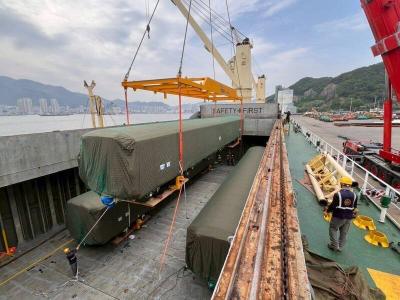
The first of 10 new high-capacity trains purchased from South Korea’s Hyundai Rotem arrived at the Port of Taipei yesterday to meet the demands of an expanding metro network, Taipei Rapid Transit Corp (TRTC) said yesterday. The train completed a three-day, 1,200km voyage from the Port of Masan in South Korea, the company said. Costing NT$590 million (US$18.79 million) each, the new six-carriage trains feature a redesigned interior based on "human-centric" transportation concepts, TRTC said. The design utilizes continuous longitudinal seating to widen the aisles and optimize passenger flow, while also upgrading passenger information displays and driving control systems for a more comfortable
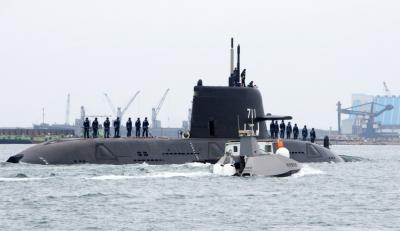
Taiwan's first indigenous defense submarine, the SS-711 Hai Kun (海鯤, or Narwhal), departed for its 13th sea trial at 7am today, marking its seventh submerged test, with delivery to the navy scheduled for July. The outing also marked its first sea deployment since President William Lai (賴清德) boarded the submarine for an inspection on March 19, drawing a crowd of military enthusiasts who gathered to show support. The submarine this morning departed port accompanied by CSBC Corp’s Endeavor Manta (奮進魔鬼魚號) uncrewed surface vessel and a navy M109 assault boat. Amid public interest in key milestones such as torpedo-launching operations and overnight submerged trials,
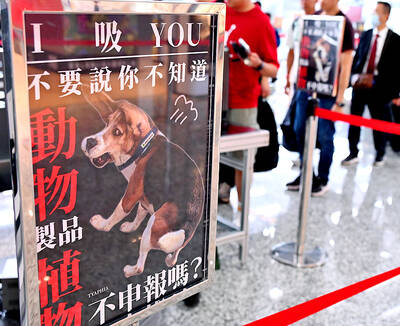
Quarantine awareness posters at Taiwan Taoyuan International Airport have gone viral for their use of wordplay. Issued by the airport branch of the Animal and Plant Health Inspection Agency, the posters feature sniffer dogs making a range of facial expressions, paired with advisory messages built around homophones. “We update the messages for holidays and campaign needs, periodically refreshing materials to attract people’s attention,” quarantine officials said. “The aim is to use the dogs’ appeal to draw focus to quarantine regulations.” A Japanese traveler visiting Taiwan has posted a photo on X of a poster showing a quarantine dog with a

Taiwan’s coffee community has launched a “one-person-one-e-mail” campaign, calling for people to send a protest-e-mail to the World Coffee Championships (WCC) urging it to redesignate Taiwanese competitors as from “Taiwan,” rather than “Chinese Taipei.” The call followed sudden action last week after the WCC changed all references to Taiwanese competitors from “Taiwan” to “Chinese Taipei,” including recent World Latte Art champion Bala (林紹興), who won the World Latte Art Championship in San Diego earlier this month. When Bala received the trophy, he was referred to as representing Taiwan, as well as in the announcement on the WCC’s Web site, until it


 RSS
RSS