


Police and fire department officers yesterday accused the government of making them work for free after they reach their monthly overtime limits.
According to Article 23 of the Civil Service Protection Act (公務人員保障法), civil servants should receive overtime pay, compensatory time off, and rewards or equivalent compensation for overtime work, said a police officer nicknamed Ta Pai (大白), who wore a mask at the news conference yesterday.
In 2000, the Executive Yuan set limits for police working overtime. Under the regulations, police are not paid for overtime work when their monthly overtime exceeds 100 hours or when their monthly overtime pay exceeds NT$17,000 (US$583).
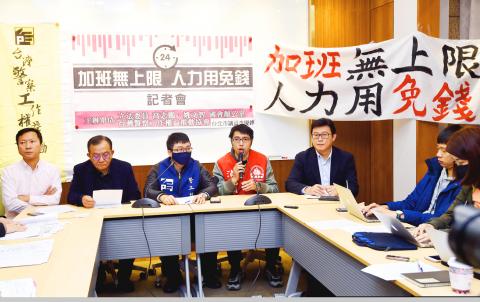
Photo: Chien Jung-fong, Taipei Times
If they exceed the limit, they only receive compensatory time off or a written commendation, which the government considers a reward equivalent to overtime pay.
Among police, this rule has come to be known as the “volunteer police program clause,” because it has allowed government agencies to overwork them and not pay them for it.
The Labor Standards Act (勞動基準法) does not apply to civil servants and officials do not recognize police labor unions, making it impossible for police officers to negotiate their work conditions, said Ta Pai, who is also a Taiwan Police Union member.
The union demanded that the government abolish the limits for overtime pay, provide overtime pay at rates stipulated by the labor law, and release police work hours and other related information.
According to the union, the Taipei City Police Department last year paid its officers NT$35 million less than they should have earned because of the overtime pay limits.
The number would have been about 10 times more if police officers had been given overtime pay of between 1.33 times and 1.66 times their hourly wages, as stipulated by the labor law, the union said.
Firefighters last year pointed out similar problems and government officials responded by saying they would look into it, but never responded, National Association for Firefighters’ Rights president Yang Shih-wei (楊適瑋) said.
When prolonged work hours become the new norm for police, the quality of law enforcement and police labor rights are all sacrificed, Democratic Progressive Party Taipei City Councilor Lee Ching-feng (李慶鋒) said.
The personnel turnover rate at police departments would continue to rise if the issue remains unsolved, Lee added.
Directorate-General of Personnel Administration official Huang Yue-ying (黃悅茵) said that because abolishing the overtime pay limits involves government budgets, the Ministry of the Interior would have to thoroughly review the issue and work with local governments to decide how to handle it best.
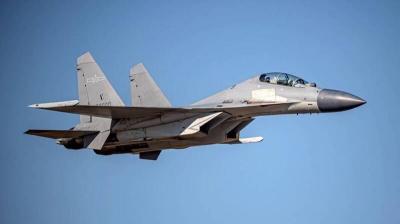
Eight Chinese naval vessels and 24 military aircraft were detected crossing the median line of the Taiwan Strait between 6am yesterday and 6am today, the Ministry of National Defense said this morning. The aircraft entered Taiwan’s northern, central, southwestern and eastern air defense identification zones, the ministry said. The armed forces responded with mission aircraft, naval vessels and shore-based missile systems to closely monitor the situation, it added. Eight naval vessels, one official ship and 36 aircraft sorties were spotted in total, the ministry said.
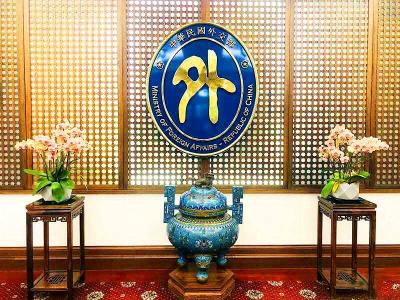
The Ministry of Foreign Affairs (MOFA) today said that if South Korea does not reply appropriately to its request to correct Taiwan’s name on its e-Arrival card system before March 31, it would take corresponding measures to alter how South Korea is labeled on the online Taiwan Arrival Card system. South Korea’s e-Arrival card system lists Taiwan as “China (Taiwan)” in the “point of departure” and “next destination” fields. The ministry said that it changed the nationality for South Koreans on Taiwan’s Alien Resident Certificates from “Korea” to “South Korea” on March 1, in a gesture of goodwill and based on the

Taiwanese officials were shown the first of 66 F-16V fighter jets purchased by Taiwan from the United States, the Ministry of National Defense said yesterday, adding the aircraft has completed an initial flight test and is expected to be delivered later this year. A delegation led by Deputy Minister of National Defense Hsu Szu-chien (徐斯儉) visited Lockheed Martin’s F-16 C/D Block 70 (also known as F-16V) assembly line in South Carolina on March 16 to view the aircraft. The jet will undergo a final acceptance flight in the US before being delivered to Taiwan, the
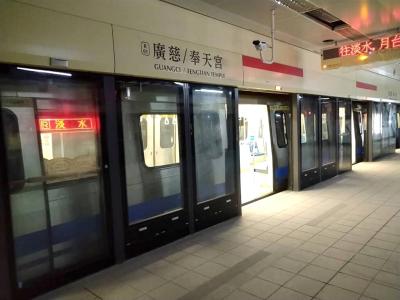
The New Taipei Metro's Sanyin Line and the eastern extension of the Taipei Metro's Tamsui-Xinyi Line (Red Line) are scheduled to begin operations in June, the National Development Council said today. The Red Line, which terminates at Xiangshan Station, would be connected by the 1.4km extension to a new eastern terminal, Guangci/Fengtian Temple Station, while the Sanyin Line would link New Taipei City's Tucheng and Yingge stations via Sanxia District (三峽). The council gave the updates at a council meeting reviewing progress on public construction projects for this year. Taiwan's annual public infrastructure budget would remain at NT$800 billion (US$25.08 billion), with NT$97.3


 RSS
RSS