


The American Institute in Taiwan (AIT) yesterday released a minute-long video promoting its upcoming move from Taipei’s Daan District (大安) to Neihu District (內湖).
The video begins with AIT Director Kin Moy in his office inviting viewers to join him on a trip to see the new complex, which is still under construction.
The camera follows Moy to the Taipei Mass Rapid Transit System’s Daan Station, where he boards a train and alights at Neihu Station, leaves through Exit 2 and walks along Jinhu Road to the AIT complex on Jinlong Road.
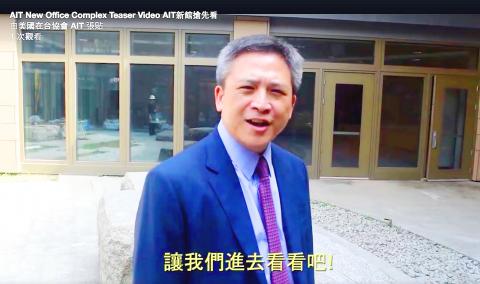
Photo: screen grab from Facebook
After a brief look at the decorated, curved wall leading to the front doors of the office building, Moy opens one of the doors and the video ends.
Moy said the nearly decade-long project is expected to be completed soon and asked viewers to “stay tuned” as it nears the “finish line.”
“As many of you know, we at AIT have been working on an exciting project. All of us are proud that we will bring it to completion later this summer,” he said.
Construction of the US$242.6 million compound began in 2009, but work was temporarily suspended in 2013 over a contract dispute about NT$470 million (US$16.1 million at the current exchange rate) in back payment between US-based Weston Solutions and its three Taiwanese subcontractors.
Built on a 6.5-hectare plot, the new facility is to house all of AIT’s departments, including the agricultural and commercial sections that are housed in different locations.
After the move, AIT’s 2.6-hectare Daan complex is to be returned to the Taipei City Government, which last year said it wanted to build a concert hall and library at the site.
Following the enactment of the US’ Taiwan Travel Act on Friday, there has been speculation on whether Washington would send officials to attend the inauguration of the new complex.
Asked whether any US officials would be invited, AIT spokeswoman Sonia Urbom did not give a direct response, saying only that the event was still in the planning stage.
Additional reporting by staff writer
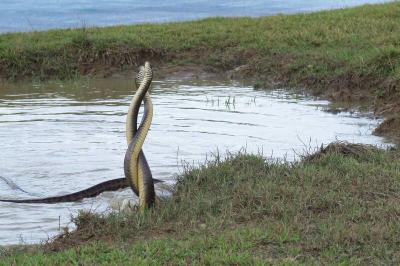
Kenting National Park service technician Yang Jien-fon (楊政峰) won a silver award in World Grand Prix Photography Awards Spring Season for his photograph of two male rat snakes intertwined in combat. Yang’s colleagues at Kenting National Park said he is a master of nature photography who has been held back by his job in civil service. The awards accept entries in all four seasons across six categories: architectural and urban photography, black-and-white and fine art photography, commercial and fashion photography, documentary and people photography, nature and experimental photography, and mobile photography. Awards are ranked according to scores and divided into platinum, gold and

SPACE VETERAN: Kjell N. Lindgren, who helps lead NASA’s human spaceflight missions, has been on two expeditions on the ISS and has spent 311 days in space Taiwan-born US astronaut Kjell N. Lindgren is to visit Taiwan to promote technological partnerships through one of the programs organized by the US for its 250th national anniversary. Lindgren would be in Taiwan from Tuesday to Saturday next week as part of the US Bureau of Educational and Cultural Affairs’ US Speaker Program, organized to celebrate the 250th anniversary of the signing of the Declaration of Independence, the American Institute in Taiwan (AIT) said in a statement yesterday. Lindgren plans to engage with key leaders across the nation “to advance cutting-edge technological partnerships and inspire the next generation of scientists and engineers,”

The Chinese Nationalist Party (KMT) caucus yesterday said it opposes the introduction of migrant workers from India until a mechanism is in place to prevent workers from absconding. Minister of Labor Hung Sun-han (洪申翰) on Thursday told the Legislative Yuan that the first group of migrant workers from India could be introduced as early as this year, as part of a government program. The caucus’ opposition to the policy is based on the assessment that “the risk is too high,” KMT caucus secretary-general Lin Pei-hsiang (林沛祥) said. Taiwan has a serious and long-standing problem of migrant workers absconding from their contracts, indicating that

TRADE-OFF: Beijing seeks to trade a bowl of tempura for a Chinese delicacy, an official said, while another said its promises were attempts to interfere in the polls The government must carefully consider the national security implications of building a bridge connecting Kinmen County and Xiamen, China, the Public Construction Commission (PCC) said yesterday. PCC Commissioner Derek Chen (陳金德), who is also a minister without portfolio, made the remarks in a meeting of the legislature’s Transportation Committee, after Democratic Progressive Party Legislator Hsu Fu-kuei (徐富癸) asked about China’s proposal of new infrastructure projects to further connect Kinmen and Lienchiang (Matsu) counties with Xiamen. China unveiled the bridge plan, along with nine other policies for Taiwan, on Sunday, the last day of Chinese Nationalist Party (KMT) Chairwoman Cheng Li-wun’s (鄭麗文) visit


 RSS
RSS