


As air pollution has spiraled into a political issue, upgrading a coal-fired power plant seems to many a retrogressive move for the Democratic Progressive Party (DPP) and an academic researcher yesterday said that the project might result in a backlash from local businesses.
The controversial Shenao (深澳) Power Plant in New Taipei City’s Rueifang District (瑞芳) is expected to start operating in 2025. Once completed, it would be the third operational power plant in the north of Taiwan, along with the municipality's Linkou (林口) Power Plant and Keelung’s Hsieh-ho (協和) Power Plant.
State-run Taiwan Power Co’s (Taipower) plan to rebuild the plant, which was decommissioned in 2007 and then demolished, had passed an environmental impact assessment (EIA) in 2006.
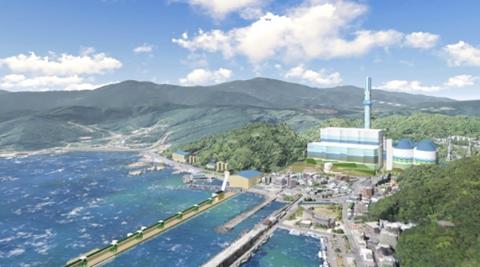
Photo courtesy of Taiwan Power Co
Due to changes to the project, Taipower filed an environmental impact analysis report with the Environmental Protection Administration (EPA) in May last year.
It proposes to replace two supercritical generators with ultra-supercritical generators and reduce their capacity from 800,000 to 600,000 kilowatts each, and has said that their polluting emissions of sulfur oxides, nitrogen oxides and particulate matter would be more than halved.
On Wednesday, the project was approved by the EPA’s environmental impact assessment grand assembly, sparking criticism.
The decisive vote was cast by assembly chairperson and EPA Deputy Minister Thomas Chan (詹順貴), who was previously a prominent lawyer known for his environmental work.
In an interview with the Taipei Times yesterday, Chan said the EPA was not entitled to reject the project, given that its potential impact on the environment has been lessened.
He added that the EPA could only choose between the 2006 project and Taipower’s modified proposal, citing Article 38 of the Environmental Impact Assessment Enforcement Rules (環境影響評估法施行細則).
“If it was a new project, the assembly could have required the developer to conduct more surveys,” he said, adding that he made the decision based on his legal expertise without any political pressure from higher-ranking officials.
Nonetheless, the assembly has required that Taipower reveal its plans for achieving energy transformation by 2025, with 50 percent of power being generated from natural gas, 30 percent from coal and 20 percent from renewable sources, he said.
In its final report on the project, the utility would clarify the information required by the assembly, Ministry of Economic Affairs Bureau of Energy Deputy Director-General Lee Chun-li (李君禮) said yesterday, but did not promise to conduct additional surveys regarding public health.
Lee added that the percentage of the nation’s power generated using coal would decrease from 47 percent to 30 percent by 2025.
Since November last year, Taipower has cooperated with the EPA and reduced electricity output when air quality is bad, Lee said.
Asked if the Shenao Power Plant upgrade would be the last coal-fired power plant construction project, he said it was difficult to say, because plants could replace older generators with better units that pollute less.
For some people, it is the utility and the ministry, instead of the EPA, that should be held responsible for the Shenao project.
As a state-run utility, Taipower should have taken the lead in convincing the public of the project’s necessity by providing thorough documentation, National Taiwan University Risk Society and Policy Research Center researcher Chao Chia-wei (趙家緯) said.
Even without the Shenao plant, the nation’s power reserve could reach about 15 percent by 2025, when taking into account the new gas-fired generators at the utility’s Datan (大潭) and Tongsiao (通霄) power plants, a new coal-fired unit at its Linkou Power Plant and about 27 gigawatts of renewable power installations, he said, adding that Formosa Plastics Group (FPG) has also announced its plan to convert its coal-fired power plant in Yunlin County’s Mailiao Township (麥寮) into a gas-fired plant.
While the EPA’s decision is upsetting, the ministry should have pushed the utility to propose a more convincing plan, he said.
The case might cause a “domino effect,” as some businesses, such as FPG, could use it as a pretext to not cooperate with the EPA’s air pollution reduction policies, Chao warned.
Nonetheless, there is still a chance to block the coal-fired plant upgrade, he added.
The Legislative Yuan could cut or freeze the utility’s budget by investigating whether the plant can really help stabilize the north’s power supply and reduce the pollution emitted from older generators, he said.
Environmental groups could also demand that the Control Yuan investigate the ministry to see if it properly fulfilled its duty of supervising the utility, Chao said.
Meanwhile, Chan said local residents opposed to the project could file an administrative appeal against the EPA and the Executive Yuan’s Petitions and Appeals Committee would have the opportunity to make the EPA to revoke its administrative action.
After the ministry reveals its plan for energy transformation by 2025, the Executive Yuan could also reassess the Shenao project’s necessity, he added.
Asked how the EPA will push other air pollution control policies after it has given the go-ahead for a coal-fired plant upgrade, Chan said it would continue implementing the policies even if the public questions its executive power.
“Improving air pollution is already a social consensus,” and people can supervise how the EPA implements its plans, Chan said, adding that he would attend a legislative session on Monday which is scheduled to discuss several amendments to the Air Pollution Control Act (空氣污染防制法).
This story has been corrected since it was first published to indicate that that original Shenao Power Plant was torn down after it was decommissioned.

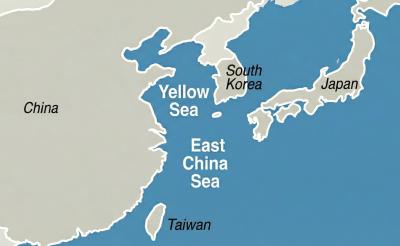
China has reserved offshore airspace in the Yellow Sea and East China Sea from March 27 to May 6, issuing alerts usually used to warn of military exercises, although no such exercises have been announced, the Wall Street Journal (WSJ) reported yesterday. Reserving such a large area for 40 days without explanation is an “unusual step,” as military exercises normally only last a few days, the paper said. These alerts, known as Notice to Air Missions (Notams), “are intended to inform pilots and aviation authorities of temporary airspace hazards or restrictions,” the article said. The airspace reserved in the alert is
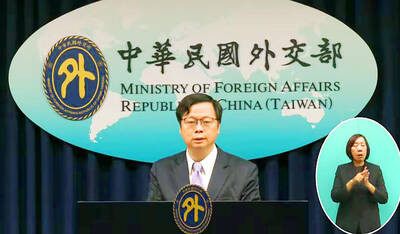
NAMING SPAT: The foreign ministry called on Denmark to propose an acceptable solution to the erroneous nationality used for Taiwanese on residence permits Taiwan has revoked some privileges for Danish diplomatic staff over a Danish permit that lists “Taiwan” as “China,” Eric Huang (黃鈞耀), head of the Ministry of Foreign Affairs’ Department of European Affairs, told a news conference in Taipei yesterday. Reporters asked Huang whether the Danish government had responded to the ministry’s request that it correct the nationality on Danish residence permits of Taiwanese, which has been listed as “China” since 2024. Taiwan’s representative office in Denmark continues to communicate with the Danish government, and the ministry has revoked some privileges previously granted to Danish representatives in Taiwan and would continue to review

More than 6,000 Taiwanese students have participated in exchange programs in China over the past two years, despite the Mainland Affairs Council’s (MAC) “orange light” travel advisory, government records showed. The MAC’s publicly available registry showed that Taiwanese college and university students who went on exchange programs across the Strait numbered 3,592 and 2,966 people respectively. The National Immigration Agency data revealed that 2,296 and 2,551 Chinese students visited Taiwan for study in the same two years. A review of the Web sites of publicly-run universities and colleges showed that Taiwanese higher education institutions continued to recruit students for Chinese educational programs without

A bipartisan group of US senators has introduced a bill to enhance cooperation with Taiwan on drone development and to reduce reliance on supply chains linked to China. The proposed Blue Skies for Taiwan Act of 2026 was introduced by Republican US senators Ted Cruz and John Curtis, and Democratic US senators Jeff Merkley and Andy Kim. The legislation seeks to ease constraints on Taiwan-US cooperation in uncrewed aerial systems (UAS), including dependence on China-sourced components, limited access to capital and regulatory barriers under US export controls, a news release issued by Cruz on Wednesday said. The bill would establish a "Blue UAS


 RSS
RSS