


The legislature yesterday elected new conveners to head its eight committees, with the Democratic Progressive Party (DPP) caucus winning nine seats and the Chinese Nationalist Party (KMT) caucus securing seven.
Under the Legislative Committee Organization Act (立法院各委員會組織法), each committee is to elect two conveners.
Apart from the Education and Culture Committee, for which the DPP secured both seats, the DPP and the KMT lawmakers secured one seat each on the other committees.
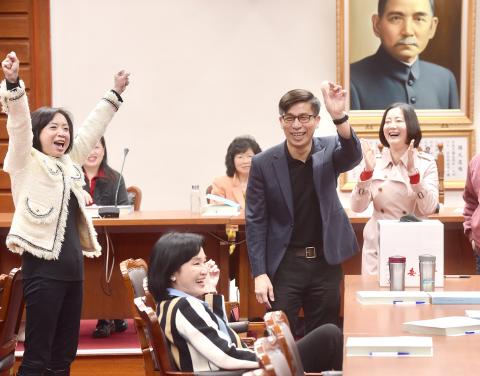
Photo: Huang Yao-cheng, Taipei Times
DPP Legislator Rosalia Wu (吳思瑤) was elected convener of the Education and Culture Committeeby a vote, while DPP Legislator Chung Chia-pin (鍾佳濱) claimed the second seat over KMT Legislator Ko Chih-en (柯志恩) after drawing lots.
The electoral process for the Transportation Committee, the Social Welfare and Environmental Hygiene Committee and the Finance Committee closely shadowed that of the Education and Culture Committee, with the DPP caucus winning the first seats by vote, but losing the other seat to the KMT after drawing lots.
DPP Legislator Hsiao Bi-khim (蕭美琴) and KMT Legislator Chen Hsueh-sheng (陳雪生) are to take turns presiding over the Transportation Committee; DPP Legislator Chiu Tai-yuan (邱泰源) and KMT Legislator Chen Yi-min (陳宜民) are to be in charge of the Social Welfare and Environmental Hygiene Committee; and DPP Legislator Wang Jung-chang (王榮璋) and KMT Legislator William Tseng (曾銘宗) are to chair the Finance Committee.
The legislators on the Economics Committee and the Foreign and National Defense Committee — which are to undertake reviews of planned pension cuts for military retirees during the ongoing session — resolved to choose their conveners through nomination.
DPP Legislator Wang Ding-yu (王定宇) and KMT Legislator Lu Yu-ling (呂玉玲) were nominated as conveners for the Defense Committee, while DPP Legislator Kao Jyh-peng (高志鵬) and KMT Legislator Sufin Siluko (廖國棟) are to preside over the Economics Committee.
DPP Legislator Tuan Yi-kang (段宜康) and KMT Legislator John Wu (吳志揚) received the highest and second-highest number votes in the election for the Judiciary and Organic Laws Committee and are to take turns presiding over the committee’s meetings.
DPP Legislator Hung Tsung-yi (洪宗熠) and KMT Legislator Yang Chen-wu (楊鎮浯) were elected Internal Administration Committee conveners.

NATIONAL SECURITY: Authorities are working to confirm the identities of the military personnel involved and investigating possible illegal conduct and regulatory violations Authorities are probing possible national security implications after Kinmen police and immigration officers on Sunday found a Chinese woman allegedly posing as a tourist while engaging in prostitution involving more than 10 military personnel. The woman, surnamed Chen (陳), has since been deported, authorities said, adding that investigators are still working to confirm the identities of those implicated, as the records only listed code names and aliases. The case stemmed from a report received by the Kinmen District Prosecutors’ Office on Friday last week from the Jinhu Precinct of the Kinmen County Police Bureau. On Sunday, police, along with the National Immigration

GLOBALGIVING: ‘ Caving to external pressure is not acceptable for an organization that has cultivated justice reform and human rights for 30 years,’ one NGO said A slew of non-government organizations (NGOs) have withdrawn from the GlobalGiving fundraising platform after it announced it would use “Chinese Taipei” instead of “Taiwan” from next month. The Taiwan Good Rice Association wrote on Facebook on Friday that it was informed on April 28 via a teleconference call of the change, which was made because the platform wanted to operate in China. Taiwan Good Rice is to terminate all cooperative relationships with GlobalGiving in response to the platform’s “unilateral and non-negotiable” decision to remove references to Taiwan, the NGO said. “Taiwan is in the official name of Taiwan Good Rice Association and the

HEAVY WEATHER: Typhoon Jangmi is due to crash straight into the Ryukyus as airlines look to shift flights to larger aircraft or cancel flights to Okinawa entirely Taiwan’s international air carriers announced flight adjustments over the weekend as Typhoon Jangmi is forecast to hit the Ryukyu Islands today and tomorrow. The Central Weather Administration (CWA) upgraded Jangmi from a tropical storm to a typhoon at 8am yesterday, with the eye located 580km south of Naha city. It was moving north at 19kph. Today, China Airlines’ CI-120, CI-121, CI-122 and CI-123 flights between Taoyuan and Naha, Okinawa, have been canceled as well as CI-132 and CI-133 between Kaohsiung and Naha. EVA Air’s BR-112, BR-113, BR-186 and BR-185 flights between Taoyuan and Naha are also canceled. Low-cost carrier Tigerair Taiwan canceled IT-230,

Chinese Nationalist Party (KMT) Chairwoman Cheng Li-wun (鄭麗文) yesterday briefed her party’s Central Standing Committee regarding her scheduled visit to the US between Monday next week and June 16, saying that her purpose would be to persuade the US that the Republic of China (ROC) Constitution was a “one China” constitution that would foster stable and peaceful cross-strait relations. The ROC Constitution is the most important defense for all Taiwanese citizens, as it upholds our democracy and has contributed to our robust economy, which aligns with international and US interests, she said. “We would not be troublemakers and drag the US under,”


 RSS
RSS