


A coalition of pro-unification groups yesterday criticized the Japanese government for encroaching on Taiwanese fishing rights during a protest outside the Japan-Taiwan Exchange Association’s Taipei office.
At 11am yesterday, about 30 protesters from the Concentric Patriotism Association (CPA), the Chung Hwa Baodiao Alliance, the Chinese Association of Friends of Okinawa (CAFO) and other groups gathered in front of the office on Qingcheng Street in the city’s Songshan District (松山), shouting “We want our fishing rights” and “Say no to Japanese invasion.”
Protesters attempted to throw eggs at the office, but were unable to approach, as it was surrounded by more than 100 police officers and protected with barricades.

Photo: Lu Yi-hsuan, Taipei Times
Japanese patrol boats on Saturday and Sunday harassed the Taiwanese fishing vessel Tung Pan Chiu No. 28 in waters near the disputed Diaoyutai Islands (釣魚台), allegedly because it crossed a designated zone for fishing activities stipulated by a 2013 Taiwan-Japan Fisheries Agreement.
“The Japanese Fisheries Agency is lying,” CAFO president Lien Shih-le (連石磊) said.
“As required by Fisheries Agency regulations, every Taiwanese fishing boat is equipped with a satellite monitoring system,” Lien said. “There is no way that a Taiwanese fishing boat would have gone beyond the exclusive economic zone.
“We are here to safeguard our fishing rights and the full sovereignty of our country,” he said. “We are sternly warning the Japanese government that we will never stop protesting until they stop encroaching upon our territory.”
Protesters also urged President Tsai Ing-wen’s (蔡英文) administration to “toughen up” and take more actions to assert Taiwan’s fishing rights.
“If Tsai is unable to protect the Taiwanese, we should ask China’s People’s Liberation Army to protect us,” CPA head Zhou Qinjun (周慶峻) said.
One of the protesters waved a flag of the People’s Republic of China.
Police then escorted Lien, Zhou and several other protesters to the entrance of the building, where they handed an official letter of complaint to a representative from the Japanese office.
The groups moved their protest to the Ministry of Foreign Affairs after the police ordered them to disperse at about 11:30am.
The protest came on the heels of an incident on Wednesday, when China Unification Promotion Party local chapter director Chen Ching-feng (陳清峰) tossed red paint at the association’s doorplate to protest Japan’s treatment of the Taiwanese fishing vessel.
Chen was later arrested for violating the Social Order Maintenance Act (社會秩序維護法) and the paint was soon removed.

Yangmingshan National Park authorities yesterday urged visitors to respect public spaces and obey the law after a couple was caught on a camera livestream having sex at the park’s Qingtiangang (擎天崗) earlier in the day. The Shilin Police Precinct in Taipei said it has identified a suspect and his vehicle registration number, and would summon him for questioning. The case would be handled in accordance with public indecency charges, it added. The couple entered the park at about 11pm on Thursday and began fooling around by 1am yesterday, the police said, adding that the two were unaware of the park’s all-day live

A former soldier and an active-duty army officer were yesterday indicted for allegedly selling classified military training materials to a Chinese intelligence operative for a total of NT$79,440. The Taipei District Prosecutors’ Office indicted Chen Tai-yin (陳泰尹) and Lee Chun-ta (李俊達) for contravening the National Security Act (國家安全法) and the Anti-Corruption Act (貪污治罪條例). Chen left the military in September 2013 after serving alongside then-staff sergeant Lee, now an army lieutenant, at the 21st Artillery Command of the army’s Sixth Corps from 2011 to 2013, according to the indictment. Chen met a Chinese intelligence operative identified as “Wang” (王) through a friend in November
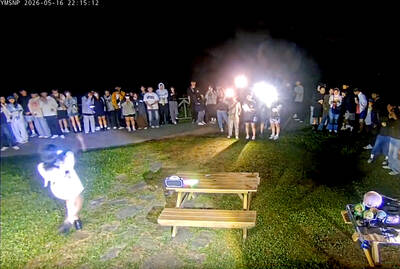
Yangmingshan National Park’s Qingtiangang (擎天崗) nature area has gone viral after a park livestream camera observed a couple in the throes of intimate congress, which was broadcast live on YouTube, drawing large late-night crowds and sparking a backlash over noise, bright lights and disruption to wildlife habitat. The area’s livestream footage appeared to show a couple engaging in sexual activity on a picnic table in the park on Friday last week, with the uncensored footage streamed publicly online. The footage quickly spread across social media, prompting a tide of visitors to travel to the site to “check in” and recreate the

Minister of Digital Affairs Lin Yi-ching (林宜敬) yesterday cited regulatory issues and national security concerns as an expert said that Taiwan is among the few Asian regions without Starlink. Lin made the remarks on Facebook after funP Innovation Group chief executive officer Nathan Chiu (邱繼弘) on Friday said Taiwan and four other countries in Asia — China, North Korea, Afghanistan and Syria — have no access to Starlink. Starlink has become available in 166 countries worldwide, including Ukraine, Malaysia, the Philippines and Vietnam, in the six years since it became commercial, he said. While China and North Korea block Starlink, Syria is not


 RSS
RSS