


Hong Kong’s political and social environment has undergone dramatic changes since its return to Chinese rule in 1997, changes that have left many there thinking about emigrating.
Hong Kong’s Security Bureau estimates that between 6,900 and 10,300 people per year have applied to emigrate between 2005 and 2016, with the US, Australia and Canada the three most popular destinations.
However, in recent years Taiwan has gained popularity among Hong Kongers seeking a fresh start.
According to Ministry of the Interior data, the number of Hong Kongers and Macanese with permanent residency in Taiwan rose from 8,697 in 2013 to 15,449 in 2016, a 78 percent jump.
A survey released by the Chinese University of Hong Kong in October last year showed that about 33 percent of Hong Kongers were considering emigrating, with Taiwan the third-favorite destination (chosen by 12.2 percent) after Australia and Canada (16.8 percent each).
The survey found politics high on the list of why people wanted to leave, with 17.1 percent saying they wanted to emigrate because of too many political disputes and serious social divisions and 9.5 percent citing the lack of democracy and dissatisfaction with the political system.
Another 8.6 percent cited dissatisfaction or a lack of confidence in the central government or concern that it is a dictatorship.
Also high on the list were daily living issues, with 12 percent citing Hong Kong’s crowded and relatively poor living environment, 8.6 percent worried about its economic future and 6.9 percent wanting to leave because of the high cost of housing.
It was those issues that led Miss Tu, a woman in her 20s, to come to live in Taiwan on her own.
She said she decided to settle here because of Hong Kong’s high cost of living and cramped spaces.
“With an influx of crowds of Chinese tourists and shoppers, Hong Kong has become even more packed than before,” she said. “In contrast, you can move easily in Taipei with the Metro and You-Bike.”
Tu also complained about the high living expenses in Hong Kong, mainly because of its limited living space, expensive rents and high eating-out costs.
That was borne out in a report issued by The Economist last year that ranked Hong Kong as the world’s second-most expensive city. Taipei placed 55th.
Tu said she had no regrets about immigrating on her own to Taiwan and has opened a shop in Taipei because she loves the city.
Another Hong Konger surnamed Lee (李) who immigrated to Taiwan as a child, said he already sees himself as Taiwanese, but its cultural similarities to Hong Kong remain important to him.
“Despite so many years having slipped away, I still remember those years in Hong Kong vividly,” he said.
“My mom sold tea drinks in Hong Kong at that time,” he said. “I now earn a living in Taiwan by selling Hong Kong-style tea and soft drinks, all of which are my memories of Hong Kong.”

SECURITY: Starlink owner Elon Musk has taken pro-Beijing positions, and allowing pro-China companies to control Taiwan’s critical infrastructure is risky, a legislator said Starlink was reluctant to offer services in Taiwan because of the nation’s extremely high penetration rates in 4G and 5G services, the Ministry of Digital Affairs said yesterday. The ministry made the comments at a meeting of the legislature’s Transportation Committee, which reviewed amendments to Article 36 of the Telecommunications Management Act (電信管理法). Article 36 bans foreigners from holding more than 49 percent of shares in public telecommunications networks, while shares foreigners directly and indirectly hold are also capped at 60 percent of the total, unless specified otherwise by law. The amendments, sponsored by Chinese Nationalist Party (KMT) Legislator Ko

The eastern extension of the Taipei MRT Red Line could begin operations as early as late June, the Taipei Department of Rapid Transit Systems said yesterday. Taipei Rapid Transit Corp said it is considering offering one month of free rides on the new section to mark its opening. Construction progress on the 1.4km extension, which is to run from the current terminal Xiangshan Station to a new eastern terminal, Guangci/Fengtian Temple Station, was 90.6 percent complete by the end of last month, the department said in a report to the Taipei City Council's Transportation Committee. While construction began in October 2016 with an

NON-RED SUPPLY: Boosting the nation’s drone industry is becoming increasingly urgent as China’s UAV dominance could become an issue in a crisis, an analyst said Taiwan’s drone exports to Europe grew 41.7-fold from 2024 to last year, with demand from Ukraine’s fight against Russian aggression the most likely driver of growth, a study showed. The Institute for Democracy, Society and Emerging Technology (DSET) in a statement on Wednesday said it found that many of Taiwan’s uncrewed aerial vehicle (UAV) sales were from Poland and the Czech Republic. These countries likely transferred the drones to Ukraine to aid it in its fight against the Russian invasion that started in 2022, it said. Despite the gains, Taiwan is not the dominant drone exporter to these markets, ranking second and fourth
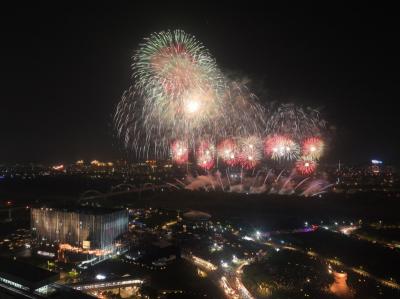
The New Taipei City Art Museum this weekend plans to celebrate its first anniversary with a two-day extravaganza featuring live concerts and a large-scale synchronized fireworks and drone display, the New Taipei City Cultural Affairs Department said. The two-day celebrations are to take place in the museum’s outdoor park, with markets and live performances by singers including Ann Bai (白安), Bii (畢書盡) and the Cosmos People (宇宙人), the department said. The highlight on both evenings would be the "Echoes of Light" show, an aerial spectacle combining fireworks and drone performances designed around the concept of "dual stages in the sky," it


 RSS
RSS