


Despite the long history of military exchanges between Taiwan and Singapore, that the city-state sent relief supplies on a military cargo plane following a magnitude 6 earthquake in Hualien on Tuesday last week is still considered rare, Taiwan Thinktank researcher Tung Li-wen (董立文) said yesterday.
Singapore on Friday dispatched a Lockheed C-130 cargo plane laden with relief and medical supplies, tents and flashlights.
The Singaporean Ministry of Defense published photographs of its disaster relief mission in Hualien on its Web site.
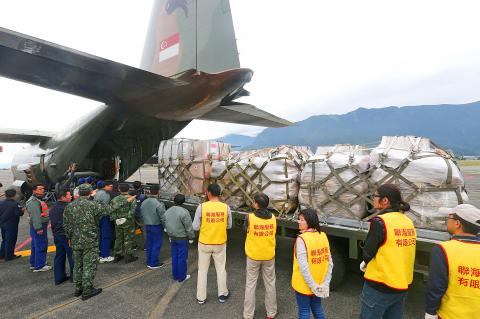
Photo: CNA
Singapore has been trying to mend its ties with China after it in 2016 voiced support for a ruling by the Permanent Court of Arbitration in The Hague, Netherlands, that Beijing’s claims to most of the South China Sea had no legal basis.
The case was brought before the court by the Philippines.
In this context, Singapore sending a plane to help disaster relief efforts is a “rare, yet remarkable” manifestation of its goodwill toward the nation, Tung said.
From the perspective of regional developments, Singapore’s dispatch of the aircraft to Taiwan could be interpreted as the “fanning out” of the US’ Indo-Pacific strategy, which shows that the US has been continuing its efforts to deepen its ties with its allies in the Asia-Pacific region, he said.
Singapore likely informed the US of its decision to join disaster relief efforts in Taiwan and obtained Washington’s backing, because despite having participated in many military drills with Taiwan, the move was still audacious considering China’s influence in the region, he said.
The Singaporean military’s disaster relief mission, coupled with deepening military exchanges between Taiwan and the US, including prospective bilateral port-of-call visits, would likely give Taiwan more space to engage in military and other kinds of collaborations with the international community, he said.
However, having accepted a favor from Singapore, Taiwan will need to shoulder greater responsibility in the international community, he added.
Singapore had previously set a precedent by sending military equipment to Taiwan on cargo ships, Democratic Progressive Party Legislator Tsai Shih-ying (蔡適應) said.
Judging by the interactions between Taiwan and Singapore, bilateral ties have remained stable, despite Beijing pressuring Singapore to keep its distance from Taiwan, Tsai said.
In contrast to international military exchanges, which are often trumpeted, Taiwan was resigned to keeping a low profile due to Beijing’s efforts to limit its international space, he said.
Taiwan should forge friendships with other nations by engaging in pragmatic exchanges and proactively extending a helping hand in their times of hardship, while being mindful of pressure from Beijing, he said.

FUKUOKA SITUATION: Japanese media reported that the pathogen is expected to be identified by the summer, while the CDC downplayed the idea that it was hMPV A “mysterious cold-like illness” reported in Japan’s Fukuoka Prefecture does not seem to be a new disease, but Japanese authorities have been asked about the situation, the Centers for Disease Control (CDC) said yesterday. The Fukuoka Prefectural Medical Association on Wednesday told a news conference that a “mystery cold” that has become a hot topic on social media is “highly likely to be caused by some kind of viral infection,” Japan’s KBC News reported. “Many people are experiencing symptoms starting with a sore throat, followed by a runny nose, phlegm and a severe cough,” KBC News reported, citing association officials. Health authorities are

Nvidia Corp CEO Jensen Huang (黃仁勳) arrived in Taiwan yesterday ahead of upcoming AI and technology events, saying he plans to meet with clients and Taiwan Semiconductor Manufacturing Co Chairman C.C. Wei (魏哲家) during his visit. After landing at Taipei Songshan Airport, Huang posed for photos with fans and handed out Yakult drinks to reporters and supporters waiting at the scene, saying he has “a lot to do” during the trip. Asked about reports that Nvidia’s planned headquarters site in Taipei’s Beitou Shilin Technology Park could break ground on May 27, Huang said that if the company holds an event, he would

The Ministry of Finance this afternoon announced the winning numbers for the March-April uniform invoice lottery. The winning number for the NT$10 million (US$318,060) special prize is 19531471, and the winning number for the NT$2 million grand prize is 85941329. Three numbers were drawn for the NT$200,000 first prize: 07225810, 20231230 and 83518781. Those with receipts matching the last seven digits of any of the first-prize numbers will win the NT$40,000 second prize, while those matching the last six digits will win the NT$10,000 third prize. Those whose receipts match the last five digits of the first-prize numbers can claim the NT$4,000 fourth prize,
Taiwan Travelogue (臺灣漫遊錄), which earlier this week became the first Taiwanese novel to win the International Booker Prize, is to be adapted into a television series through a Taiwan-Japan coproduction, producer Chang Chen-yu (張辰漁) said yesterday. Chang, a producer at World Softest Production Film Co, wrote on Facebook that the company had been searching for projects with international appeal that retain a strong Taiwanese identity after colleagues and Japanese partners strongly recommended the novel. After reading the book, Chang said he immediately decided to pursue the screen rights. “A great story has the power to transcend time and borders, and connect countless people,”


 RSS
RSS