


A child protection group yesterday said it handled 1,646 cases involving online child pornography last year and that the figure has tripled since 2016.
Of the 1,646 cases, 473 involved serious child sexual abuse or exploitation, according to the End Children Prostitution, Child Pornography and Trafficking of Children for Sexual Purposes (ECPAT) report on Internet safety for children, released yesterday to mark Safer Internet Day.
While most of the content was found on Web sites with IP addresses outside of Taiwan, 97 percent of them are in Chinese, said Clair Chen, head of the organization’s child online safety section, adding that the majority are private online forums in simplified Chinese.
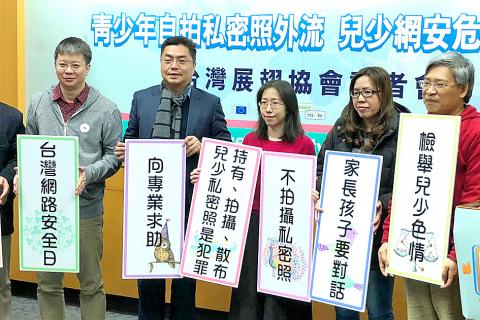
Photo: CNA
Many of the forums have a tiered membership structure designed to motivate members to spread links to the site by granting those who do so access to more illegal content, she said.
Some also reward members who help recruit users by paying them commission, she added.
Depending on whether the membership is monthly, annual or permanent, users pay a membership fee of between NT$800 and NT$10,000 (US$27 and US$340), Chen said.
If the Web sites are shut down, they can usually find a new IP addresses very quickly and link their users back through e-mails and chat apps, she added.
Last year, ECPAT also handled more than 1,000 reported attempts to obtain nude or explicit children’s pictures by adults pretending to befriend them through social media and chat apps, Chen said, adding that the figure has increased fivefold since 2016.
“A common pretext by people sending out the requests is that they are the same age as the child and only want to compare their bodies with others to make sure the body changes they are experiencing are normal,” she said.
In addition to handling reports of child pornography on the Internet, ECPAT also provides a counseling service on Internet safety.
“Last year was the first year that our counseling service received more cases of sextortion than those of cyberbullying,” Chen said.
According to the organization, 15.38 percent of calls made to its counseling hotline involved sextortion.
While male victims are typically blackmailed for money, female victims are more often embroiled in a relationship with the blackmailer, allowing the latter to obtain more intimate videos, Chen said.
Children who become victims of sextortion often do not tell others out of shame and fear of ridicule, she said, adding that the intense stress could lead some to contemplate suicide.
“Maintaining children’s safety on the Internet requires collaborative work by the government, schools, parents, civil groups and Internet companies,” ECPAT secretary-general Chen Yi-ling (陳逸玲) said.
The government, in particular, “has much room to improve,” she said, adding that police should devote more resources to child sexual abuse and exploitation, and try to remove child pornography from the Web as soon as possible.
The police should take advantage of Microsoft’s PhotoDNA and other technologies that can be used to prevent the distribution of child pornography, she said, adding that schools should also educate children about Web safety.

Considering that most countries issue more than five denominations of banknotes, the central bank has decided to redesign all five denominations, the bank said as it prepares for the first major overhaul of the banknotes in more than 24 years. Central bank Governor Yang Chin-lung (楊金龍) is expected to report to the Legislative Yuan today on the bank’s operations and the redesign’s progress. The bank in a report sent to the legislature ahead of today’s meeting said it had commissioned a survey on the public’s preferences. Survey results showed that NT$100 and NT$1,000 banknotes are the most commonly used, while NT$200 and NT$2,000

The Centers for Disease Control (CDC) yesterday reported the first case of a new COVID-19 subvariant — BA.3.2 — in a 10-year-old Singaporean girl who had a fever upon arrival in Taiwan and tested positive for the disease. The girl left Taiwan on March 20 and the case did not have a direct impact on the local community, it said. The WHO added the BA.3.2 strain to its list of Variants Under Monitoring in December last year, but this was the first imported case of the COVID-19 variant in Taiwan, CDC Deputy Director-General Lin Ming-cheng (林明誠) said. The girl arrived in Taiwan on

South Korea is planning to revise its controversial electronic arrival card, a step Taiwanese officials said prompted them to hold off on planned retaliatory measures, a South Korean media report said yesterday. A Yonhap News Agency report said that the South Korean Ministry of Foreign Affairs is planning to remove the “previous departure place” and “next destination” fields from its e-arrival card system. The plan, reached after interagency consultations, is under review and aims to simplify entry procedures and align the electronic form with the paper version, a South Korean ministry official said. The fields — which appeared only on the electronic form

The Ministry of Foreign Affairs (MOFA) is suspending retaliation measures against South Korea that were set to take effect tomorrow, after Seoul said it is updating its e-arrival system, MOFA said today. The measures were to be a new round of retaliation after Taiwan on March 1 changed South Korea's designation on government-issued alien resident certificates held by South Korean nationals to "South Korea” from the "Republic of Korea," the country’s official name. The move came after months of protests to Seoul over its listing of Taiwan as "China (Taiwan)" in dropdown menus on its new online immigration entry system. MOFA last week


 RSS
RSS