


Lawmakers across partisan lines yesterday voiced support for central bank Deputy Governor Yang Chin-long (楊金龍) to succeed central bank Governor Perng Fai-nan (彭淮南) next month.
Democratic Progressive Party Legislator Wu Ping-jui (吳秉叡) was one of the lawmakers who praised the selection, which has reportedly been made by President Tsai Ing-wen (蔡英文), but has yet to be confirmed publicly.
Picking Yang means taking advantage of his experience at the central bank, where he has worked since 1989, Wu said, adding that his familiarity with the institution would allow Yang to get off to a running start and would be good for the institution’s morale.
Echoing Wu, Chinese Nationalist Party (KMT) Legislator Lai Shyh-bao (賴士葆) said that Yang, who has worked with Perng for a long time, can be expected to follow Perng’s approach of stabilizing interest rates and the foreign exchange market.
The choice of Yang is also welcome because it steers clear of politics, Lai said, adding that Yang is a good candidate and should be able to maintain the central bank’s independence.
Following speculation, including a report in yesterday’s Liberty Times (sister newspaper of the Taipei Times) saying Yang’s appointment had been finalized internally, a source familiar with the matter confirmed that Yang will be the next central bank governor.
Cabinet spokesman Hsu Kuo-yung (徐國勇) said that once the decision has been made, the information would be made public in accordance with standard procedure.
Regardless of who becomes the next governor, the president expects the person to work well under pressure and avoid political affiliations to maintain the stability of the country’s economy, Presidential Office spokesman Sidney Lin (林鶴明) said.
People First Party Legislator Lee Hung-chun (李鴻鈞) said he expected Yang to continue to use the appropriate monetary policy to support the nation’s economy, which is its main source of soft power, at a time when ties with China are worsening and Taiwan is faced with rising barriers in the global political arena.
While presidential advisor Chen Po-chih (陳博志) agreed with Yang’s selection, he urged him not to compare himself with Perng, but to follow his own path in leading the bank.
Otherwise, not earning an “A” grade as Perng did could throw Tang off following his monetary policy direction, Chen said.
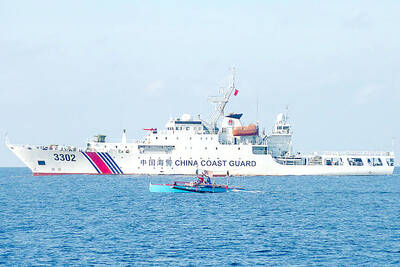
EXPANSIONIST: China deploys an average of 40 to 50 warships and coast guard vessels daily in the South China Sea, despite pledges not to militarize the region, an official said China is attempting to expand its influence across the First Island Chain and increase pressure on Japan by sending coast guard vessels into waters off of Taiwan under the pretext of maritime negotiations with Japan and the Philippines, a national security official said yesterday. China’s recent actions in the waters east of Taiwan and Japan and the Philippines’ exclusive economic zones (EEZ) are attempts to establish dominance in First Island Chain waters, said the official who declined to be named, adding that this is “expansion disguised as law enforcement.” Framing China’s actions solely as a cross-strait issue is a serious misjudgment that

EXCUSES: Beijing is using government and research vessels as a pretext to harass the nation and enter its EEZ, and engage in ‘hegemonic expansion,’ the coast guard said The Coast Guard Administration yesterday said it drove away Chinese oceanographic research vessel Xiang Yang Hong 22 (向陽紅33) from restricted waters after warning it that it was in Taiwan’s exclusive economic zone (EEZ). The Chinese vessel entered restricted waters off the coast of Yilan County’s Suao (蘇澳) at 11:35pm on Thursday, the coast guard said, adding that it dispatched the Lanyu patrol vessel and the boat PP-10077 to shadow the Chinese ship and issue radio warnings ordering it to leave. China has no sovereignty over waters off Taiwan’s east coast, Lanyu’s crew told Xiang Yang Hong 22 over the radio, and demanded
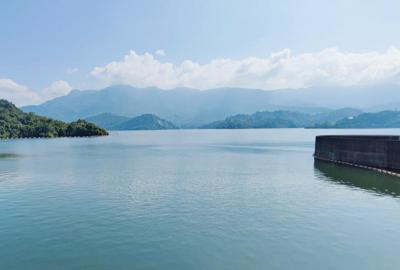
Several major reservoirs are estimated to have received 590 million tonnes of water inflow from June 4 to this morning, with storage levels at Wushantou Reservoir exceeding 50 percent and Zengwen Reservoir approaching 30 percent as of 9am today, data from the Water Resources Agency showed. Of the estimated 590 million tonnes, 450 million have already been stored in reservoirs, the data showed. As of 9am today, Baoshan Reservoir storage levels reached 100 percent, while Baoshan Second Reservoir, Yongheshan Reservoir and Techi Reservoir all exceeded 90 percent, data on the Water Resources Agency’s Web site showed. In addition, the Shimen Reservoir is at

BAIT AND SWITCH: Allowing KMT-run counties to sell to China while the threat of abrupt cancelations hangs overhead is another form of coercion, officials said Beijing is using agricultural purchase offers announced during the Straits Forum to deepen Taiwan’s dependence on the Chinese market, a Taiwanese official said yesterday as they criticized the Taitung County commissioner’s participation in the initiative. During the Straits Forum held in Xiamen on Saturday, Chinese officials announced a sales and purchase agreement for agricultural products from some counties led by the Chinese Nationalist Party (KMT). Taitung County Commissioner Yao Ching-ling (饒慶鈴), who was barred from attending the event in person by the Mainland Affairs Council, participated via video. Under the agreement, China would purchase atemoyas, pomeloes, tea and grouper harvested in Taitung,


 RSS
RSS