


The number of visitors to Hualien County exceeded 10 million last year, despite a decrease in the number of Chinese tourists to the area, statistics released on Monday by the Hualien Tourism Department showed.
Last year, the 12 major tourist attractions in the county saw a combined total of 10.27 million visitors, an increase from 9.55 million visitors in 2016, the department said, adding that this was still a lower number than 2014’s 10.88 million.
Taroko National Park continued to attract the most visitors at 4.65 million, a 2.8 percent increase from 4.52 million in 2016, the department added.
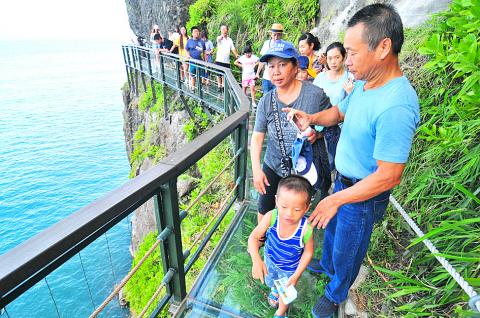
Photo: Hua Meng-ching, Taipei Times
Coming in second was Cisingtan (七星潭), which attracted 1.35 million visitors last year, it said.
The Cinbujhihzih Walk (親不知子海上古道) — a new attraction in Fongbin Township (豐濱) that opened last year — saw nearly 170,000 visitors in its first four months, it said.
The total number of visitors rose, mainly because the number of people who went on a one-day trip to the county increased, department acting director Peng Wei-tsu (彭偉族) said.
Visitors did not stay overnight and their local spending was not high, Peng said.
Although the number of visitors last year shot up, surveys showed that South Korean visitors only went to Hualien for one-day tours of Taroko National Park and Cisingtan, Peng said, adding that hotels and guesthouses did not benefit.
Hualien plans to participate in tourism fairs abroad to boost its marketing, Peng said, adding that he hoped to increase the number of days international visitors stay in the county.
The Ministry of Transportation and Communications and the Taiwan Railways Administration have been working together with Hualien business owners to push travel packages that include transportation and accommodation to reduce the difficulty of purchasing train tickets to the area and increase hotel occupancy rates at the same time, Peng said.
Tourism-oriented businesses should grasp changing trends and innovate, expand their customer base and work with other industries, said Executive Yuan Eastern Taiwan Joint Services Center Executive Director Hsu Chuan-sheng (許傳盛), who is a former director of Kaohsiung’s Tourism Bureau.
The MICE — meetings, incentives, conventions and exhibitions — industry is a high value-added business, Hsu said.
The government should encourage the Hualien Tzu Chi Hospital, National Dong Hwa University and other organizations to host international conferences, Hsu said.
Attendees could then extend their stay in Hualien for leisure purposes, he said.
“As a major tourism destination, Hualien should maintain high standards and find unique local traits,” Hsu said, adding that would be its real advantage.
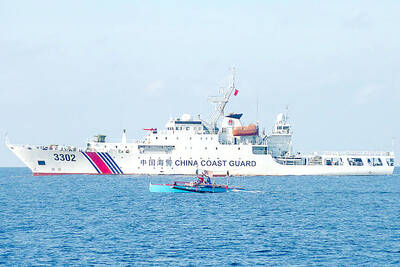
EXPANSIONIST: China deploys an average of 40 to 50 warships and coast guard vessels daily in the South China Sea, despite pledges not to militarize the region, an official said China is attempting to expand its influence across the First Island Chain and increase pressure on Japan by sending coast guard vessels into waters off of Taiwan under the pretext of maritime negotiations with Japan and the Philippines, a national security official said yesterday. China’s recent actions in the waters east of Taiwan and Japan and the Philippines’ exclusive economic zones (EEZ) are attempts to establish dominance in First Island Chain waters, said the official who declined to be named, adding that this is “expansion disguised as law enforcement.” Framing China’s actions solely as a cross-strait issue is a serious misjudgment that
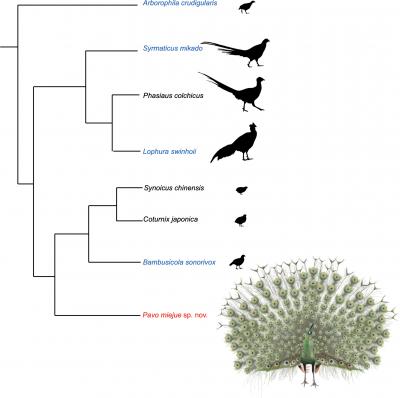
Through analyzing fossil evidence, a research team at National Taiwan University (NTU) discovered the largest endemic bird to have lived in Taiwan, naming it Pavo miejue, or extinct peafowl (滅絕孔雀). The Mikado pheasant, which is printed on the back of the NT$1,000 bank note, was previously believed to be the biggest endemic bird to Taiwan. The research team’s findings suggest that Pavo miejue lived during the Pleistocene epoch tens of thousands of years ago. It is the first endemic extinct bird species discovered and formally named in Taiwan. The study was coauthored by NTU Institute of Ecology and Evolutionary Biology professor Tsai Cheng-hsiu (蔡政修),
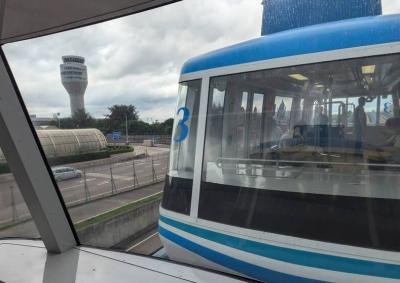
Taiwan Taoyuan International Airport is to suspend its automated Skytrain service connecting Terminal 1 and Terminal 2 starting on July 1 to facilitate connection works for the upcoming Terminal 3, the airport operator said today. Passengers and staff who need to travel between the two terminals after the suspension can instead use the Taoyuan MRT or the airport's 24-hour shuttle bus service, Taoyuan International Airport Corp said. The Taoyuan MRT Airport Line directly links the two terminals, while the shuttle buses are to operate around the clock, the company added. The Skytrain provides free transportation between the airport’s two terminals for travelers and
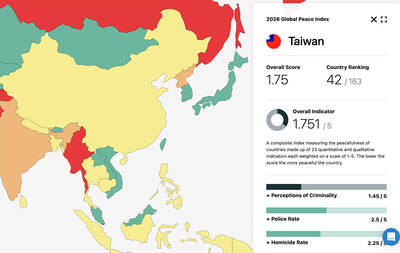
Taiwan ranked 42nd in terms of peacefulness among 163 countries, down five places from last year, according to this year’s Global Peace Index. With an overall score of 1.751, Taiwan dropped from 37th last year, the report published by the global Institute for Economics and Peace showed. The overall score measures a country’s level of peacefulness using 23 quantitative and qualitative indicators across three domains — ongoing domestic and international conflict, societal safety and security, and militarization. While Taiwan ranked 42nd worldwide, it was listed in ninth place among the 19 Asian-Pacific countries in the report, after New Zealand, Singapore, Japan, Malaysia,


 RSS
RSS